Researchers from the Dipartimento di Fisica Universit a di Bari and INFN Sezione di Bari in Italy have conducted a study on waveguide quantum electrodynamics (QED), a platform used for generating entanglement and tailoring photonic states. The team explored the role of identical qubits coupled to a parity-invariant waveguide in the microwave domain, providing a unified view of decay processes. They highlighted the importance of achieving selective and tunable directional propagation of photons and discussed the role of identical emitters in a parity-invariant waveguide. The study opens up new possibilities for using waveguide QED in photonics.
Waveguide Quantum Electrodynamics: A Powerful Platform for Photonic States
Waveguide quantum electrodynamics (QED) is a powerful platform for generating entanglement and tailoring photonic states. This research was conducted by Maria Maffei, Domenico Pomarico, Paolo Facchi, Giuseppe Magnifico, Saverio Pascazio, and Francesco V. Pepe from the Dipartimento di Fisica Universit a di Bari and INFN Sezione di Bari in Italy.
The Role of Qubits in Waveguide QED
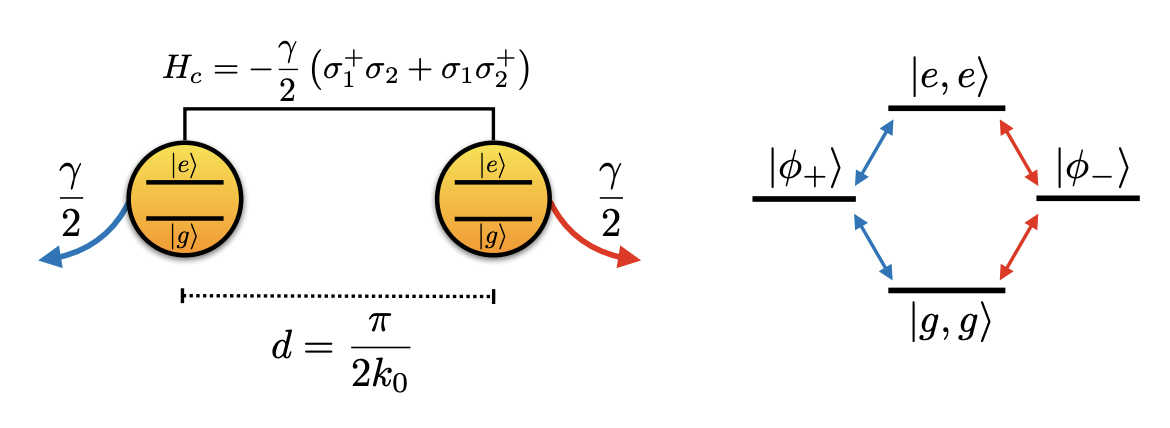
The researchers considered a pair of identical qubits coupled to a parity-invariant waveguide in the microwave domain. They provided a unified view of decay processes and showed the common origin of directional single-photon emission and two-photon directional bunching. The phenomena are rooted in the selective coupling of orthogonal qubits Bell states with different photon propagation directions.
The Importance of Directional Propagation of Photons
In waveguide quantum electrodynamics, achieving selective and tunable directional propagation of photons is crucial. This task is easily achieved in the optical domain by exploiting the locking of the photon polarization with the direction of propagation in chiral waveguides. In the microwave domain, destructive interference between fields emitted by a pair of identical two-level systems (qubits) has been identified as a promising strategy.
The Role of Identical Emitters in a Parity-Invariant Waveguide
The most natural description of a pair of identical emitters in a parity-invariant waveguide uses the propagating electromagnetic field’s centrally symmetric and antisymmetric states. However, unless specific interferometric techniques are employed, such a natural formulation does not correspond to a simple experimental detectability of the two kinds of photons (symmetric or antisymmetric).
The Emission of Photons and the Role of Control Coupling
An independent emission of photons propagating to the left or to the right of the emitters can be achieved only for certain specific values of the distance between the emitters. It also requires the implementation of a control coupling between them. Two identical qubits placed a quarter wavelength apart and connected via a suitable control coupling can emit and absorb single photons directionally.
The Generation of Two-Photons N00N States
The same mechanism used for the independent emission of photons can also generate two-photons N00N states. The researchers provided a unified view of the decay processes of a pair of qubits in the one-excitation and two-excitation sectors, showing the common origin of directional emission and bunching phenomena.
In the article titled “Directional emission and photon bunching from a qubit pair in waveguide“, published on February 2, 2024, authors Maria Maffei, Domenico Pomarico, Paolo Facchi, Giuseppe Magnifico, Saverio Pascazio, and F. Pepe explore the complex dynamics of photon emission from a pair of qubits in a waveguide. The research was published on the arXiv platform by Cornell University.