

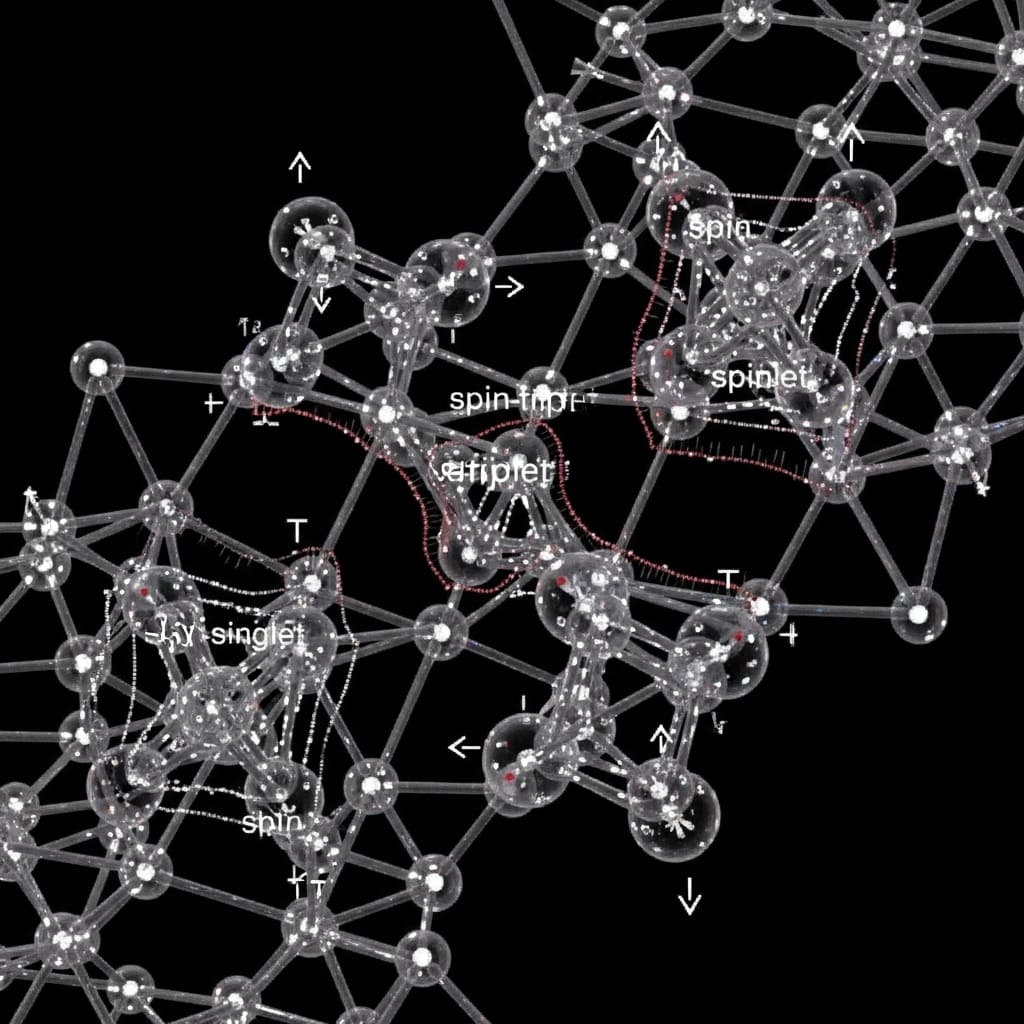
Researchers have uncovered a surprising link between magnetism and superconductivity, revealing a pathway to a highly unusual form of the latter in p-wave magnets. Maxim Khodas (Racah Institute of Physics, Hebrew University of Jerusalem), Libor Šmejkal, and I. I. Mazin et al. demonstrate that these materials , characterised by unique, non-collinear spin arrangements , can only host Ising superconductivity, a rare state where Cooper pairs possess both singlet and triplet characteristics. This finding is significant because it contrasts sharply with conventional superconductors and even other magnetic materials like antiferromagnets and altermagnets, which support different pairing symmetries; the inherent triplet component promises enhanced resilience against disruptive forces. Understanding this mechanism could unlock new avenues for designing robust and exotic superconducting materials with potentially groundbreaking applications.
Understanding this mechanism could unlock new avenues for designing robust and exotic superconducting materials with potentially groundbreaking applications.
P-wave Magnets and Novel Ising Superconductivity
Scientists have unveiled a novel pathway to superconductivity within a recently discovered class of materials known as p-wave magnets (pwMs). The team achieved this understanding through detailed theoretical modelling of pwM band structures and symmetry properties, revealing a mechanism distinct from those observed in antiferromagnets or altermagnets. The study establishes that the unusual magnetic configuration of pwMs, collinear spin polarization in momentum space but noncollinear in real space, dictates the superconducting symmetry. Researchers demonstrate that if superconductivity arises in these materials, whether driven by Phonons or other mechanisms, the only viable superconducting state is Ising superconductivity.
This contrasts sharply with regular antiferromagnets, capable of supporting Cooper pairs of any parity, and altermagnets, limited to nonunitary triplet pairs. This finding opens exciting possibilities for designing robust superconducting materials with tailored properties. Experiments show that the key difference between pwMs and materials relying on spin-orbit coupling lies in the origin of spin splitting. In pwMs, the exchange mechanism can generate spin splittings on the order of electron volts, far exceeding the typically weaker spin-orbit coupling observed in most materials. This enhanced splitting leads to qualitatively new phenomena, including a non-relativistic Edelstein effect and the potential for field-induced non-unitary triplet pairing.
Furthermore, the work unveils that pwMs can be orthorhombic, leading to p-wave symmetry in their spin polarization, a contrast to the f-wave symmetry typically found in spin-orbit driven Ising superconductors. The team’s analysis of the effective Bloch Hamiltonian describing pwMs reveals a unique symmetry, t[C2⊥||E], which protects the collinearity of spins in full 3D momentum space. This collinearity is crucial for the formation of the unusual Cooper pairs observed in Ising superconductivity, where each pair consists of either |k, ↑; −k, ↓⟩ or |k, ↓; −k, ↑⟩, differing from the singlet or triplet pairs found in conventional superconductors. This discovery promises a new avenue for exploring and engineering exotic superconducting states with enhanced stability and functionality.
P-wave Magnetism and Predicted Ising Superconductivity
Scientists. Experiments employed a doubled unit cell approach, recognising that each cell contains two non-magnetic atoms belonging to distinct sublattices,. This method achieves a qualitative shift in understanding, revealing that Cooper pairs in p-wave magnets are fundamentally different from those in standard superconductors or altermagnets, each pair is either |k, ↑; −k, ↓⟩ or |k, ↓; −k, ↑⟩, unlike pure singlet or triplet pairings.
Ising superconductivity emerges in p-wave magnets
The team measured the spin polarization to be collinear in momentum space, yet noncollinear in real space, with time-reversal symmetry maintained in the momentum space, a key characteristic of these materials. Tests prove that the superconductivity may induce magnetization reorientation if the condensation energy exceeds the magnetic anisotropy energy, while conversely, the polarization direction can effectively switch superconductivity on and off. Data shows that several previously established findings, including the absence of Pauli limiting, field-induced topological transitions to nodal states, field-induced Bogoliubov Fermi surfaces, mirage gaps, and critical in-plane anisotropy, also apply to these p-wave magnets. However, in non-relativistic spin-orbit coupled p-wave magnets, this translates into strongly coupled and distinct singlet and triplet components of the order parameter.
Measurements confirm that the transition temperature in orthorhombic p-wave magnets is determined by the net interaction within the singlet and p-wave triplet channels. The breakthrough delivers unconventional parity-mixed superconductivity, previously reported in studies of spin-orbit coupled Ising superconductors with multi-valley Fermi surfaces and realistic electron-phonon interactions. Experiments reveal that the non-unitary and nodal pairing can be accessed via quasiparticle interference, and the s + p state specific to p-wave magnets responds non-trivially to applied fields, transforming into a non-unitary s + p + ip′ mixed symmetry state. Furthermore, the introduction of magnetic impurities with an easy axis allows for re-entrant superconductivity in an applied field, a phenomenon observed through careful manipulation of magnetic anisotropy energies. This work was supported by grants from the Israel Science Foundation, the European Research Council, and the Office of Naval Research, facilitating these groundbreaking discoveries.
P-wave Magnets Enhance Ising Superconductivity Resilience to disorder
This contrasts with other magnetic materials like antiferromagnets and altermagnets, which exhibit different superconducting symmetries and pairing characteristics. The findings reveal that the limitations imposed by impurity scattering are less restrictive in p-wave magnets due to their larger non-relativistic spin splitting, potentially influencing the material’s superconducting behaviour. Furthermore, the study suggests that superconductivity can induce reorientation of magnetization if its condensation energy exceeds the magnetic anisotropy energy of impurities, offering a potential mechanism to control superconductivity. The authors acknowledge that their analysis relies on certain approximations and that the magnetic anisotropy energy of impurities could affect these results.
Future research could explore the quasiparticle interference patterns to access the non-unitary and nodal pairing states predicted for these materials. The team also anticipates that the unconventional pairing characteristics will be more pronounced in non-relativistic Ising superconductors, potentially leading to novel superconducting phenomena. This work provides a theoretical foundation for understanding superconductivity in p-wave magnets and opens avenues for designing new materials with tailored superconducting properties.
👉 More information
🗞 Nonrelativistic-Ising superconductivity in p-wave magnets
🧠 ArXiv: https://arxiv.org/abs/2601.19829
