

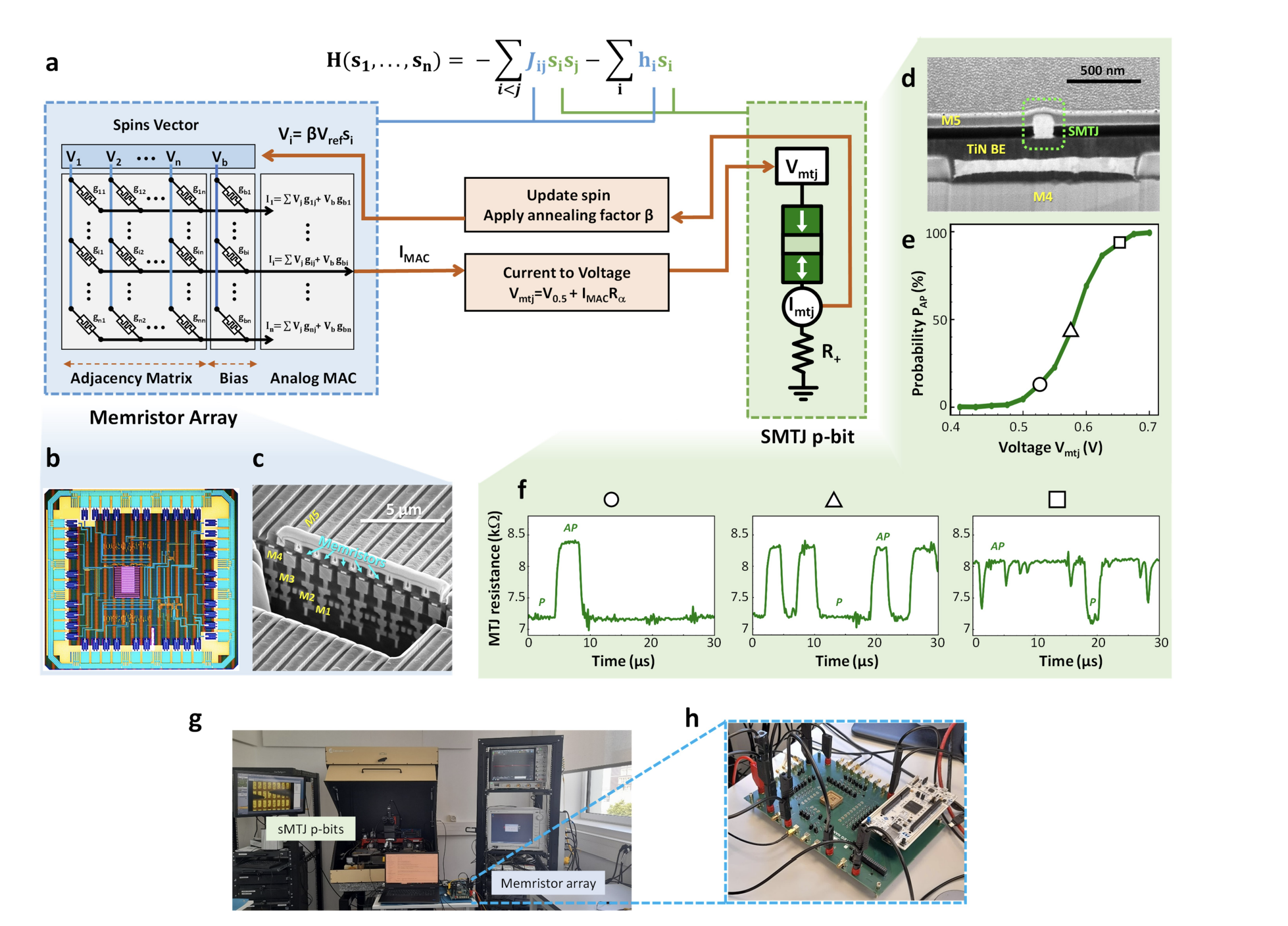
A novel Ising machine integrates memristor crossbars and stochastic magnetic tunnel junctions, achieving intrinsic annealing via voltage control. The prototype, operating without external magnetic fields, consistently solves complex optimisation problems including a 24-vertex MAX-CUT and a 10-vertex graph-colouring task, demonstrating potential for scalable, energy-efficient computation.
The pursuit of efficient solutions to complex optimisation problems drives innovation in computational hardware, with recent attention focused on emulating the principles of statistical mechanics. Researchers are increasingly exploring physical systems that naturally lend themselves to solving problems framed within the Ising model, a mathematical construct describing interacting spins, and thus offering potential advantages over conventional digital computers for specific tasks. A collaborative team, comprising Mohammed Akib Iftakher, Hugo Levices, Kamel-Eddine Harabi, Adrien Renaudineau, Mathieu-Coumba Faye, Corentin Bouchard, Florian Disdier, Bernard Viala, Elisa Vianello, Philippe Talatchian, Kevin Garello, Damien Querlioz, and Louis Hutin, from institutions including Université Paris-Saclay, CNRS, and Université Grenoble-Alpes, detail their development of an Ising machine in the article, ‘Intrinsic Annealing in a Hybrid Memristor-Magnetic Tunnel Junction Ising Machine’. Their work presents a novel architecture integrating memristor crossbars – devices exhibiting variable resistance – with stochastic magnetic tunnel junctions, creating a system where the very act of reading the device’s state facilitates a process of ‘annealing’, reducing randomness and guiding the machine towards optimal solutions for complex problems.
The development of novel computational architectures continues to focus on addressing complex optimisation problems, and recent research details an Ising machine utilising a combined memristor and stochastic magnetic tunnel junction (SMTJ) design. This architecture aims to improve efficiency and scalability compared to existing approaches. An Ising model, in this context, is a mathematical framework used to represent systems with interacting ‘spins’, which can be mapped onto variables in an optimisation problem.
Central to this machine’s operation is the integration ofmemristorsand SMTJs
Central to this machine’s operation is the integration of memristors and SMTJs. Memristors function as non-volatile memory elements, effectively storing the weighted connections that define the relationships between variables within the optimisation problem. Simultaneously, SMTJs act as the physical realisation of the ‘spins’ inherent to the Ising model, exhibiting stochastic, or random, behaviour that allows the system to explore a broad range of potential solution states.
A key innovation lies in the implementation of a shared read voltage. This single voltage simultaneously reads the connection weights stored in the memristors and biases the SMTJs, simplifying the overall circuit design and significantly reducing energy consumption. This contrasts with many existing designs that require separate and complex control circuitry for each component.
The machine operates via an intrinsic annealing process. Annealing, in this context, refers to a computational technique inspired by metallurgy, where a material is heated and slowly cooled to reach a low-energy, stable state. The shared voltage and the stochastic behaviour of the SMTJs guide the system towards this low-energy state, which corresponds to the optimal or near-optimal solution to the optimisation problem.
Initial testing demonstrates the machine’s capability. A prototype successfully solved a 24-vertex weighted MAX-CUT problem and a 10-vertex three-color graph problem, achieving optimal solutions for both. The MAX-CUT problem involves partitioning the vertices of a graph to maximise the number of edges crossing the partition, while the three-color graph problem seeks to assign colours to vertices such that no two adjacent vertices share the same colour.
Furthermore, this design eliminates the need for an
Furthermore, this design eliminates the need for an external magnetic field, a requirement of some alternative Ising machine implementations. This simplification contributes to a more compact and potentially more energy-efficient system. The architecture’s compatibility with complementary metal-oxide-semiconductor (CMOS) integration suggests a pathway towards building larger and more powerful machines capable of tackling increasingly complex optimisation challenges.
🗞 Intrinsic Annealing in a Hybrid Memristor-Magnetic Tunnel Junction Ising Machine
🧠 DOI: https://doi.org/10.48550/arXiv.2506.14676


