

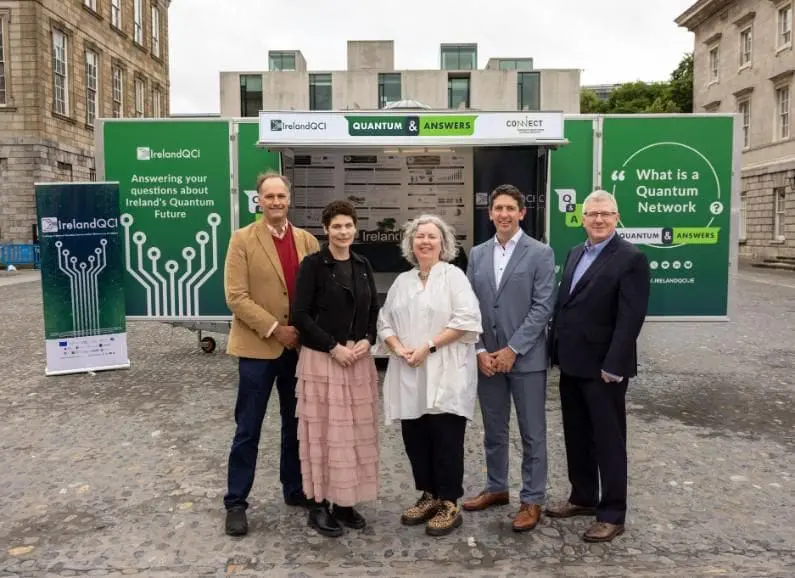
IrelandQCI, a €10 million project co-funded by the Irish government and the European Commission, has launched a mobile engagement trailer to promote understanding of quantum technologies. Led by the Walton Institute at South East Technological University, the initiative aims to establish a national quantum communication infrastructure connecting Dublin to Cork via Waterford, utilising existing fibre optic networks. This infrastructure aims to protect critical national systems against emerging cyber threats resulting from advances in quantum computing. The project, involving six universities, ESB Telecoms and HEAnet, will deploy quantum key distribution (QKD) and the accompanying trailer will tour Ireland, providing interactive demonstrations and educational resources to stakeholders and the public, with a focus on inspiring future STEM professionals.
The objective of this program is to cultivate a workforce and citizenry capable of understanding, navigating, and contributing to the evolving landscape of quantum technologies, with a strong focus on the cybersecurity challenges and opportunities they present.
I. Core Components (Target Audiences & Activities)
A. K-12 Education (Foundation Building)
Develop age-appropriate modules on basic quantum concepts – superposition and entanglement – integrated into existing science and math curricula, prioritising conceptual understanding over complex mathematics. Hands-on activities and simulations are crucial for effective learning. Provide professional development workshops for K-12 teachers, equipping them with the knowledge and resources to teach quantum concepts effectively; this is critical for successful curriculum integration. Encourage the formation of after-school quantum computing clubs and participation in STEM competitions focused on quantum-related challenges. Introduce basic cybersecurity principles alongside quantum concepts, highlighting how quantum computers could break current encryption methods.
B. Higher Education (Specialized Training)
Develop or enhance undergraduate programs in quantum information science, quantum engineering, and related fields, ensuring a strong cybersecurity component is included. Expand graduate programs to address the growing demand for quantum scientists and engineers, focusing research on post-quantum cryptography, quantum key distribution, and quantum-resistant algorithms. Encourage collaboration between quantum physicists, computer scientists, mathematicians, and cybersecurity experts to foster interdisciplinary research. Establish partnerships with companies working on quantum technologies to provide students with internships and research opportunities.
C. Workforce Development (Upskilling & Reskilling)
Offer intensive bootcamps and short courses for professionals in cybersecurity, IT, and related fields to upskill them in quantum technologies. Develop online courses and resources that are accessible to a wider audience, facilitating broader knowledge dissemination. Create certification programs to validate skills and knowledge in quantum cybersecurity, providing a recognised standard of competence. Provide funding for training programs to address the skills gap in the workforce, ensuring adequate expertise is available.
D. Public Awareness & Engagement (Citizen Science & Outreach)
Develop interactive exhibits and displays for museums and science centres to educate the public about quantum technologies. Organise public lectures and workshops to demystify quantum concepts, fostering greater understanding. Engage the public in data analysis and problem-solving related to quantum research through citizen science projects. Work with journalists and media outlets to raise awareness about quantum technologies and their potential impact, ensuring informed public discourse.
II. Cybersecurity Focus – Key Areas
A major emphasis should be on developing and deploying post-quantum cryptography (PQC) algorithms that are resistant to attacks from quantum computers, encompassing research, standardisation, and implementation. Explore quantum key distribution (QKD) as a potential solution for secure communication, but also address its limitations and challenges. Develop strategies for upgrading existing IT infrastructure to be resistant to quantum attacks, ensuring future security. Develop methods for identifying and assessing the risks posed by quantum computers to critical infrastructure and sensitive data through quantum threat modelling. Train a specialised workforce of cybersecurity professionals with expertise in quantum technologies, addressing the critical skills shortage.
III. Program Implementation & Evaluation
Secure funding from government agencies, private foundations, and industry partners to ensure long-term sustainability. Establish partnerships with universities, research institutions, industry, and government agencies to maximise impact and resource sharing. Develop metrics to track the program’s impact, such as the number of students trained, the number of PQC algorithms deployed, and the level of public awareness. Regularly evaluate the program and make adjustments based on feedback and results, ensuring continuous improvement and relevance.
External Link: Click Here For More


