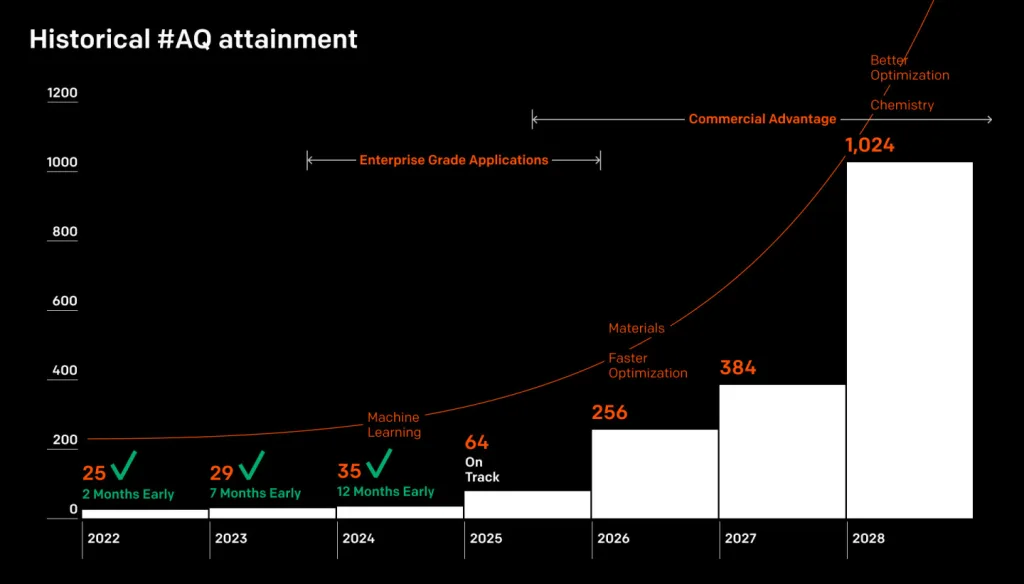
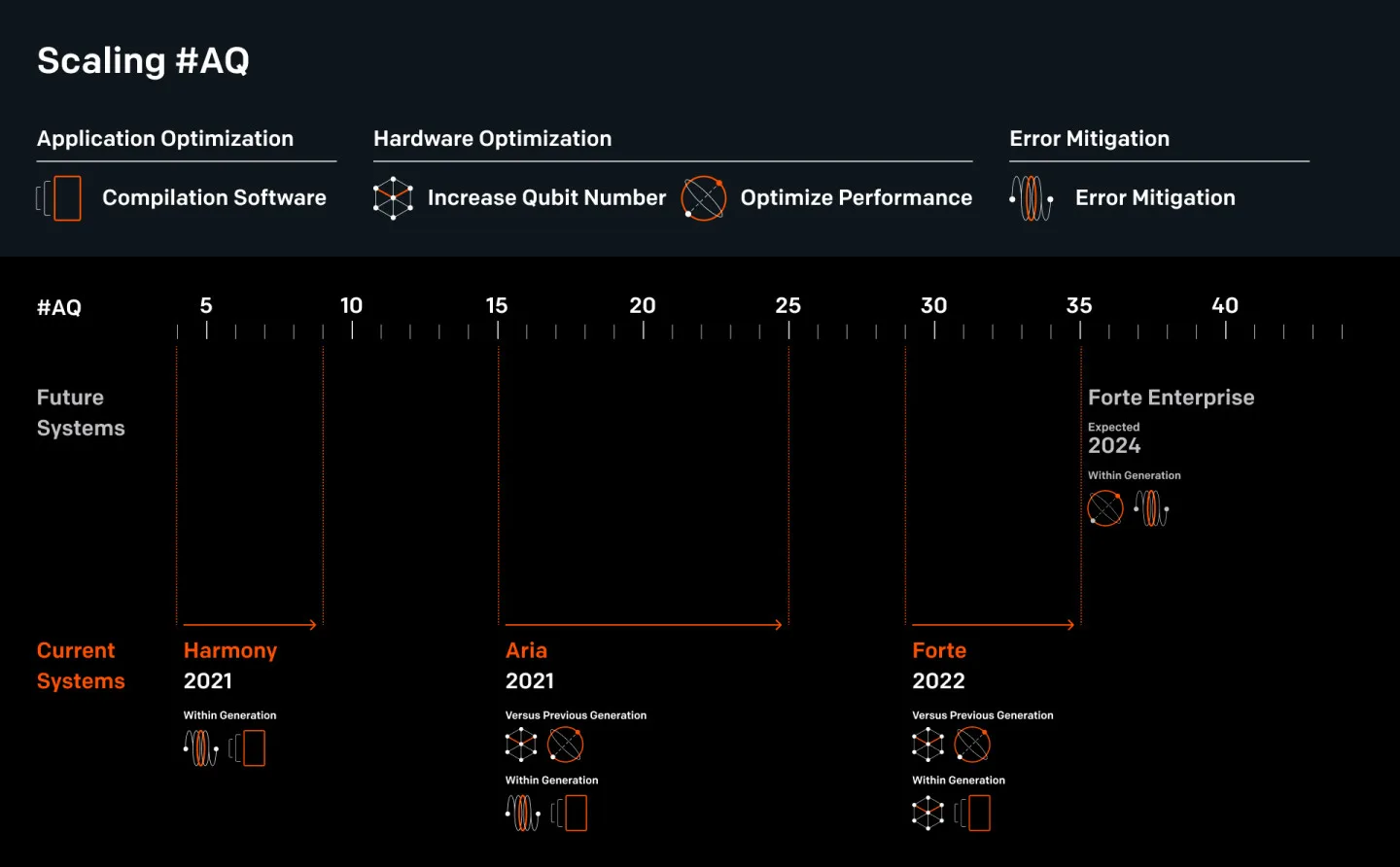
IonQ, a quantum computing company, announced that its flagship quantum computer, IonQ Forte, has achieved its 2024 performance target a year early. The computer passed the #AQ 35 benchmark suite, a technical target set by IonQ. The company’s goal is to build quantum computers that can execute applications of value to customers. IonQ Forte’s key feature is software reconfigurability, allowing elements to be dynamically reconfigured. The company’s strategy for achieving its targets involves improvements in application optimization, hardware optimization, and error mitigation. IonQ is now focusing on its next target, #AQ 64.
IonQ Achieves 2024 Performance Target Ahead of Schedule
IonQ, a quantum computing company, recently announced that its flagship quantum computer, IonQ Forte, has successfully passed the #AQ 35 benchmark suite. This achievement was a year ahead of the company’s 2024 technical target. The #AQ 35 benchmark suite is a measure of the performance of quantum computers, and IonQ’s achievement marks a significant step forward in the field of quantum computing.
IonQ’s Performance Roadmap and Quantum Computing Strategy
IonQ’s goal is to build quantum computers that can deliver value to customers by successfully executing applications. The company’s roadmap is based on achieving higher performance on an application-based benchmark that is representative of the most promising commercial algorithmic approaches. IonQ developed a benchmark called Algorithmic Qubits (#AQ) in collaboration with the QED-C, the largest quantum industry consortium. The company has been focused on optimizing across the entire quantum computing stack to attain the ambitious targets laid out in its roadmap.
IonQ Forte: A New Approach to Quantum Computing
IonQ Forte, announced in 2022, is a quantum computer with software reconfigurability as one of its key features. This means that elements in Forte can be dynamically reconfigured, allowing for a combination of hardware and software upgrades. IonQ Forte is designed to run wider circuits while maintaining high gate fidelity and all-to-all qubit connectivity.
Performance Optimization in Quantum Computing
IonQ considers three factors in optimizing the performance of a quantum computer: application optimization, hardware optimization, and error mitigation. Application optimization involves implementing a best-in-class algorithm for the problem a customer is trying to solve and compiling it as efficiently as possible for the unique machine hardware. Hardware optimization involves getting as much raw performance from the hardware as possible. Error mitigation refers to data processing techniques that can boost the effective performance of noisy quantum circuit operations.
Achieving #AQ 35: Hardware and Application Optimization
IonQ Forte achieved the #AQ 35 benchmark through two critical factors: increased qubits (hardware optimization) and more efficient compilation (application optimization). The qubit count was increased from 30 to 36, and new detection optics were designed and installed to accurately image and measure the longer qubit chain. Additionally, the performance of the compiler was boosted, reducing the two-qubit gate counts for certain benchmark circuits by up to 97%.
The Future of IonQ
IonQ plans to continue investing in application-based benchmarks and is already looking toward its next target: #AQ 64. The company believes that achieving #AQ 64 will be a turning point for the industry, where circuits that are large enough and complex enough to create commercial value can be successfully executed on IonQ hardware. This will be dependent on hardware optimizations driven by the transition to Barium qubits and the deployment of reconfigurable multi-core quantum architectures enabled by new IonQ trap technology. Software optimization and error mitigation will also continue to improve algorithmic results.