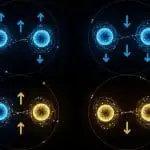
A significant milestone in the development of scalable quantum networks has been achieved through the successful demonstration of quantum frequency conversion to telecom wavelengths at IonQ. The company has converted photons from visible wavelengths, used in its trapped barium ion quantum systems, into telecom wavelengths on a prototype system, paving the way for interconnecting quantum computers over vast distances utilising existing fiber optic infrastructure. This advancement, conducted with research support from the Air Force Research Laboratory (AFRL), signifies a major step towards IonQ’s long-term vision for a Quantum Internet – distributed quantum computing via secure quantum networks. Niccolo de Masi, Chairman and CEO of IonQ, announced the achievement, anticipating the connection of two quantum computers over standard wavelengths and the subsequent opening of opportunities for broadly networked quantum devices.
IonQ Achieves Quantum Internet Milestone, Demonstrates Frequency Conversion to Telecom Wavelengths. COLLEGE PARK, MD – September 23, 2025 – IonQ (NYSE: IONQ), a leading firm in quantum computing and networking, has announced a significant advancement in scalable quantum networks, with research support from the Air Force Research Laboratory (AFRL). The company successfully demonstrated the frequency conversion of photons from visible wavelengths – used to interface with trapped barium ions – into telecom wavelengths on a prototype system. This milestone represents a key step towards realising IonQ’s long-term vision for a Quantum Internet, enabling distributed quantum computing via secure quantum networks.
The ability to transform visible light, employed in IonQ’s trapped ion quantum systems, into telecom wavelengths is crucial for compatibility with existing telecommunications infrastructure. Prior to this development, interfacing quantum systems – typically operating at visible or ultraviolet wavelengths – with the established fibre optic network presented a substantial technological challenge. The successful conversion allows quantum information to be transmitted over standard optical fibres, optimised for wavelengths used in conventional telecommunications.
The research team employed a multifaceted approach, integrating theoretical modelling with experimental validation to refine the frequency conversion process, optimising efficiency and minimising signal loss. This involved precise control of laser pulses and careful manipulation of the quantum states of individual ions.
This achievement builds upon decades of foundational research conducted at the Air Force Research Laboratory, and represents a pivotal moment in the evolution of quantum communication and networking. The findings have generated considerable excitement within the scientific community, with researchers actively exploring avenues to build upon and extend this work.
The practical implications of this advancement are far-reaching, paving the way for secure quantum communication networks and distributed quantum computing. Beyond immediate applications, this research opens new avenues for scientific inquiry and technological innovation, potentially accelerating progress across multiple related fields, from materials science to computational physics.
Looking ahead, this research points towards transformative possibilities for technology and society. As research teams worldwide build upon these findings, accelerated progress towards breakthroughs that will define the next generation of scientific achievement is anticipated, ultimately enabling a more connected and secure future.
Original Press Release
Source: IonQ (a publicly traded company – NYSE: IONQ)
View Original Source