
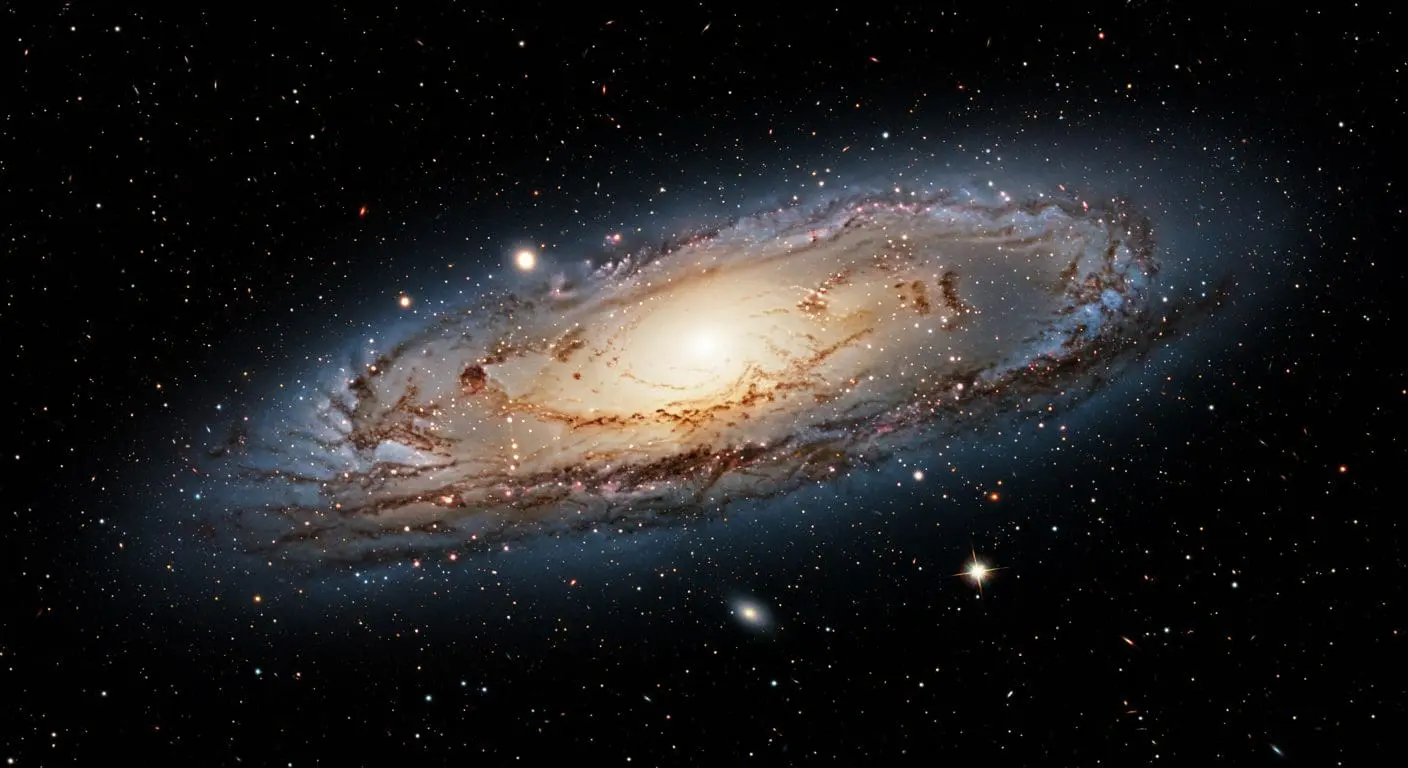
Observations of 292 galaxies at redshift 6 reveal strong Lyman-alpha emission clustered within overdensities spanning 5-11 arcmin and distances of 24 pMpc. This supports predictions regarding the size of ionised bubbles during reionisation, though the extent of ionisation detected presents challenges to current models.
The epoch of reionization, when the first stars and galaxies illuminated the universe after the cosmic ‘dark ages’, remains a key area of cosmological investigation. Understanding the distribution of neutral hydrogen during this period requires probing the environments surrounding early galaxies, specifically examining the interplay between galaxy overdensities and the expanding ionized bubbles they create. A new study, detailed in a paper by Zuyi Chen, Daniel P. Stark, Charlotte A. Mason, Mengtao Tang, Lily Whitler, Ting-Yi Lu, and Michael W. Topping, utilises Lyman-α (Lyα) spectroscopy to characterise these environments at a redshift of approximately 3.5. Their analysis of 292 galaxies across a substantial comoving volume of 100 Mpc³ reveals a strong correlation between galaxy overdensities, predicted bubble sizes, and the presence of strong Lyα emission, potentially challenging current models of reionization.
Galaxy Concentrations Illuminate the Epoch of Reionization
Recent spectroscopic observations of Lyman-alpha (Lyα) emission are providing new insights into the morphology of ionized regions during the epoch of reionization. This period, occurring between approximately 150 million and one billion years after the Big Bang, witnessed the universe transition from a neutral to an ionized state, driven by the first sources of light. A new study, utilising data from 292 galaxies at a redshift of approximately 6, investigates the spatial relationship between galaxies and these ionized ‘bubbles’, seeking to characterise the environment surrounding Lyα emitters and confirm theoretical predictions regarding bubble size. The analysis spans a comoving volume of 1000 megaparsecs cubed (Mpc³).
The research identified 36 galaxies exhibiting Lyα emission, including nine previously unobserved sources. Crucially, these emitters consistently reside within galaxy overdensities – regions where galaxies are more densely clustered than average. Thirteen significant overdensities were identified, and strong Lyα emitters almost exclusively populate these structures, typically located between the centre and the far side. This suggests a direct link between galaxy concentrations and the ionization process. These overdensities exhibit line-of-sight distances and angular scales consistent with predicted radii of ionized bubbles at this redshift, ranging from approximately 0.6 to 1.5 physical megaparsecs (pMpc). This supports the hypothesis that galaxies actively drive the reionization of the surrounding intergalactic medium.
The study presents evidence for a substantial ionized region extending across the observed volume. This challenges standard reionization models, which may struggle to account for such a large, contiguous ionized volume at this early epoch. The observed degree of ionization suggests the reionization process may have been more advanced or spatially inhomogeneous than previously thought, prompting a reevaluation of existing theoretical frameworks.
Future work will focus on expanding the sample size and volume coverage to better constrain the distribution and properties of ionized bubbles. Spectroscopic follow-up of candidate emitters will be crucial for confirming their redshifts and characterizing their emission properties, providing valuable insights into the physical conditions within these ionized regions. Detailed radiative transfer modelling is also needed to investigate the impact of these ionized bubbles on the surrounding neutral hydrogen and to assess the consistency of the observations with different reionization scenarios.
This research demonstrates the power of Lyα spectroscopy in tracing the distribution of ionized bubbles and mapping the evolving ionization state of the early universe. By linking galaxy overdensities with strong Lyα emission, the study provides observational constraints on the size and morphology of these bubbles, and highlights potential tensions with current theoretical frameworks, opening new avenues for research. Further investigation is needed to reconcile these observations with models of reionization and refine our understanding of this crucial epoch.
👉 More information
🗞 The Impact of Galaxy Overdensities and Ionized Bubbles on Ly Emission at
🧠 DOI: https://doi.org/10.48550/arXiv.2505.24080