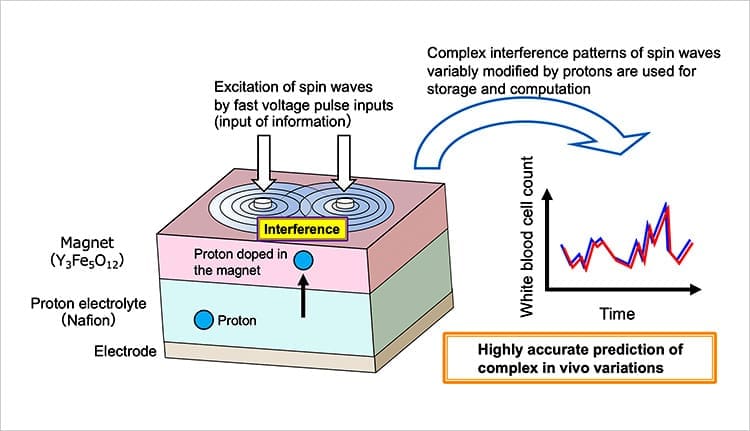
The pursuit of enhancing artificial intelligence capabilities has led to developing a novel high-performance AI device by a research team from the National Institute for Materials Science and the Japan Fine Ceramics Center. This innovative hardware component, which leverages ion-controlled spin wave interference in magnetic materials, has demonstrated superior information processing performance compared to conventional physical reservoir computing devices.
By harnessing the power of spin waves and ion dynamics, this technology has achieved remarkable accuracy in time-series predictions, with error rates less than one tenth those of traditional devices. The device’s ability to fine-tune interference patterns through an iono-magnonic reservoir has far-reaching implications for the development of energy-efficient, high-precision AI solutions, potentially transforming various industrial applications and enabling the creation of sophisticated AI devices that can be integrated with diverse sensors to drive innovation in fields such as biotechnology and materials science.
Introduction to Iono-Magnonic Reservoir Computing
Developing high-performance artificial intelligence (AI) devices is an ongoing pursuit, driven by the need for energy-efficient and sophisticated solutions. A recent breakthrough in this field has been achieved by a research team from the National Institute for Materials Science (NIMS) and the Japan Fine Ceramics Center (JFCC). They have successfully developed a next-generation AI device that incorporates an iono-magnonic reservoir, which controls spin waves, ion dynamics, and their interactions. This technology has demonstrated significantly higher information processing performance than conventional physical reservoir computing devices.
The newly developed device utilizes yttrium iron garnet (YIG) magnets to generate spin waves, which are collective excitations of electron spins in magnetic materials. The interference patterns of these spin waves can be fine-tuned by applying voltage to the magnets and adjusting the number of ions introduced into them. This approach enables the device to perform computations by leveraging dynamic interference patterns through an iono-magnonic reservoir. The research team, consisting of experts from NIMS and JFCC, has published their findings in the journal Advanced Science, highlighting the potential of this technology to transform AI technologies.
The development of this device is a significant step forward in the field of AI, as it addresses the growing demand for energy-efficient and high-performance solutions. The use of iono-magnonic reservoir computing allows for the creation of devices that can process complex information with high accuracy and speed. This technology has the potential to be implemented in various industrial applications, including the development of energy-efficient and high-precision AI devices for a wide range of purposes.
Principles of Iono-Magnonic Reservoir Computing
Iono-magnonic reservoir computing is a novel approach that combines the principles of spin wave dynamics and ion gating to create a high-performance computing device. The device generates spin waves using antennas integrated with YIG magnets, which are then manipulated by applying voltage to the magnets and adjusting the number of ions introduced into them. This creates dynamic interference patterns that can be leveraged for computational purposes.
The use of ion gating allows for fine-tuned control over the spin wave dynamics, enabling the creation of complex patterns that can be used for information processing. The research team has demonstrated that this approach can achieve high-performance computing with low error rates, making it a promising technology for various applications. The device’s ability to perform computations using dynamic interference patterns also enables it to process complex information with high accuracy and speed.
The principles of iono-magnonic reservoir computing are based on the manipulation of spin waves and ion dynamics in magnetic materials. The research team has developed a deep understanding of these phenomena, which has enabled them to create a device that can harness their potential for computational purposes. The use of YIG magnets and ion gating has allowed for the creation of a high-performance device that can process complex information with high accuracy and speed.
Performance Evaluation and Applications
The performance of the iono-magnonic reservoir computing device was evaluated using a standard testing method based on the Mackey-Glass equations, which are commonly used to model complex variations in biological systems. The results showed that the device achieved error rates less than one-tenth those of conventional devices, demonstrating its exceptional performance in time-series predictions.
The potential applications of this technology are vast, ranging from the development of energy-efficient and high-precision AI devices for industrial purposes to the creation of sophisticated AI systems for complex tasks. The research team has demonstrated that the device can be miniaturized without performance degradation, making it suitable for various applications. The use of iono-magnonic reservoir computing also enables the creation of devices that can process complex information with high accuracy and speed, making it a promising technology for various fields.
The evaluation of the device’s performance has shown that it has the potential to transform AI technologies, enabling the creation of sophisticated AI systems that can process complex information with high accuracy and speed. The research team’s findings have been published in the journal Advanced Science, highlighting the significance of this breakthrough in the field of AI. The development of iono-magnonic reservoir computing devices has the potential to revolutionize various industries, from healthcare to finance, by enabling the creation of sophisticated AI systems that can process complex information with high accuracy and speed.
Future Directions and Challenges
The development of iono-magnonic reservoir computing devices is a significant step forward in the field of AI, but there are still challenges to be addressed. The research team has demonstrated the potential of this technology, but further research is needed to fully explore its capabilities and limitations. The development of more sophisticated devices that can harness the full potential of iono-magnonic reservoir computing is an ongoing pursuit.
One of the main challenges facing the development of iono-magnonic reservoir computing devices is the need for a deeper understanding of the underlying phenomena. The research team has made significant progress in this area, but further research is needed to fully understand the dynamics of spin waves and ion gating in magnetic materials. Additionally, the development of more efficient and scalable devices is necessary to enable the widespread adoption of this technology.
The future directions of iono-magnonic reservoir computing are promising, with potential applications in various fields, from healthcare to finance. The research team’s findings have highlighted the significance of this breakthrough in the field of AI, and further research is needed to fully explore its capabilities and limitations. The development of more sophisticated devices that can harness the full potential of iono-magnonic reservoir computing is an ongoing pursuit, with the potential to revolutionize various industries by enabling the creation of sophisticated AI systems that can process complex information with high accuracy and speed.
External Link: Click Here For More