

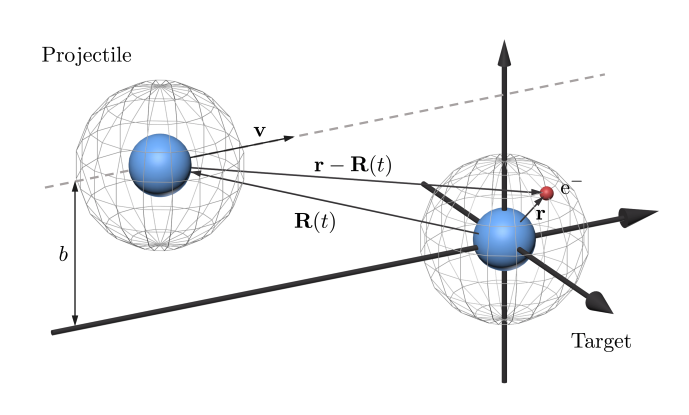
Simulations accurately model ion-atom collisions using a hybrid classical computing framework, validating its performance with proton-hydrogen collisions across a 1-25 keV energy range. Computed charge transfer cross sections demonstrate strong agreement with existing experimental and theoretical data, establishing a viable approach for modelling complex collision dynamics.
The accurate modelling of collisions between ions and atoms presents a persistent computational challenge, demanding detailed understanding of the simultaneous movement of both electrons and atomic nuclei. Researchers are now leveraging the capabilities of quantum computation, combined with established classical methods, to address this complexity. Minchen Qiao and Yu-xi Liu, both from Tsinghua University, detail such an approach in their work, “Quantum-Classical Computing for Time-Dependent Ion-Atom Collision Dynamics: Applications to Charge Transfer Cross Section Simulations”. Their study presents a hybrid computational framework, validated through simulations of proton-hydrogen collisions at energies ranging from 1 to 25 keV, demonstrating strong agreement with existing experimental and theoretical data for charge transfer cross sections, a measure of the probability of an electron changing allegiance during the collision. This work suggests a viable pathway for applying emerging quantum technologies to complex collision physics, even within the limitations of current, intermediate-scale quantum devices.
Recent advances in quantum computing demonstrate a novel hybrid classical-quantum framework capable of accurately simulating time-dependent ion-atom collisions, potentially unlocking progress across diverse scientific disciplines. Researchers have developed this approach to model the intricate dynamics of these collisions, achieving high fidelity in reproducing charge transfer processes and validating results against established experimental data and theoretical calculations.
The research team addresses the longstanding challenge of accurately modelling the interplay between electronic and nuclear motion during ion-atom collisions by integrating the strengths of both classical and quantum computational methods. They employ distinct time evolution schemes, allowing for a nuanced and accurate representation of the collision dynamics and enabling the simulation of complex many-body interactions, where the behaviour of multiple particles is considered simultaneously. This hybrid approach effectively maps these problems onto near-term computing devices, representing a progression towards utilising quantum computing for practical applications and overcoming the limitations of classical methods.
Researchers validate the framework by simulating proton-hydrogen collisions
Researchers validate the framework by simulating proton-hydrogen collisions across an energy range of 1–25 keV, focusing on charge transfer dynamics—the process where an electrical charge moves between atoms. The simulations demonstrate a high degree of fidelity, exhibiting strong agreement with existing data and prior calculations across the entire energy spectrum. This validation confirms the accuracy and applicability of the hybrid framework for calculating scattering cross sections, a key metric in collision physics that quantifies the probability of a collision occurring.
The methodology leverages variational quantum algorithms (VQAs), specifically tailored for simulating the time evolution of quantum systems and addressing computational challenges that exceed the capabilities of classical methods. VQAs employ a hybrid classical-quantum approach, utilising a quantum computer to evaluate certain calculations and a classical computer to optimise the parameters of the quantum algorithm. These algorithms harness the principles of quantum mechanics to model many-body interactions with greater efficiency and accuracy, enabling researchers to explore complex collision systems and energy regimes previously inaccessible.
Researchers focus on mitigating the inherent errors present in near-term quantum computers, developing techniques to enhance the robustness of calculations and overcome the limitations of current hardware. They employ measurement reduction and optimise variational parameters, improving the reliability of quantum simulations. Measurement reduction techniques aim to minimise the impact of noise and errors during the measurement of quantum states, while optimising variational parameters involves adjusting the parameters of the quantum algorithm to achieve the most accurate results.
The study presents a robust computational tool for investigating atomic and molecular collisions, with potential applications in fields such as plasma physics, astrophysics, and materials science. Accurate modelling of charge transfer dynamics contributes to a deeper understanding of fundamental atomic processes and enables more sophisticated simulations of complex physical systems.
Researchers achieve a progression towards utilising quantum computing
Researchers achieve a progression towards utilising quantum computing for practical applications by carefully designing algorithms and mitigating the limitations of current quantum hardware. The framework’s success highlights a promising pathway for advancing collision dynamics simulations in the Noisy Intermediate-Scale Quantum (NISQ) era, where quantum computers are still under development and prone to errors.
The research team expands the framework’s applicability to collisions involving more complex ions and target atoms, investigating the impact of electronic correlation—the interactions between electrons—and relativistic effects on collision dynamics.
The study provides a valuable tool for addressing challenges in areas such as plasma physics, astrophysics, and fusion energy research, accurately modelling ion-atom collisions and contributing to a deeper understanding of fundamental physical processes. Accurate modelling of charge transfer dynamics is essential for understanding the behaviour of plasmas, predicting the radiation emitted from astrophysical sources, and optimising fusion reactor designs. This hybrid approach offers a viable strategy for harnessing the power of quantum computing to address these challenges and advance our understanding of the physical world.
🗞 Quantum-Classical Computing for Time-Dependent Ion-Atom Collision Dynamics: Applications to Charge Transfer Cross Section Simulations
🧠 DOI: https://doi.org/10.48550/arXiv.2506.19374


