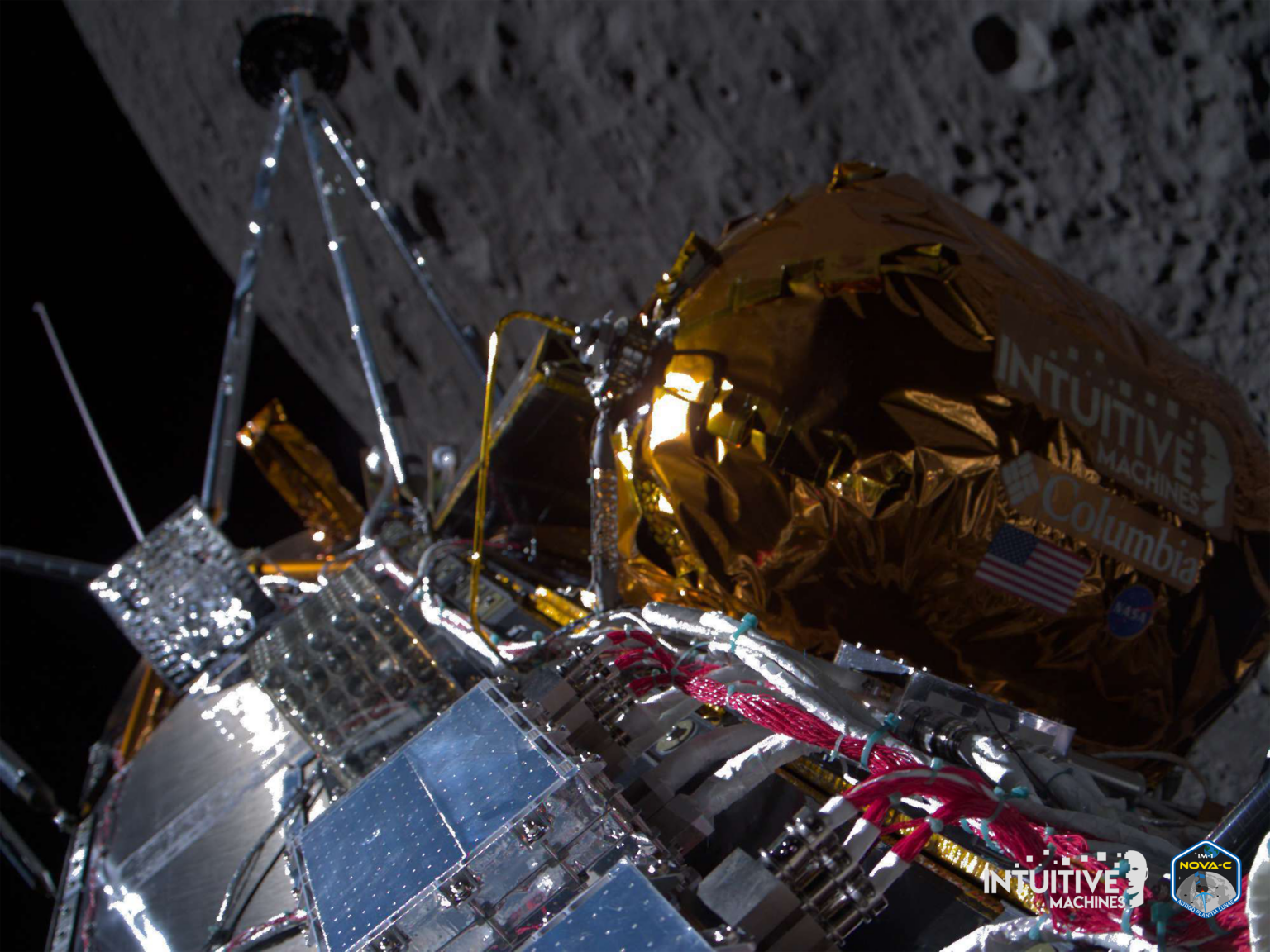
Intuitive Machines’ Odysseus lander, in collaboration with NASA, has successfully entered lunar orbit and is set to land on the moon. The spacecraft is carrying various NASA science instruments, including LN-1, NDL, RFMG, ROLSES, and SCALPSS, all of which are functioning as expected. The LN-1 has established real-time communications with NASA’s Deep Space Network. The landing is scheduled for February 22. This mission, part of NASA’s Commercial Lunar Payload Services initiative, aims to gain new insights into the lunar environment to support future crewed missions under NASA’s Artemis campaign.
Successful Lunar Orbit Insertion by Odysseus Lander
The Odysseus lander, a project by Intuitive Machines, has successfully entered lunar orbit. The spacecraft is currently in a healthy state and is orbiting approximately 60 miles (92km) from the Moon. The lander is set to orbit the Moon for about a day before it begins its descent towards the lunar surface. The landing is scheduled for Thursday, Feb. 22, at 5:30 p.m. EST.
Onboard NASA Science Instruments Operating as Expected
All the powered NASA science instruments onboard the Odysseus have completed their transit checkouts, received data, and are functioning as expected. These instruments include the Lunar Node 1 Navigation Demonstrator (LN-1), Navigation Doppler Lidar for Precise Velocity and Range Sensing (NDL), Radio Frequency Mass Gauge (RFMG), Radio-wave Observations at the Lunar Surface of the Photoelectron Sheath (ROLSES), and Stereo Cameras for Lunar Plume-Surface Studies (SCALPSS). The Laser Retroreflector Array (LRA) instrument, a passive experiment designed for the lunar surface, is not operational during transit.
Successful Communication with NASA’s Deep Space Network
The LN-1 has established real-time communications with NASA’s Deep Space Network, making three successful passes with ground stations on Earth. Upon lunar touchdown, the LN-1 team will conduct a full systems checkout and begin continuous operations within 24 hours of landing. The Deep Space Network will receive its transmissions, capturing telemetry, Doppler tracking, and other data and relaying it back to Earth.
SCALPSS and RFMG Functioning as Expected
A checkout of the SCALPSS was completed during transit, confirming that the cameras are operating as expected and the instrument is in good health. The SCALPSS, using four tiny cameras, will collect imagery of how the lunar surface changes from interactions with the spacecraft’s engine plume as the lander descends toward the Moon. The RFMG continues to gauge the cryogenic propellants on Odysseus throughout the mission, including propellant loading, transit, lunar orbit insertion burn, and low lunar orbit. Data collection and analysis will continue through landing on the Moon and could provide insights on measuring fuel in microgravity.
Intuitive Machines’ First Mission under NASA’s Commercial Lunar Payload Services Initiative
The IM-1 mission by Intuitive Machines is the company’s first under NASA’s Commercial Lunar Payload Services initiative. This initiative aims to gain new insights into the lunar environment and expand the lunar economy to support future crewed missions under NASA’s Artemis campaign. For the latest operational updates on their mission, follow along with Intuitive Machines.
External Link: Click Here For More