

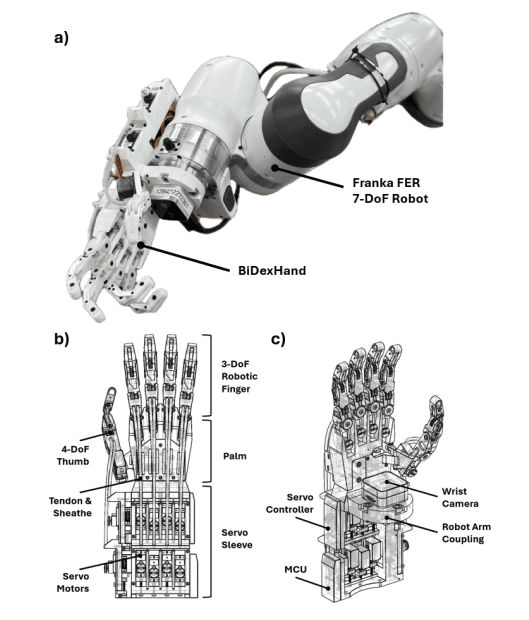
On April 20, 2025, Zhengyang Kris Weng introduced BiDexHand, a biomimetic robotic hand featuring 16 degrees of freedom that achieves human-like dexterity. The device successfully lifts up to 10 pounds and serves as an open-source tool for advancing robotics research.
BiDexHand is a cable-driven biomimetic hand with 16 independently actuated degrees of freedom and novel phalange designs enabling natural finger motion. It successfully performed all 33 grasp types in the GRASP Taxonomy, achieved 9 out of 11 positions in the Kapandji thumb opposition test, demonstrated a fingertip force of 2.14 N, and lifted a 10 lb weight. As an open-source platform supporting multiple control modes, including vision-based teleoperation, BiDexHand aims to provide accessible advanced manipulation capabilities for researchers.
The field of robotics has witnessed significant advancements, particularly in replicating human dexterity with robotic hands. However, these systems often remain prohibitively expensive and complex, hindering widespread adoption. Enter BiDexHand—a groundbreaking project that offers an open-source, affordable solution, poised to transform interactions across industries from healthcare to manufacturing.
BiDexHand is engineered to emulate human hand movements through advanced kinematics and tendon-driven mechanisms. Its open-source design facilitates collaboration among researchers, engineers, and hobbyists, fostering rapid innovation while maintaining accessibility. The robotic hand excels in performing complex tasks with precision, comparable to human dexterity, achieved by modeling human biomechanics for efficiency and intuitive control.
A key distinction of BiDexHand is its affordability, utilizing low-cost materials and an open-source design to democratize access. This accessibility holds significant implications for industries reliant on automation. In healthcare, it could revolutionize prosthetics by offering affordable yet functional solutions. For manufacturing, it enables small businesses to adopt robotic technologies without the financial constraints of proprietary systems.
BiDexHand is rooted in real-world applications, focusing on practical use cases such as assembly line work or medical procedures requiring precision. Its community-driven approach has garnered global contributions since its launch, leading to swift design improvements. This collaborative effort accelerates development while fostering a sense of shared ownership among contributors.
As BiDexHand evolves, it signifies a shift towards accessible innovation in robotics. By reducing entry barriers for advanced systems, it empowers individuals and organizations to explore new automation frontiers. The project’s open-source platform provides resources like documentation and forums, supporting further development and educating future engineers.
In conclusion, BiDexHand represents more than just technological advancement; it embodies a commitment to making sophisticated robotics accessible to all. This initiative not only enhances current capabilities but also paves the way for future innovations in automation and beyond.
👉 More information
🗞 BiDexHand: Design and Evaluation of an Open-Source 16-DoF Biomimetic Dexterous Hand
🧠 DOI: https://doi.org/10.48550/arXiv.2504.14712


