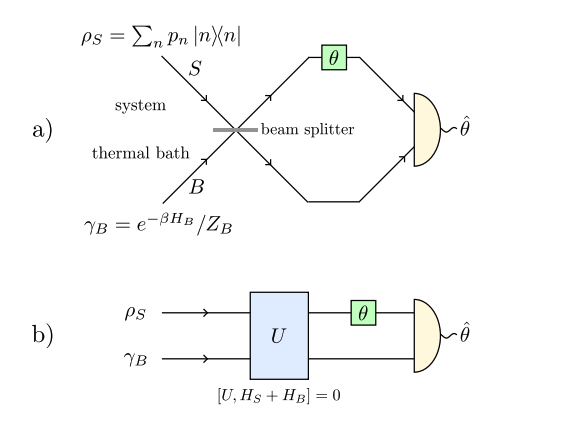
Research establishes a direct relationship between the non-thermal characteristics of a quantum resource and the achievable precision in its interference with a thermal bath. This work defines a fundamental limit to precision, applicable to both finite-dimensional systems and linear optics, and constrains the rate of joint system-bath evolution under energy conservation.
Interferometry, a technique measuring the relative phase difference between quantum subsystems, underpins technologies ranging from gravitational wave detection to precision sensing. Traditional analyses often assume a vacuum input state, an approximation that fails at lower frequencies where thermal backgrounds dominate and limit performance. This necessitates a re-evaluation of input state interaction with the thermal environment and its impact on phase sensitivity, prompting investigations into ‘athermality’ as a crucial resource for enhancing measurement accuracy. Athermality, representing a quantum state’s deviation from thermal equilibrium, directly impacts achievable precision in interferometric measurements. Quantum metrology establishes fundamental limits on parameter estimation precision, often utilising states with enhanced coherence or entanglement, and this work extends this framework by demonstrating that athermality, beyond coherence, serves as a key determinant of the quantum Fisher information (QFI). The QFI, a measure quantifying how much information about a parameter is encoded in a quantum state, dictates the ultimate achievable precision in phase estimation.
Recent research introduces ‘latent coherence’, a novel approach to quantifying coherence, establishing a rigorous and quantifiable measure of information a quantum state carries about an unknown parameter. Unlike conventional coherence definitions that become unreliable in noisy environments, latent coherence remains well-behaved, accurately characterising coherence even when a resource state interacts with a thermal bath, a ubiquitous source of noise. This is significant because it accurately characterises coherence even when the quantum system undergoing measurement interacts with a thermal bath.
This approach extends beyond defining coherence, providing insights
This approach extends beyond defining coherence, providing insights into the dynamics of quantum systems interacting with their environment. The research establishes an upper bound on the speed at which a system and a thermal bath can jointly evolve under energy-conserving interactions, crucial because the rate of evolution directly impacts measurement precision and the overall performance of quantum devices. The methodology applies broadly, encompassing both finite-dimensional quantum systems and those operating within the realm of linear optics.
The research rigorously defines these limits under the constraints of global unitarity and energy conservation, ensuring broad applicability. Central to the analysis are resource states, which actively interfere with a thermal bath. The study demonstrates that increased athermality directly translates to enhanced precision in phase estimation, identifying a key property of quantum states that can be leveraged to improve interferometer performance, crucial for applications ranging from gravitational wave detection to precision spectroscopy.
The article successfully connects theoretical concepts to practical considerations, offering insights relevant to the design and optimisation of interferometric measurements. By establishing a clear link between the athermality of a resource state and achievable precision, it provides a valuable tool for researchers seeking to push the boundaries of quantum metrology. The study rigorously connects this concept to the Cramér-Rao bound and quantum Fisher information, quantifying the potential to surpass the standard quantum limit in measurement precision. This approach moves beyond traditional coherence measures, offering a generalised framework applicable to a broader range of quantum states and experimental scenarios.
A key finding concerns the importance of negative number correlations as a prerequisite for achieving enhanced precision, and the work highlights that leveraging these correlations is fundamental to improving measurement sensitivity, particularly in the presence of unavoidable thermal backgrounds. The framework explicitly addresses and mitigates the effects of thermal noise, a crucial consideration for practical applications where such noise is pervasive, and connections to established concepts in quantum optics, such as first and second-order coherence, further ground the new framework within existing knowledge.
Future work should prioritise experimental verification of the
Future work should prioritise experimental verification of the theoretical predictions, designing experiments to measure latent coherence in realistic scenarios. Exploring specific applications in areas like gravitational wave detection, biological sensing, and materials characterization would demonstrate the practical utility of the framework. Extending the analysis to higher-order coherence measures could provide a more complete understanding of quantum state coherence properties. Investigating the behaviour of latent coherence for non-Gaussian states is also crucial, potentially revealing new insights into the role of non-classicality in quantum metrology. Furthermore, exploring the effects of decoherence on latent coherence within open quantum systems is essential to understand the limitations of the framework in realistic, noisy environments. These investigations will refine the framework and broaden its applicability to a wider range of quantum technologies.
🗞 Quantum phase sensing with states out of thermal equilibrium
🧠 DOI: https://doi.org/10.48550/arXiv.2507.06030