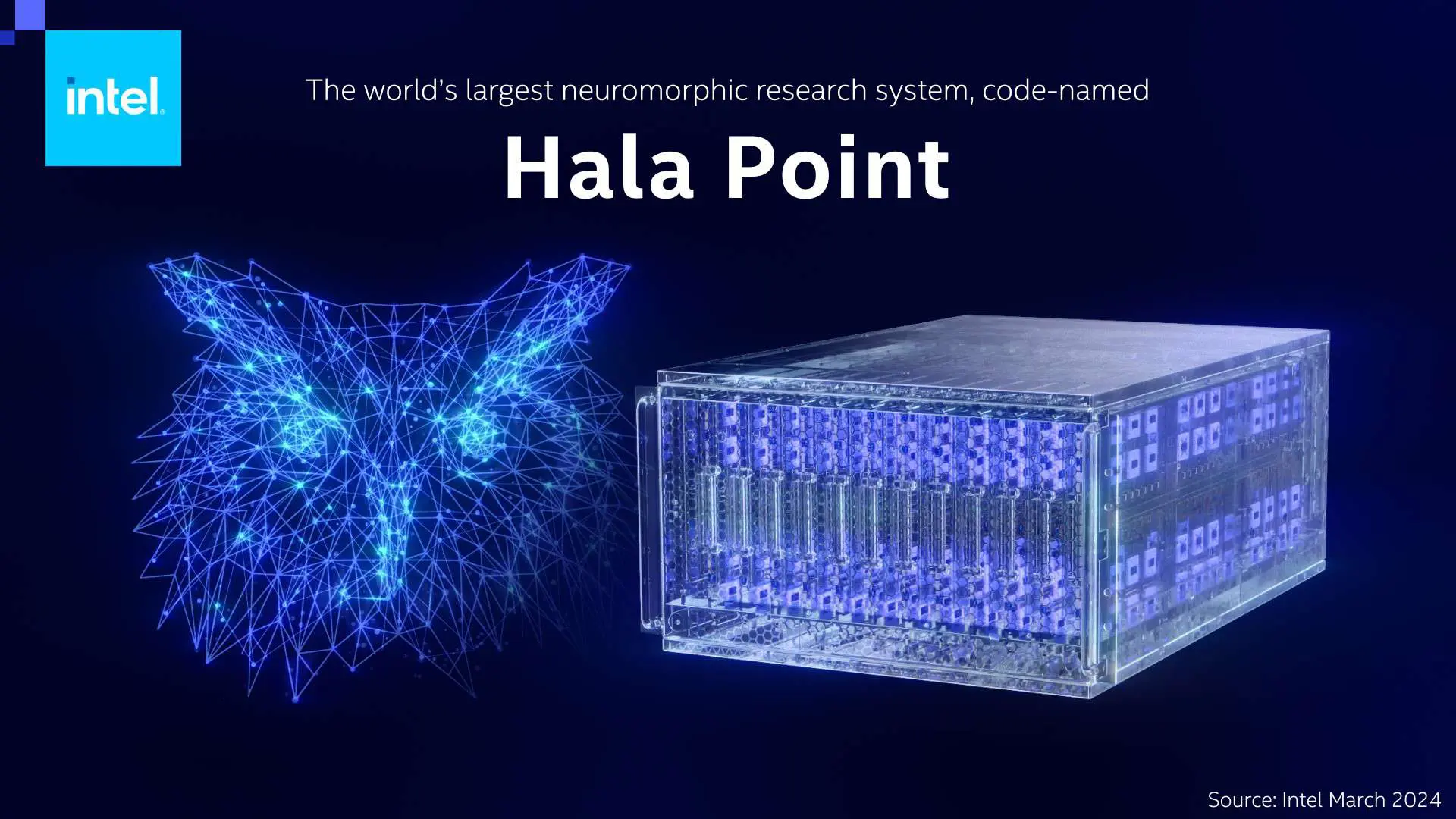
Intel has built the world’s largest neuromorphic system, Hala Point, which contains 1.15 billion neurons and uses 1,152 Loihi 2 processors. This system, the size of a microwave oven, is designed to support research for future brain-inspired artificial intelligence (AI) and address efficiency and sustainability challenges in AI. Hala Point can perform up to 20 quadrillion operations per second and is expected to improve the efficiency of large-scale AI technology significantly. Researchers at Sandia National Laboratories will use the system for advanced brain-scale computing research.
Intel’s Hala Point: A Leap Forward in Neuromorphic Systems
Intel Corporation has announced the creation of Hala Point, the most advanced neuromorphic system to date. This system, which is the largest of its kind, contains 1.15 billion neurons and is housed in a six-rack-unit data center chassis, roughly the size of a microwave oven. The system is powered by 1,152 Loihi 2 processors, produced on Intel’s 4 process node, and supports up to 1.15 billion neurons and 128 billion synapses distributed over 140,544 neuromorphic processing cores. The system also includes over 2,300 embedded x86 processors for ancillary computations.
Hala Point is a significant advancement in the field of neuromorphic systems, which are designed to mimic the human brain’s structure and operation. This system is expected to pave the way for more efficient and scalable artificial intelligence (AI) technologies. The system was initially deployed at Sandia National Laboratories, where it will be used for advanced brain-scale computing research.
Hala Point’s Performance and Efficiency
Hala Point has demonstrated impressive computational efficiencies on mainstream AI workloads. It can support up to 20 quadrillion operations per second, or 20 petaops, with an efficiency exceeding 15 trillion 8-bit operations per second per watt (TOPS/W) when executing conventional deep neural networks. This level of efficiency rivals and even surpasses those achieved by architectures built on graphics processing units (GPU) and central processing units (CPU).
Hala Point’s unique capabilities could enable future real-time continuous learning for AI applications such as scientific and engineering problem-solving, logistics, smart city infrastructure management, large language models (LLMs), and AI agents. The system’s performance and efficiency gains could be particularly beneficial for real-time workloads such as video, speech, and wireless communications.
The Role of Hala Point in Research and Commercial Applications
Researchers at Sandia National Laboratories plan to use Hala Point for advanced brain-scale computing research. The organization will focus on solving scientific computing problems in device physics, computer architecture, computer science, and informatics.
While Hala Point is currently a research prototype, Intel anticipates that the lessons learned from its use will lead to practical advancements, such as the ability for LLMs to learn continuously from new data. Such advancements could significantly reduce the training burden of widespread AI deployments, making them more sustainable.
The Significance of Neuromorphic Computing
The development of Hala Point highlights the importance of neuromorphic computing in addressing the sustainability challenges of AI. Neuromorphic computing is a new approach that draws on neuroscience insights to integrate memory and computing with highly granular parallelism, minimizing data movement.
Hala Point’s Loihi 2 neuromorphic processors apply brain-inspired computing principles, such as asynchronous, event-based spiking neural networks (SNNs), integrated memory and computing, and sparse and continuously changing connections to achieve significant gains in energy consumption and performance.
The Future of Neuromorphic Systems
The delivery of Hala Point to Sandia National Labs marks the first deployment of a new family of large-scale neuromorphic research systems that Intel plans to share with its research collaborators. Further development will enable neuromorphic computing applications to overcome power and latency constraints that limit AI capabilities’ real-world, real-time deployment.
Intel is working with an ecosystem of more than 200 Intel Neuromorphic Research Community (INRC) members, including leading academic groups, government labs, research institutions, and companies worldwide, to push the boundaries of brain-inspired AI. This collaboration aims to progress this technology from research prototypes to industry-leading commercial products over the coming years.
External Link: Click Here For More