

Optical amplifiers underpin many modern technologies, yet current options either limit the wavelengths they support or introduce significant noise, hindering advances in sensing and information processing. Devin J. Dean, Taewon Park, and Hubert S. Stokowski, at Stanford University, alongside Luke Qi and Sam Robison, and Alexander Y. Hwang, now present a breakthrough in optical amplification with a new integrated device that dramatically reduces power requirements. Their research demonstrates an optical parametric amplifier on a thin-film lithium niobate platform, achieving over 17 decibels of gain with less than 200 milliwatts of input power, an order of magnitude improvement over previous designs. This low-power architecture, enabled by a second-harmonic resonance design that efficiently generates and recirculates the amplifying signal, paves the way for practical on-chip optical amplifiers for both quantum and classical photonics, promising significant advances in a wide range of applications.
Lithium Niobate Photonic Integrated Circuit Fabrication
This research details the fabrication and characterization of lithium niobate (LN) photonic integrated circuits (PICs), focusing on achieving ultra-low loss and high-quality factor (Q) resonators. Scientists are pushing the boundaries of LN PICs to enable more complex and efficient optical systems. The work centers on fabricating low-loss waveguides in LN, a challenging material due to its inherent properties and the need for precise processing. High-Q resonators, crucial for applications like filtering, sensing, and nonlinear optics, are a key component of this research. The team utilizes X-cut LN wafers and grows thin-film LN epitaxially to create waveguides with enhanced refractive index contrast.
Reactive ion etching defines the waveguide structures, requiring precise control to minimize sidewall roughness and maintain quality. Surface passivation techniques reduce surface scattering, further minimizing optical loss. Post-processing annealing steps improve the crystal quality of the LN, reducing stress and enhancing performance. The research demonstrates ultra-low optical loss in the waveguides, potentially below 0. 1 dB/cm, and achieves high Q-factors for the resonators, exceeding one million. These PICs operate in the visible and near-infrared spectral range, opening possibilities for optical filters, sensors, and nonlinear optical devices, and are particularly relevant for advancing quantum photonics where low-loss waveguides and resonators are essential building blocks.
Resonant Lithium Niobate Amplifier Achieves High Gain
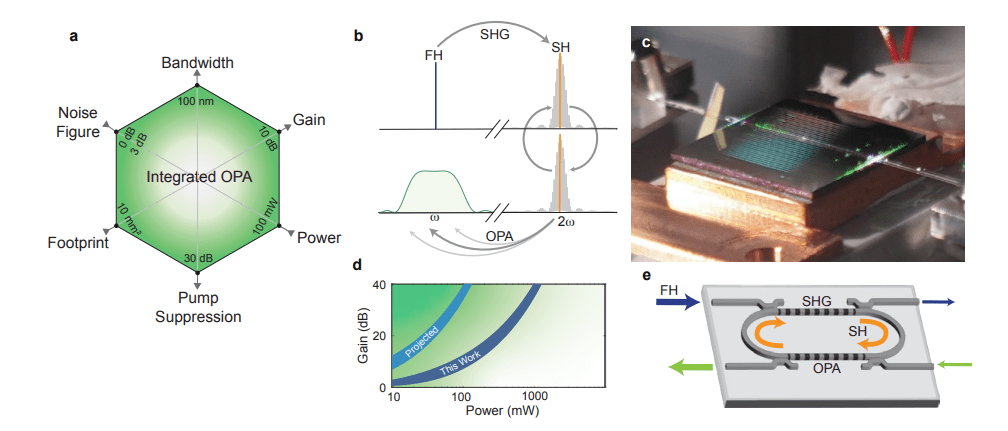
Scientists have pioneered a new approach to optical amplification, achieving over 17 dB of gain with less than 200mW of input power, a significant improvement over previous devices. They engineered an integrated optical parametric amplifier on a thin-film lithium niobate platform, employing a second-harmonic-resonant design to enhance both pump generation efficiency, reaching 95% conversion, and pump power utilization through recirculation without sacrificing bandwidth. This resonant architecture effectively increases pump power by nearly ten-fold compared to conventional designs, while simultaneously multiplexing the signal and pump wavelengths for improved performance. Experiments reveal a bandwidth exceeding 150nm, confirming the theoretical dispersion predicted by simulations, and demonstrate flat, near-quantum-limited noise performance over a 110nm range. This detailed methodology paves the way for practical on-chip optical parametric amplifiers for both quantum and classical photonics applications.
High-Gain Integrated Optical Parametric Amplifier Demonstrated
Scientists have achieved a significant breakthrough in optical amplification with the demonstration of an integrated optical parametric amplifier (OPA) on a thin-film lithium niobate platform. This new device delivers over 17 dB of gain with less than 200mW of input power, representing an order of magnitude improvement over previous integrated devices. The research team’s second-harmonic-resonant design enhances both pump generation efficiency, reaching 95% conversion, and pump power utilization through recirculation, without compromising bandwidth. Measurements confirm a 3-dB amplification bandwidth of 110nm, nearly three times wider than conventional amplifiers, and dispersion-engineered designs promise bandwidths exceeding 340nm.
Further analysis demonstrates a phase-sensitive gain of over 17 dB at degenerate wavelengths around 1576nm and 12 dB of phase-insensitive gain around 1590nm, all achieved with less than 200mW of input power. The team quantified noise performance, achieving a noise figure approaching the quantum limit of 0 dB across most of the 1520-1630nm band, and as low as 0. 5 dB, demonstrating stable amplification even with fluctuating phase conditions. This low-power architecture enables practical on-chip OPAs for next-generation and classical photonics applications.
On-Chip Amplifier Achieves High Gain, Low Noise
This research demonstrates a significant advance in optical amplification through the development of an integrated optical parametric amplifier on a thin-film lithium niobate platform. The team achieved over 17 decibels of gain with less than 200 milliwatts of input power, representing an order of magnitude improvement over previous integrated devices. This breakthrough stems from a novel second-harmonic-resonant design that efficiently enhances pump generation and utilization without compromising bandwidth, effectively increasing pump power by nearly ten times compared to conventional approaches. The researchers successfully demonstrated flat, near-quantum-limited noise performance across a 110 nanometer bandwidth, paving the way for practical on-chip optical amplifiers for both classical and quantum photonics.
The key to this achievement lies in decoupling pump power build-up from signal bandwidth, utilizing an intracavity second-harmonic generation process to drive a single-pass optical parametric amplifier. While current limitations include minor gain ripple caused by end-facet reflections and potential for further improvement in fiber coupling efficiency, refinements in anti-reflection coating, coupler design, poling quality, and resonator quality factor could reduce required pump power by another order of magnitude. This work establishes a versatile and scalable approach to integrated, broadband, low-noise amplification and squeezed-light generation, potentially enabling fully integrated optical systems through co-integration with existing chip-scale lasers.
👉 More information
🗞 Low-power integrated optical parametric amplification via second-harmonic resonance
🧠 ArXiv: https://arxiv.org/abs/2509.26425

