

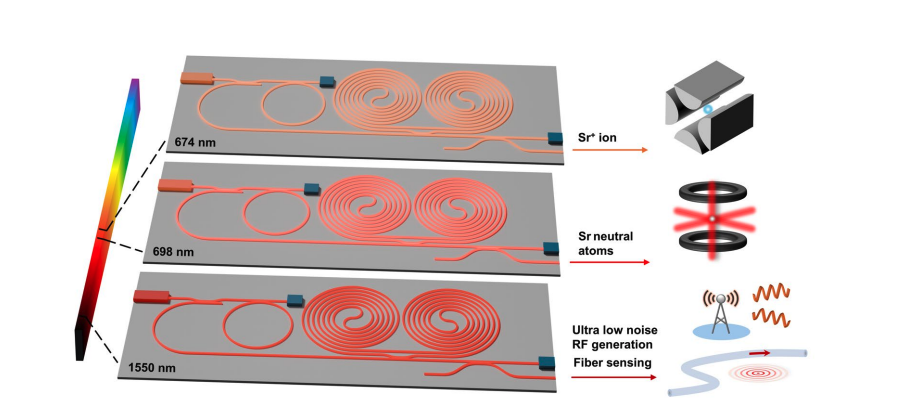
Precision applications, including atomic clocks, quantum sensing, and low-noise microwave generation, demand lasers with exceptionally stable and narrow wavelengths, but current technology often relies on bulky, laboratory-bound setups. Meiting Song, Nitesh Chauhan, Mark Harrington, and colleagues at the University of California, Santa Barbara, and the University of Massachusetts Amherst, have developed an integrated laser system that significantly expands the operating range and stability of these crucial components. Their research demonstrates a novel, chip-scale Brillouin laser design, stabilized by integrated coils, capable of operating across a broad spectrum, from visible to short-wave infrared wavelengths. The team achieves remarkably low noise and narrow linewidths, an order of magnitude improvement over existing integrated systems, with frequencies ranging from 674 nm to 1550 nm, paving the way for portable, robust, and exact laser technology for a wide range of applications and future integration into compact systems-on-chip solutions.
Ultra-Stable Photonics for Quantum Technologies and Clocks
This research focuses on developing ultra-low-noise photonic integrated circuits (PICs) for applications demanding exceptionally stable and precise optical sources. These circuits promise to revolutionize fields requiring highly accurate timing and sensing capabilities, serving as fundamental building blocks for advanced optical atomic clocks, quantum technologies, and high-precision measurement systems. The team utilizes silicon nitride (Si3N4) photonics as the primary material platform, leveraging its low optical loss to create complex PICs with minimal signal degradation. They integrate various optical components onto a single chip, including high-quality microresonators to enhance light-matter interactions and create stable optical sources, and employ integrated Brillouin lasers to generate ultra-low noise light crucial for sensitive applications.
The research extends to stabilizing external cavity lasers using PICs and developing techniques for controlling light with both electric and acoustic fields. Furthermore, the team is expanding the capabilities of these PICs to operate at both visible and C-band wavelengths, broadening their potential applications, and has achieved extremely low noise levels, with some sources reaching a fundamental linewidth of just a few Hertz. These advancements have enabled the creation of laser sources with sub-Hertz linewidths and the stability required for next-generation optical clocks. The team has successfully developed PICs operating at visible and C-band wavelengths, and demonstrated Brillouin lasers with up to 40 milliwatts of output power. This research is supported by funding from several agencies, with fabrication performed at leading nanofabrication facilities.
Integrated Brillouin Laser Stabilization on a Chip
Researchers developed a novel approach to creating ultra-stable lasers by integrating multiple advanced techniques onto a compact silicon nitride chip. Recognizing the limitations of traditional laser stabilization methods, they aimed to create a portable and robust system suitable for precision applications. The core of their innovation lies in a Brillouin laser architecture, stabilized using an integrated coil resonator, offering a departure from conventional free-space cavity designs. A key element of the methodology is a two-stage noise reduction process. The team first generates a Brillouin laser, shining a pump laser into a specialized waveguide to create a new, highly coherent light source.
This initial laser is then locked to a carefully designed coil resonator, a long, spiraling waveguide that acts as a frequency filter, suppressing noise and stabilizing the laser’s output. The coil resonator’s length and geometry are precisely tailored for each wavelength, maximizing its effectiveness. To accurately measure and refine the laser’s stability, the researchers employed a combination of optical techniques. They utilized an unbalanced fiber Mach-Zehnder interferometer and a frequency comb to achieve a comprehensive understanding of the laser’s frequency stability across a broad spectrum, allowing them to extract fundamental and integrated linewidth values, key indicators of laser stability.
The design incorporates wavelength-specific optimizations, demonstrating operation at 674 nanometers, 698 nanometers, and 1550 nanometers. This versatility is achieved through precise control of waveguide dimensions and resonator geometry, tailored to each wavelength’s unique properties. The entire system is controlled through a feedback loop, utilizing an acousto-optic modulator to fine-tune the laser’s frequency and maintain its stability, demonstrating a fully integrated and self-correcting laser system.
Narrow Linewidth Lasers and Low-Loss Resonators
The research team achieved key numerical results demonstrating the performance of their integrated laser system. Fundamental linewidths ranged from 1 to 17 Hertz, while integrated linewidths ranged from 181 to 630 Hertz. Allan deviation measurements indicated long-term frequency stability, reaching values of 6. 5 x 10 -13 at 674 nanometers, 6. 0 x 10 -13 at 698 nanometers, and 2.
The coil resonators exhibited exceptionally low loss, with measurements of 0. 63 decibels per meter at 674 nanometers, 0. 53 decibels per meter at 698 nanometers, and 0. 64 decibels per meter at 1550 nanometers.
Corresponding quality factors reached 94 x 10 6 at 674 nanometers, 110 x 10 6 at 698 nanometers, and 41 x 10 6 at 1550 nanometers. The system demonstrated stable lasing with thresholds of 7 milliwatts at 674 nanometers, 5 milliwatts at 698 nanometers, and 14. 6 milliwatts at 1550 nanometers. Using Stimulated Brillouin Scattering, the team achieved fundamental linewidths of 14 Hertz at 674 nanometers, 7 Hertz at 698 nanometers, and 1. 0 Hertz at 1550 nanometers, and integrated linewidths with the coil resonator reached 322 Hertz at 674 nanometers, 630 Hertz at 698 nanometers, and 181 Hertz at 1550 nanometers.
Stable Chip Laser Across Visible and Infrared
This research demonstrates a new integrated laser design capable of achieving remarkably stable and narrow linewidth performance across a broad wavelength range, spanning visible and near-infrared light. By employing a coil-resonator-stabilised Brillouin laser architecture on a chip, the team has created a compact and stable laser source with applications in quantum technologies and precision metrology.
🗞 Octave Spanning Visible to SWIR Integrated Coil-Stabilized Brillouin Lasers
🧠 ArXiv: https://arxiv.org/abs/2508.03036


