

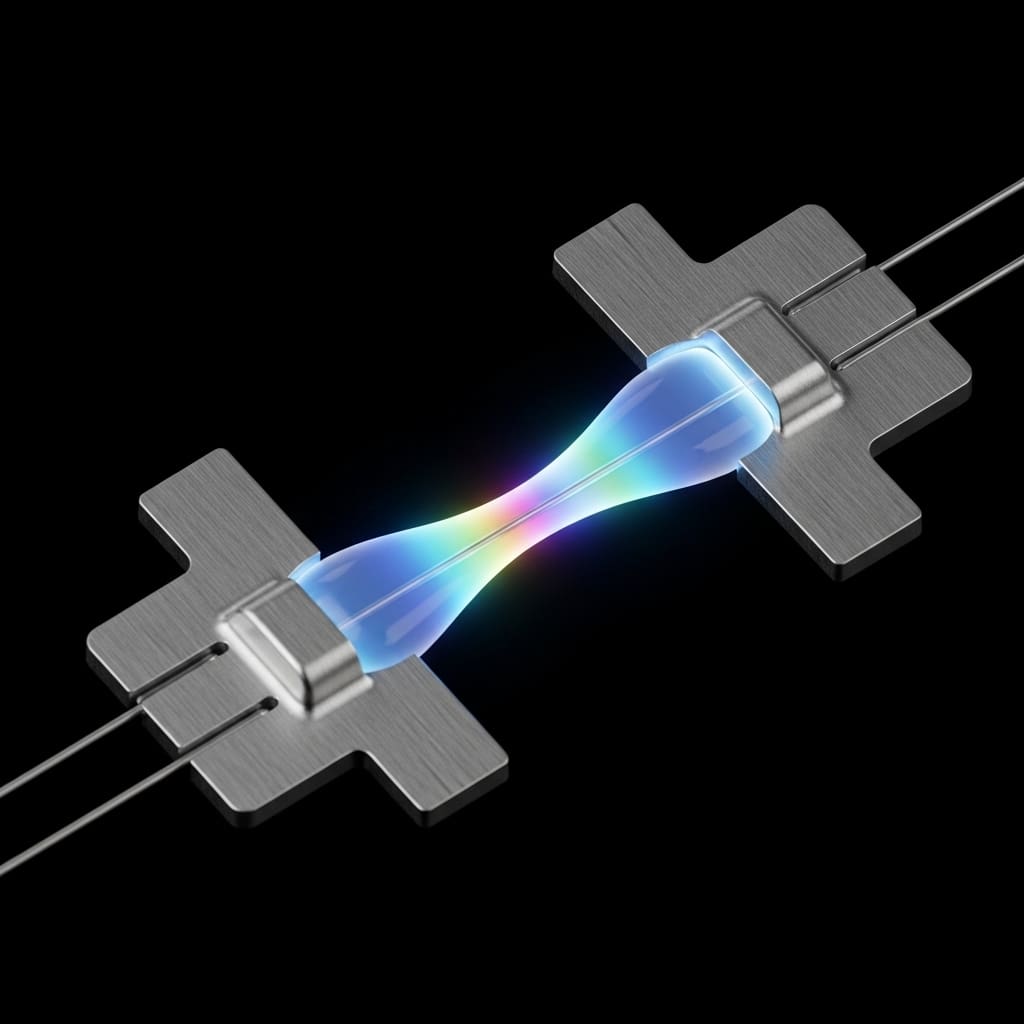
The pursuit of stable topological quantum computing relies on creating and controlling exotic states of matter, and recent research focuses on hybrid superconductor-semiconductor nanowires as promising platforms for realising these states. Guoan Li, Xiaofan Shi, Ruixuan Zhang, and colleagues, alongside Marco Rossi and Ghada Badawy, now demonstrate a significant advance with the creation of the first three-terminal devices utilising lead-indium antimonide hybrids. Their work reveals a broad spectrum of nonlocal signals, indicating the potential to engineer artificial Kitaev chains, a crucial step towards building robust quantum bits. Importantly, these devices exhibit strong signals at temperatures far exceeding those achievable with conventional aluminium-based systems, offering a pathway to practical, warm-temperature topological quantum devices protected by a substantially larger topological gap and greatly expanding the possibilities for future research.
InAs Nanowires and Superconducting Interfaces
Scientists are developing hybrid nanowires combining indium arsenide and superconductors to create and characterize a minimal Kitaev chain, a crucial step towards realizing topological quantum computation. This research focuses on creating quantum dots within the nanowires and carefully controlling their coupling to superconducting leads. Measurements reveal the presence of Andreev bound states within the superconducting gap, indicated by zero-bias peaks in differential conductance. These states are crucial for realizing the Kitaev chain and are split in a magnetic field, providing information about their spin properties.
Evidence of nonlocal transport demonstrates that electrons can tunnel between quantum dots without passing through the leads, a key signature of the Kitaev chain. The coupling between quantum dots is tunable using electrostatic gates, and stability diagrams visualize the different charge states and coupling strengths. Researchers also observed crossed Andreev reflection, indicating that Cooper pairs can split between quantum dots. These findings demonstrate a solid foundation for future investigations in topological quantum computation and provide a pathway towards realizing more complex and robust quantum devices based on the principles of topological superconductivity.
Lead-Semiconductor Hybrids for Robust Superconductivity
Scientists engineered three-terminal hybrid devices by combining lead and semiconductor nanowires to investigate topological superconductivity and Majorana zero modes, a platform crucial for fault-tolerant quantum computing. This study pioneered a method for creating these hybrid structures, utilizing lead as a superconductor to induce a proximity effect within the semiconductor material, resulting in a significantly larger induced gap, approximately five times greater than that achieved with aluminum-based hybrids. This larger gap, measuring around 1. 4 meV, and a critical temperature of 7. 2K, enhances the robustness of the induced superconducting state and extends the operating temperature range for potential devices.
The team employed nonlocal differential conductance spectroscopy to simultaneously resolve both the parent lead gap and the induced gap within the semiconductor nanowire. By tuning gate voltages, scientists achieved control over the induced gap and observed the formation of Andreev bound states, quasiparticle states that arise at the interface between a superconductor and a normal conductor. These states underwent singlet-doublet transitions, revealing details about their quantum mechanical properties. Researchers further investigated the behavior of these Andreev bound states by modulating gate voltages, achieving resonating sign reversals of the nonlocal conductance.
This allowed them to identify three distinct regimes corresponding to different configurations of quantum dot resonances, single, double, and series resonance, within the semiconductor nanowire. The coupling between Andreev bound states and quantum dots was also explored, demonstrating a tunable transition from weak to strong coupling, indicating the potential for realizing artificial Kitaev chains. The robust nonlocal signatures observed persisted up to 1K, significantly exceeding the operating temperatures of aluminum-based devices, and greatly expanding the accessible parameter space for designing and implementing warm-temperature topological quantum devices.
Lead Nanowires Demonstrate Enhanced Topological Gaps
Scientists have achieved a significant breakthrough in the development of hybrid superconductor-semiconductor nanowires, demonstrating a platform for creating topological quantum devices with substantially enhanced performance. This work centers on utilizing lead, a superconductor exhibiting a bulk gap of approximately 1. 4 meV and a critical temperature of 7. 2K, to induce a proximity effect in a nanowire, creating a large induced gap roughly five times greater than that achieved with aluminum. The team fabricated the first three-terminal devices using this lead-based hybrid structure and performed nonlocal differential conductance spectroscopy to characterize its properties.
Experiments reveal a distinct dual-gap feature, comprising the inherent gap of the lead superconductor and a large, tunable induced gap within the nanowire. By manipulating gate voltages, researchers observed several types of Andreev bound states and tracked their transitions between singlet and doublet configurations. Crucially, the team achieved gate-controlled resonating sign reversals of the nonlocal conductance, identifying three distinct regimes corresponding to different quantum-dot resonance configurations. Measurements confirm that the coupling between these Andreev bound states and quantum dots can be tuned from weak to strong coupling, a critical step towards realizing artificial Kitaev chains.
The robust nonlocal signatures observed persisted at temperatures up to 1K, significantly exceeding the operating temperature of comparable aluminum-based devices. This achievement, stemming from the unusually large induced gap, greatly expands the accessible parameter space for topological phases and underscores the potential of lead-based hybrids for creating “warm” Kitaev chain devices with enhanced scalability and protection. The team demonstrated a hard induced gap, evidenced by a contrast ratio exceeding two orders of magnitude between conductance inside and outside the gap, and a zero nonlocal signal below the gap, confirming the robustness of the induced superconductivity. These results demonstrate that a large hard gap, gate-controlled inter-site coupling, and reliable nonlocal read-out can be realized simultaneously in a lead-based hybrid structure.
Lead-Semiconductor Hybrids Show Robust Topological Gap
This research demonstrates a significant advance in the development of hybrid superconductor-semiconductor nanowires, specifically utilizing lead to create devices exhibiting robust topological properties. Scientists successfully fabricated the first three-terminal devices combining lead and a semiconductor material, enabling detailed nonlocal measurements that reveal a uniquely large and easily tuned induced gap, a crucial feature for realizing topological superconductivity. These measurements simultaneously resolve both the inherent superconducting gap of lead and the substantially larger gap induced within the semiconductor. The team observed various Andreev bound states within the induced gap and importantly, demonstrated control over these states using gate voltages, achieving sign reversals in the nonlocal conductance.
This control was achieved through manipulating quantum dot resonances, transitioning between single, double, and series resonance configurations, and modulating the coupling between Andreev bound states and quantum dots. The unusually large induced gap, approximately one meV, allows these robust nonlocal signatures to persist at temperatures up to one Kelvin, significantly exceeding the performance of similar devices based on aluminum. Researchers acknowledge that further refinement of device fabrication and control over charging energy within the system will be necessary to fully realize artificial Kitaev chains. Future work will likely focus on optimizing the coupling between superconducting leads and Andreev bound states, and exploring strategies to fine-tune device parameters for optimal performance. These findings represent a crucial step towards creating more stable and scalable topological quantum devices, potentially with a substantially larger topological gap, paving the way for advancements in fault-tolerant quantum computation.
👉 More information
🗞 Broad nonlocal spectrum in the Pb-InSb hybrid three terminals for potential realization of Kitaev chains
🧠 ArXiv: https://arxiv.org/abs/2510.10064


