Researchers are advancing miniature underwater robots (MURs) for aquatic environments, focusing on improving propulsion efficiency, miniaturization, energy management, and control. These robots face high drag forces, limited onboard energy storage, and unstable locomotion in unpredictable currents. Innovations include bio-inspired propulsion methods like undulatory motion and pulsation, soft robotics with compliant materials, and AI-driven control strategies for enhanced autonomy.
Applications span marine exploration, environmental monitoring, infrastructure inspection, and biomedical fields, with the potential for swarm robotics and targeted drug delivery. The study highlights progress in actuation mechanisms, evaluates propulsion techniques, identifies key challenges, and outlines future research directions to enhance underwater robot capabilities.
Miniature Underwater Robots Revolutionizing Aquatic Exploration
Miniature Underwater Robots (MURs) are transforming how we explore aquatic environments by addressing challenges such as efficient propulsion in water’s high resistance. These robots utilize two main propulsion methods: conventional systems like propellers and jet propulsion, which face miniaturization and energy efficiency issues, and bio-inspired approaches that mimic marine organisms’ movements.
Bio-inspired propulsion, including fish-like undulatory motion and jellyfish-like pulsation, offers enhanced maneuverability and energy efficiency compared to traditional methods. This approach leverages soft robotics and shape-adaptive propulsors, enabling MURs to adapt effectively to dynamic underwater conditions.
Despite these advancements, challenges remain. Miniaturization without compromising power output is a significant hurdle, alongside energy efficiency concerns due to limited onboard storage. Additionally, maintaining precise control in unpredictable currents poses navigation accuracy issues.
Future innovations aim to integrate artificial intelligence and swarm intelligence, enhancing autonomy and coordination among MURs. These developments could expand applications beyond exploration to include environmental monitoring, infrastructure inspection, and biomedical fields like targeted drug delivery.
In summary, advancements in propulsion mechanisms, energy efficiency, and AI integration are driving the evolution of MURs, enabling them to tackle a broader range of tasks with enhanced efficiency and reliability. These innovations address current challenges while paving the way for novel applications that benefit various industries and environmental conservation efforts.
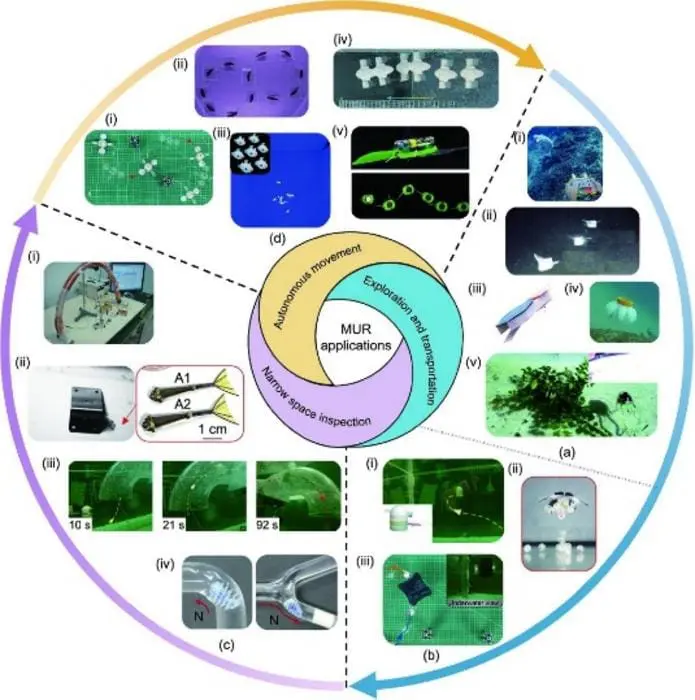
Applications of MURs in Marine Science and Industry
Recent advancements in propulsion mechanisms for Miniature Underwater Robots (MURs) have integrated soft robotics with bio-inspired designs, enabling efficient movement through aquatic environments. These innovations allow MURs to mimic the undulatory motion of fish or the pulsation of jellyfish, enhancing their ability to navigate complex underwater terrains while reducing energy consumption.
Energy efficiency remains a critical focus due to the limited onboard storage capacity of MURs. Researchers are exploring alternative power solutions such as piezoelectricity and thermoelectric generation to sustain operations without frequent recharging. These technologies aim to extend operational lifespans, making MURs more practical for long-term underwater missions.
Integrating artificial intelligence (AI) into MURs enhances their autonomy and adaptability. Machine learning algorithms enable MURs to optimize navigation paths, respond to dynamic environmental changes, and coordinate with other robots in swarm configurations. This capability is particularly valuable for large-scale ecological monitoring or search operations in challenging underwater conditions.
MURs’ applications extend beyond exploration into areas like marine conservation and infrastructure inspection. Equipped with advanced sensors, MURs can conduct real-time assessments of water quality and monitor ecosystems. They show potential for targeted drug delivery systems in biomedical fields, leveraging their precision and adaptability to navigate complex biological environments effectively.
These technological advancements are expanding the utility of MURs across various industries. They address current operational challenges while opening new possibilities for underwater exploration and practical applications.
More information
External Link: Click Here For More