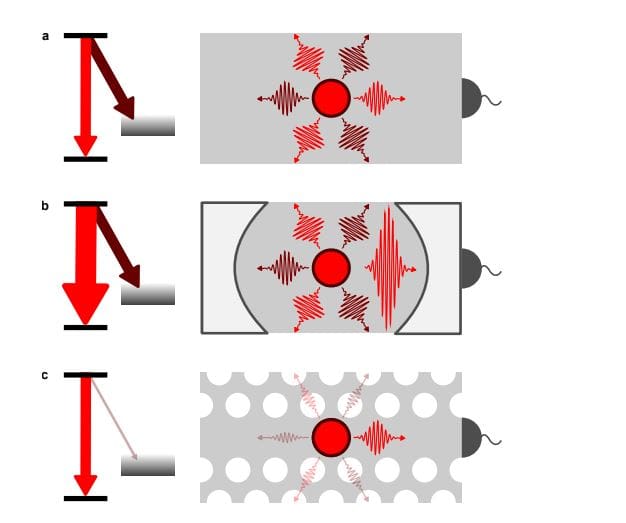
Efficient spin-photon interfaces represent a crucial challenge for developing advanced quantum networks and scalable quantum technologies, and Florian Burger, Stephan Rinner, and Andreas Gritsch, alongside their colleagues, now present a novel approach to overcome key limitations in this field. The team demonstrates that inhibiting unwanted radiative decay channels, rather than strongly enhancing a single transition, significantly improves the performance of single-photon emitters. By carefully tailoring the photonic bandgap of a silicon photonic crystal waveguide, they successfully channelled emission from tens of erbium dopants, preserving and even extending their lifetimes compared to bulk materials. This innovative method facilitates greater spatial separation between emitters, minimising unwanted interactions and paving the way for more coherent and scalable photonic technologies, offering a promising route towards realising practical quantum devices.
Silicon and Silicon Carbide Quantum Emitters
This research explores the creation and control of single-photon emitters, and sometimes spin qubits, within silicon and silicon carbide materials, aiming to build essential components for future quantum networks and computing technologies. Scientists are addressing the challenges of creating reliable, efficient, and indistinguishable single-photon sources, crucial for applications like quantum key distribution and quantum computation. The work focuses on utilizing the unique properties of these materials and innovative fabrication techniques to achieve precise control over light emission at the nanoscale. A major focus involves incorporating erbium ions into silicon, leveraging the maturity of silicon technology for integration with existing microfabrication processes.
Researchers also investigate vanadium in silicon carbide, benefiting from its wide bandgap and potential for isotopic purification, which can extend the coherence of quantum states. Nanophotonic structures, such as photonic crystal waveguides, play a critical role in manipulating light at the nanoscale, enabling light confinement, slowing down light propagation, and efficient integration of emitters with waveguides. This research aims to create the building blocks for a quantum network, including quantum memories for storing quantum information, quantum repeaters for overcoming signal loss in long-distance communication, and sources of entangled photons for quantum communication and computation. Significant effort is dedicated to optimizing materials and fabrication processes, including isotopic purification to reduce decoherence and the design of photonic crystal structures with specific properties. Advanced microfabrication techniques are employed to create nanoscale devices, and sophisticated characterization methods are used to analyze their properties.
Photonic Crystal Waveguides Suppress Spontaneous Emission
Scientists have engineered a novel approach to interfacing spin and photons by inhibiting unwanted spontaneous emission, rather than enhancing desired transitions with traditional optical resonators. The team fabricated silicon photonic crystal waveguides, meticulously designed to suppress radiative decay channels across a broad spectral range, and embedded erbium dopants within these structures. The waveguides feature a large photonic bandgap, effectively reducing the optical density of states and channeling emission from multiple erbium dopants to the desired transition. This precise control enables spectral resolution and individual addressing of the dopants, facilitating efficient photon collection.
This study employed a unique methodology focused on tailoring the photonic environment to inhibit unwanted transitions, a departure from conventional Purcell enhancement techniques. Researchers leveraged the properties of silicon photonic crystal waveguides, creating structures that minimize the local density of states over a wide spectral range, specifically within the telecommunications C band. By reducing the available radiative pathways, the team preserved, and in some instances extended, the emitter lifetimes compared to bulk material, even while maintaining broad spectral coverage. This innovative approach facilitates low dopant concentrations and large spatial separations between emitters, mitigating unwanted interactions that typically limit coherence.
The experiment relies on erbium-doped silicon, a platform offering coherent optical transitions and compatibility with established semiconductor manufacturing processes. Measurements demonstrate that this method not only channels emission to the desired transition but also preserves emitter lifetimes, offering a pathway towards scalable and multiplexed single-photon sources for quantum networks. The system delivers broadband operation and maintains, or even increases, emitter lifetimes, addressing limitations inherent in traditional high-quality factor resonator designs.
Tailoring Erbium Emission in Silicon Waveguides
Scientists have developed a novel photonic crystal waveguide capable of precisely tailoring the radiative decay of individual erbium dopants embedded in silicon, offering a new approach to controlling light emission at the nanoscale. This work overcomes limitations of traditional methods by suppressing unwanted emission channels rather than solely enhancing desired transitions, paving the way for scalable photonic networks. The team integrated erbium into silicon at specific lattice sites, focusing on transitions between energy levels within the 1538nm telecommunications band. Experiments reveal that the designed waveguide features a large photonic band gap and a strongly dispersive guided mode, effectively inhibiting spontaneous emission from unwanted transitions.
Simulations demonstrate that the local density of states, a measure of available light modes, is significantly reduced, to less than 0. 1 of its bulk value, for transitions that would normally lead to light emission at undesired wavelengths. This suppression is most pronounced within the band gap, extending from approximately 190THz to 195THz, and remains considerable even at lower frequencies. Measurements confirm that this inhibition leads to an increase in the lifetime of the excited state of the erbium dopants, counteracting the natural decay processes. By carefully adjusting the geometry of the waveguide, scientists can precisely balance the suppression of unwanted transitions with the enhancement of the desired transition between the Y1 and Z1 energy levels.
This allows for channeling almost all emitted light into a single waveguide mode, without altering the intrinsic lifetime of the emitters. The simulated data shows a substantial increase in the local density of states, greater than 10times the bulk value, at frequencies corresponding to the desired transition, maximizing the efficiency of light collection. This breakthrough delivers a method for spectrally resolving and individually addressing tens of erbium dopants within the same device, opening possibilities for advanced photonic technologies and scalable quantum networks. The team’s approach facilitates low dopant concentrations and large spatial separations between emitters, minimizing unwanted interactions that would limit coherence. The results demonstrate a significant advancement in controlling light emission at the nanoscale, with potential applications in quantum computing, optical communications, and integrated photonics.
Tailoring Waveguides Suppresses Unwanted Emission Pathways
This research demonstrates a new method for creating efficient interfaces between light and individual erbium dopants embedded within silicon photonic crystal waveguides. Rather than intensifying light emission from a specific transition, the team successfully suppressed unwanted emission pathways by carefully tailoring the photonic bandgap of the waveguide. This approach allows for the spectral resolution and individual addressing of numerous dopants, effectively channeling their emission into the desired guided mode. Importantly, the observed emitter lifetimes were maintained, and in some cases extended, compared to bulk materials, while also facilitating a large spatial separation between dopants to minimise unwanted interactions. The achieved results represent a significant advance in the field, offering increased potential for spectral multiplexing, as the number of addressable emitters is limited by spectral diffusion and the emitter ensemble’s width, rather than the photonic device’s spectral limitations. While moderate Purcell enhancement was demonstrated, the authors note that further increases are possible through device optimisation.
👉 More information
🗞 Inhibited radiative decay enhances single-photon emitters
🧠 ArXiv: https://arxiv.org/abs/2511.23301