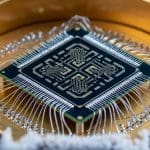
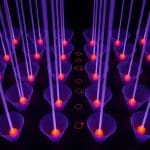
In a significant breakthrough, scientists from India’s Defence Research and Development Organisation (DRDO) Young Scientists Laboratory for Quantum Technologies (DYSL-QT) and Tata Institute of Fundamental Research (TIFR) have successfully completed end-to-end testing of a 6-qubit quantum processor based on superconducting circuit technology.
The demonstration was conducted in front of the apex committee overseeing DYSL-QT, showcasing the execution of a quantum circuit from a cloud-based interface to the computation and updating of results. This collaborative project involves TIFR’s Colaba campus, Tata Consultancy Services (TCS), and DYSL-QT. The qubits were designed and fabricated at TIFR using a novel ring-resonator design, while the control and measurement apparatus was developed by DYSL-QT scientists using commercial off-the-shelf electronics and custom-programmed development boards. With this achievement, plans are underway to provide wider access to the system for education, research, and testing of superconducting quantum devices.
Quantum Computing Breakthrough: 6-Qubit Processor Completes End-to-End Testing
In a significant milestone, scientists from the DRDO Young Scientists Laboratory for Quantum Technologies (DYSL-QT) and Tata Institute of Fundamental Research (TIFR) have successfully completed end-to-end testing of a 6-qubit quantum processor based on superconducting circuit technology. This achievement marks a crucial step forward in the development of quantum computing capabilities in India.
The demonstration, witnessed by the apex committee overseeing DYSL-QT, showcased the seamless integration of various components involved in the quantum processing workflow. The process began with submitting a quantum circuit from a cloud-based interface, followed by the execution of the program on the quantum hardware, and finally updating the cloud interface with computed results. This end-to-end testing validates the functionality of the 6-qubit processor, paving the way for further advancements.
The collaborative project, executed at TIFR’s Colaba campus in Mumbai, brings together expertise from DYSL-QT, TIFR, and Tata Consultancy Services (TCS). The DYSL-QT scientists designed and assembled the control and measurement apparatus using a combination of commercial off-the-shelf electronics and custom-programmed development boards. Meanwhile, the qubits were designed and fabricated at TIFR, leveraging their novel ring-resonator design. The cloud-based interface to the quantum hardware was developed by TCS.
Optimizing System Performance: The Next Steps
With the successful completion of end-to-end testing, the scientists are now focused on optimizing various aspects of the system’s performance before it becomes ready for operation. This phase is critical in refining the processor’s capabilities and ensuring its reliability. The optimization process will involve fine-tuning the control and measurement apparatus, as well as the quantum processor architecture.
The ultimate goal is to provide wider access to this system for education, research, and eventually as a test bed for testing superconducting quantum devices for analysis. This will enable researchers and developers to explore the vast potential of quantum computing, driving innovation and advancements in the field.
Scaling Up: The Future of Quantum Computing
The next development target is to scale up the number of qubits and assess the scaling trends with respect to technology challenges, development effort/time, and monetary resources required for development, operations, and commercialization of various sizes of quantum computers. This ambitious goal demands a holistic view, encompassing quantum theory, engineering, and business feasibility.
As researchers push the boundaries of quantum computing, they will need to address the complexities that arise with increasing qubit numbers. This includes managing errors, optimizing control systems, and developing more efficient fabrication techniques. The successful scaling up of qubits will be crucial in unlocking the full potential of quantum computing, enabling applications in fields such as cryptography, optimization, and simulation.
Collaborative Research: A Key to Success
The achievement of this milestone is a testament to the power of collaborative research. The partnership between DYSL-QT, TIFR, and TCS has brought together diverse expertise, facilitating the development of a cutting-edge quantum processor. This collaboration has enabled the sharing of resources, knowledge, and risks, accelerating the progress of the project.
The success of this project serves as a model for future research initiatives in India, highlighting the importance of interdisciplinary collaborations in driving innovation and advancements in emerging technologies like quantum computing.
External Link: Click Here For More