

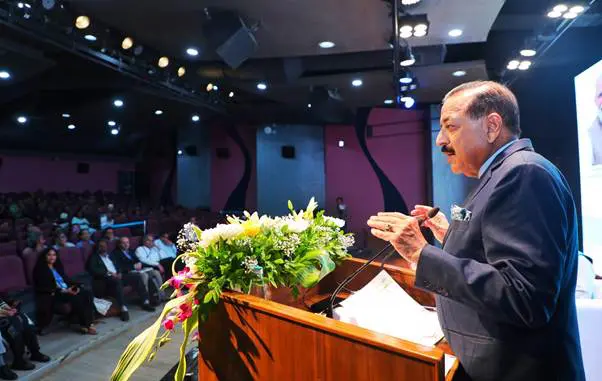
Union Minister Dr. Jitendra Singh announced the establishment of four state-of-the-art Quantum Fabrication and Central Facilities totaling ₹720 crore. These facilities will be located at IIT Bombay, IISc Bengaluru, IIT Kanpur, and IIT Delhi under the National Quantum Mission (NQM). IIT Bombay and Kanpur will focus on quantum sensing and metrology infrastructure, while IISc Bengaluru and IIT Bombay will advance quantum computing fabrication utilizing superconducting, photonic, and spin qubits; IIT Delhi will host quantum materials and device development. This initiative positions India among global leaders in next-generation quantum technologies, fostering a sovereign, secure, and scalable quantum hardware ecosystem.
₹720-Crore Investment in Quantum Fabrication & Facilities
A ₹720-crore investment will establish quantum fabrication and central facilities across four key institutions: IIT Bombay, IISc Bengaluru, IIT Kanpur, and IIT Delhi. This initiative, under the National Quantum Mission (NQM), aims to build indigenous quantum fabrication capacity and reduce India’s dependence on foreign quantum labs. The facilities will focus on quantum sensing, computing, and materials, creating a hardware ecosystem for sovereign, secure, and scalable quantum devices. These will be accessible to academia, industry, and strategic sectors nationwide.
IIT Bombay and IIT Kanpur will anchor the nation’s quantum sensing and metrology infrastructure, while IISc Bengaluru and IIT Bombay will advance quantum computing fabrication using superconducting, photonic, and spin qubits. IIT Delhi will host India’s quantum materials and device development ecosystem. This specialized infrastructure will allow for prototyping indigenous quantum devices and supporting translational research, alongside training a new generation of quantum hardware experts.
The ₹720-crore investment is intended to act as a springboard for India to build globally competitive quantum hardware, accelerating progress towards Prime Minister Modi’s vision of a “Viksit Bharat” by 2047. The Minister emphasized that these facilities will empower India to design, fabricate, and scale its own quantum technologies, ushering in an era of sovereign, secure, and world-class scientific innovation, comparable to the impact of India’s space achievements like Chandrayaan.
National Quantum Mission & Technology Development
The National Quantum Mission (NQM) is receiving a ₹720-crore investment to establish Quantum Fabrication and Central Facilities across four institutions: IIT Bombay, IISc Bengaluru, IIT Kanpur, and IIT Delhi. This initiative aims to reduce India’s reliance on foreign quantum labs by creating a domestic hardware ecosystem for quantum sensing, computing, and materials. These facilities will be accessible not only to NQM investigators but also to academic, industrial, and strategic sectors throughout India, fostering a broader base for quantum technology development.
IIT Bombay and IIT Kanpur will focus on quantum sensing and metrology infrastructure, while IISc Bengaluru and IIT Bombay will advance quantum computing fabrication utilizing superconducting, photonic, and spin qubits. IIT Delhi will host India’s quantum materials and device development ecosystem. This specialization aims to create a controlled environment for prototyping indigenous quantum devices, support translational research, and train a new generation of quantum hardware experts, ultimately building globally competitive quantum hardware.
The ₹720-crore investment, alongside initiatives like NM-ICPS and BharatGen, represent India’s commitment to deep-tech leadership and Atmanirbhar Bharat. The Minister highlighted that these facilities will empower India to design, fabricate, and scale its own quantum technologies, contributing to the vision of a Viksit Bharat by 2047. Furthermore, IIT Bombay’s Technology Innovation Hub currently supports 96 technology projects and over 50 deep-tech start-ups, demonstrating a robust innovation pipeline.
AI Initiatives: BharatGen & Digital Innovation
India’s BharatGen initiative is establishing the nation’s first sovereign multilingual AI models, capable of processing text, speech, and vision across 22+ Indian languages. This initiative, alongside applications like Krishi Sathi, e-VikrAI and Docbodh, demonstrates India’s growing leadership in AI and data sovereignty. BharatGen aims to foster inclusive digital innovation, positioning India as a key player in the development and deployment of AI technologies tailored to its diverse linguistic landscape.
A significant investment of ₹720 crore is being directed towards establishing Quantum Fabrication and Central Facilities across four premier institutions: IIT Bombay, IISc Bengaluru, IIT Kanpur, and IIT Delhi. This is part of the National Quantum Mission (NQM) and aims to reduce reliance on foreign quantum labs by building indigenous capabilities in quantum sensing, computing, and materials. These facilities will be accessible to academia, industry, and start-ups, fostering a national quantum hardware ecosystem.
IIT Bombay’s Technology Innovation Hub (TIH) under the National Mission on Interdisciplinary Cyber-Physical Systems (NM-ICPS) is a model for translational research. It currently supports 96 technology projects and over 50 deep-tech start-ups, with portfolio companies achieving a combined valuation of ₹466 crore. This demonstrates a successful pathway from research to market, highlighting the government’s commitment to fostering innovation and supporting the growth of India’s deep-tech sector.
India has emerged as one of the earliest nations to launch a National Quantum Mission, reflecting the government’s willingness to embrace disruptive ideas and rapidly translate them into national initiatives.


