

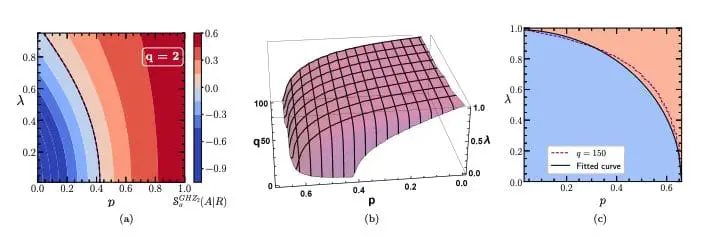
A study by researchers from the Indian Institute of Technology Dharwad has explored the separability in multiqubit systems with an accelerating qubit. Using Abe Rajagopal (AR) q-conditional entropy, the team found that pure multiqubit GHZ and W states remain nonseparable regardless of the qubits’ acceleration. The findings are significant for the field of relativistic quantum information, which combines general relativity and quantum information. The research could lead to a better understanding of quantum information properties of mixed states and impose stricter constraints on separability.
What is the Study About?
The study, conducted by Harsha Miriam Reji, Hemant Shreepad Hegde, and R Prabhu from the Department of Physics at the Indian Institute of Technology Dharwad, focuses on the separability in multiqubit systems with an accelerating qubit. The researchers used Abe Rajagopal (AR) q-conditional entropy to characterize the separability in both pure and mixed Greenberger-Horne-Zeilinger (GHZ) and W states with an accelerating qubit.
The researchers observed that the pure multiqubit GHZ and W states in the inertial and non-inertial bipartition, with one of their qubits being accelerated, will remain nonseparable irrespective of the qubits’ acceleration. They effectively captured the variation of their nonseparability with respect to the acceleration of the qubit and the AR q-conditional entropy parameter q.
What is the Significance of the Study?
The study is significant as it contributes to the field of relativistic quantum information, which is a fusion of two previously disjoint fields: general relativity and quantum information. The primary objective of this scientific domain is to integrate relativistic effects into quantum information tasks and study their performance.
The researchers’ findings provide necessary conditions for separability in multiqubit states with a relativistic qubit. This is crucial for quantum information tasks like quantum teleportation, quantum dense coding, and quantum key distribution, which consider certain essential properties present in quantum systems to be generally invariant during the realization of such quantum information protocols.
How was the Study Conducted?
The researchers initially considered a generalized pure 2-qubit Greenberger-Horne-Zeilinger (GHZ) state with one of its qubits under acceleration and characterized its non-separability in the inertial and non-inertial bipartition with respect to system parameters, acceleration of the qubit, and parameter q.
They introduced an eigenvalue truncation procedure to numerically handle the infinite eigenvalues in such systems. They then extended their non-separability characterization to the multiqubit pure GHZ and W states.
What were the Findings of the Study?
The researchers found that in the corresponding multiqubit mixed states obtained by introducing noise to the above pure states, one could get stronger conditions on their separability in the inertial and non-inertial bipartition in terms of the mixing parameter, acceleration of the qubit, and the number of qubits in the system in the asymptotic limit of parameter q.
These conditions, obtained from AR q-conditional entropy, serve as necessary conditions for separability in such multiqubit states with a relativistic qubit.
What are the Implications of the Study?
The study’s findings have implications for the characterization and quantification of entanglement in bosonic and fermionic modes when their subsystems are in non-inertial frames, entanglement near black holes, entanglement in an expanding universe, relativistic quantum metrology, discord in relativistic states, relativistic quantum teleportation, and relativistic quantum speed limit.
The researchers’ work could potentially lead to better understanding and exploration of the valuable quantum information properties of mixed states. This could impose stricter constraints on separability compared to those derived from the von Neumann conditional entropy alone.
qubit using a conditional entropy”
Publication Date: 2024-04-03
Authors: Harsha Miriam Reji, Hemant Shreepad Hegde and R. Prabhu
Source: arXiv (Cornell University)
DOI: https://doi.org/10.48550/arxiv.2404.02716


