Superconducting qubits represent a leading technology for building powerful quantum computers, but current designs often rely on limited materials for their critical components. Amrita Purkayastha, Amritesh Sharma, and Param Patel, all from the University of Pittsburgh, alongside collaborators at institutions including Yale University and the University of California, Santa Barbara, now present a new approach using tin as the superconducting material in a transmon qubit. This innovation overcomes limitations associated with traditional aluminium-based qubits and opens up possibilities for tailoring qubit properties, as the team demonstrates a frequency tuning range exceeding 3 GHz. The resulting devices exhibit promising coherence times, with energy relaxation lasting up to 27 microseconds, and suggest a pathway towards improved quantum circuit performance through advanced materials and design.
Superconductor qubits typically use aluminum-aluminum oxide tunnel junctions, but these suffer from unwanted energy loss, limiting performance. Recent advances in materials science enable the creation of high-quality structures from different materials, offering a promising alternative for improved Josephson junctions. This research investigates using bismuth selenide as a barrier material, aiming to suppress energy loss and enhance qubit coherence, paving the way for more robust and scalable quantum circuits.
InAs Nanowire Transmon Fabrication and Characterization
This supplementary material details the fabrication and characterization of superconducting qubits built using indium arsenide nanowires and tin junctions. The goal is to demonstrate the viability of this approach and understand factors limiting qubit coherence. The material provides detailed information about the multi-step fabrication process, including nanowire positioning and the creation of superconducting junctions. The experimental setup, incorporating dilution refrigeration and shielding, is described to highlight measures taken to minimize noise and maximize signal quality. Measurements of resonator quality factors reveal that loss is likely due to material imperfections.
Data for two qubits, labelled A and B, provides detailed spectroscopic and time-domain measurements. Qubit A demonstrates variations with gate voltage and drive power, exhibiting an average energy relaxation time (T1) of 23. 6 microseconds. Qubit B shows variations in resonator frequency and vacuum Rabi splitting, and a T1 of 4. 2 microseconds.
The difference in T1 suggests variations in junction quality or the surrounding environment. The asymmetric chevron pattern observed in Rabi oscillations for Qubit A indicates that charge dispersion may contribute to decoherence. This supplementary material supports the conclusions of the main paper and provides valuable insights into developing superconducting nanowire transmons.
Indium Arsenide Qubit Exhibits Tunable Coherence
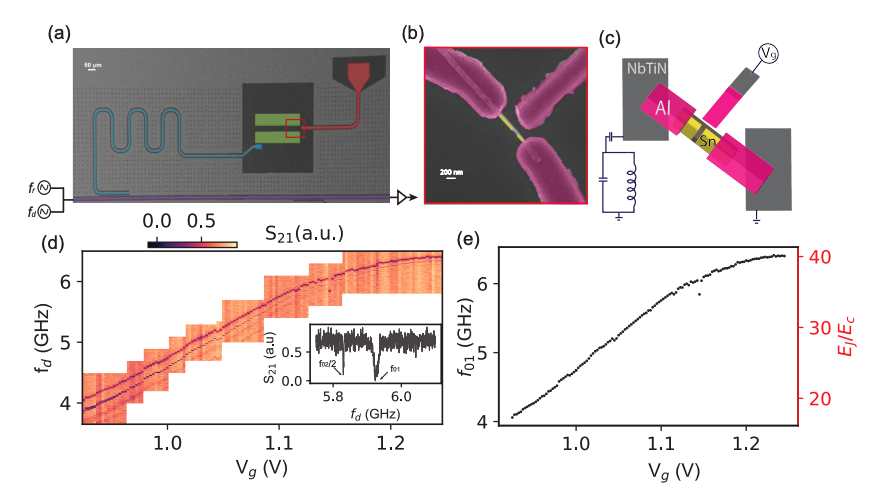
Researchers have developed a new superconducting qubit, moving beyond aluminum designs, and demonstrating promising coherence times. This qubit utilizes a combination of indium arsenide nanowires and a tin superconducting shell to create the junction controlling qubit behavior, offering a potential pathway to overcome limitations associated with aluminum. The team successfully demonstrated a gate-tunable qubit, meaning the qubit’s frequency can be adjusted over a substantial range of 3 GHz, providing greater flexibility for complex quantum circuits. This innovative design addresses a key challenge in superconducting qubits: operating temperature.
Aluminum-based qubits require extremely low temperatures and are susceptible to disruptions from external radiation; tin exhibits a larger superconducting gap, potentially allowing for operation at higher temperatures and increased resilience. The indium arsenide nanowire acts as a high-transparency barrier, facilitating the exploration of various superconductor combinations to optimize performance. The researchers achieved energy relaxation times (T1) of up to 27 microseconds, and dephasing times (T2) reaching 1. 8 microseconds, indicating the potential for maintaining quantum information for a useful duration.
While these coherence times are not yet superior to the best aluminum-based qubits, they represent a significant achievement for an alternative junction material, and demonstrate coherence in the tens of microseconds range. The ability to tune the qubit’s frequency via a gate voltage is a particularly valuable feature, enabling more complex interactions between qubits in a quantum processor. The team attributes current limitations to the substrate and the qubit cavity design, suggesting that improvements in these areas could further enhance performance. This research opens up exciting possibilities for materials exploration in quantum computing, moving beyond the constraints of aluminum. By utilizing indium arsenide nanowires as a template, researchers can efficiently prototype different superconductor combinations, paving the way for the development of more robust and versatile quantum technologies.
Tin Transmon Qubits Demonstrate Coherence and Control
This research demonstrates the successful fabrication and control of transmon qubits using tin as the superconducting material in the Josephson junctions, offering an alternative to traditional aluminum-based qubits. The qubits exhibit a frequency tunability of approximately 3 GHz, achieved through voltage control, and demonstrate coherence times comparable to existing aluminum devices. Specifically, the longest energy relaxation time (T1) measured 27 microseconds, while the longest echo dephasing time (T2) reached 1. 8 microseconds. The findings suggest that tin can effectively serve as a superconductor in qubit fabrication, potentially enabling new designs for scalable quantum circuits and broadening the understanding of materials science in quantum technologies.
The authors acknowledge that coherence times are influenced by factors such as eddy current dissipation and offset charge fluctuations, and identify several avenues for improvement, including optimizing materials, substrate selection, and measurement setups. Future work will focus on addressing these limitations and further enhancing qubit performance through refinements in nanowire growth and fabrication techniques. Data and code supporting these findings are publicly available to facilitate further research.
🗞 Transmon qubit using Sn as a junction superconductor
🧠 ArXiv: https://arxiv.org/abs/2508.04007