Quantum machine learning offers promising solutions to challenges in data science, and a new study explores how to improve learning when labelled data is limited. Hamed Gholipour from University of Beira Interior, Farid Bozorgnia from New Uzbekistan University, and Hamzeh Mohammadigheymasi from Harvard University, alongside their colleagues, present a hybrid approach to graph-based semi-supervised learning. Their work introduces two enhanced models, the Improved Laplacian Semi-Supervised Learning and the Improved Poisson Semi-Supervised Learning, which embed graph structure into quantum states using a technique called QR decomposition. The team validates these models on benchmark datasets, demonstrating consistent outperformance over classical methods, particularly when labelled data is scarce, and importantly, provides insights into how circuit complexity impacts learning quality on current quantum hardware. This research highlights the potential of quantum-enhanced machine learning to advance data-efficient classification, offering a pathway to overcome limitations in applications where obtaining labelled data is costly or difficult.
Recognizing the challenges of effectively propagating labels in datasets with limited labeled examples, researchers designed quantum-enhanced models to improve learning performance. This work moves beyond traditional methods by leveraging the principles of quantum mechanics to enhance the label propagation process, particularly in complex datasets where relationships between data points are crucial. Semi-supervised learning utilizes both labeled and unlabeled data for training, proving particularly useful when obtaining labeled data is expensive or time-consuming.
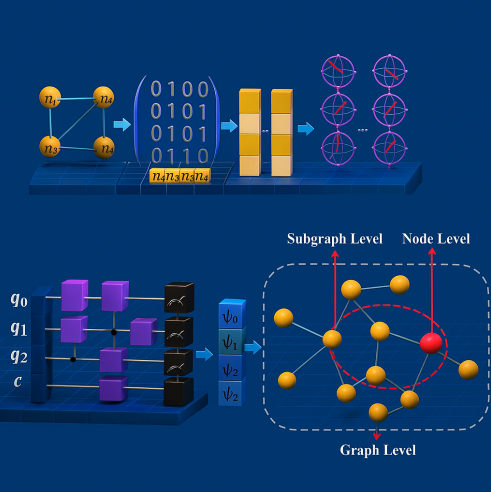
Graph-based semi-supervised learning represents data as a graph, where data points are nodes and relationships between them are edges, allowing algorithms to propagate labels from labeled nodes to unlabeled ones. This research applies quantum machine learning, utilizing quantum computers or quantum-inspired algorithms, to solve these machine learning problems. These circuits are specifically designed to embed the structure of a graph, representing data relationships, directly into quantum states, achieved through a mathematical technique called QR decomposition.
By encoding the graph structure into quantum states, the models aim to improve the accuracy and robustness of label propagation. The team tested these models on benchmark datasets including Iris, Wine, Heart Disease, and German Credit, demonstrating that the quantum-assisted approach outperforms traditional semi-supervised learning algorithms. A key innovation lies in addressing the limitations of conventional methods, which often struggle with extremely limited labeled data. Researchers hypothesized that quantum mechanics could provide a more effective way to propagate label information, even with minimal supervision.
To understand the impact of circuit complexity, the team investigated the role of entanglement and noise. They analyzed entanglement entropy and employed Randomized Benchmarking to assess how circuit depth and qubit count affect learning quality, revealing a trade-off between expressivity and stability on current quantum hardware. This careful analysis provides valuable insights into designing effective quantum circuits for machine learning applications.
Quantum Learning Boosts Limited Data Performance
Researchers have developed new quantum-enhanced methods for semi-supervised learning, particularly useful when labeled data is scarce. The team demonstrates that these approaches consistently outperform traditional semi-supervised learning algorithms across benchmark datasets including Iris, Wine, Heart Disease, and German Credit, especially when only a limited number of data points are labeled. The core innovation lies in embedding the structure of the data graph directly into quantum states, allowing the models to learn more effectively from limited supervision.
By encoding data relationships into quantum circuits, the researchers aim to enhance the ability to generalize from sparse data, a common challenge in many real-world applications. Importantly, the performance gains are not simply theoretical; the team rigorously tested the models on established datasets, achieving improved accuracy compared to classical methods. Beyond demonstrating improved performance, the study also investigates the impact of quantum circuit complexity on learning quality. Analysis reveals that while a degree of entanglement can enhance the model’s ability to generalize, increasing the complexity of the quantum circuit beyond a certain point can introduce noise that degrades performance on current quantum hardware.
This finding highlights the importance of carefully balancing expressivity and stability when designing quantum machine learning algorithms. The research provides valuable insights into the potential of quantum machine learning for data-efficient classification, offering a pathway towards more robust and accurate models in scenarios where obtaining large amounts of labeled data is impractical or costly. The team’s work not only advances the field of quantum machine learning but also offers practical guidance on how to design quantum circuits that can effectively balance the benefits of quantum effects with the limitations of current hardware.
Robust Quantum Learning with Limited Labels
This study introduces a quantum-classical approach to enhance graph-based semi-supervised learning, particularly when labeled data is limited. Evaluations across four datasets, Iris, Wine, Heart Disease, and German Credit, demonstrate that both models consistently outperform classical semi-supervised learning techniques. Notably, IPQSSL exhibited strong performance and robustness, especially with noisy or variable data, suggesting its potential for real-world applications where data quality and label availability are often challenging.
The research also investigated the impact of quantum circuit complexity on model performance, finding that while increased circuit depth can enhance representational capacity, it also introduces the risk of amplified noise. This highlights the need to carefully balance expressivity and stability when implementing these models on current quantum hardware. Future work will focus on extending these techniques to larger datasets, integrating active learning protocols, and exploring advanced error mitigation strategies to build more practical and scalable quantum machine learning systems.
👉 More information
🗞 Enhancement of Quantum Semi-Supervised Learning via Improved Laplacian and Poisson Methods
🧠 ArXiv: https://arxiv.org/abs/2508.02054