

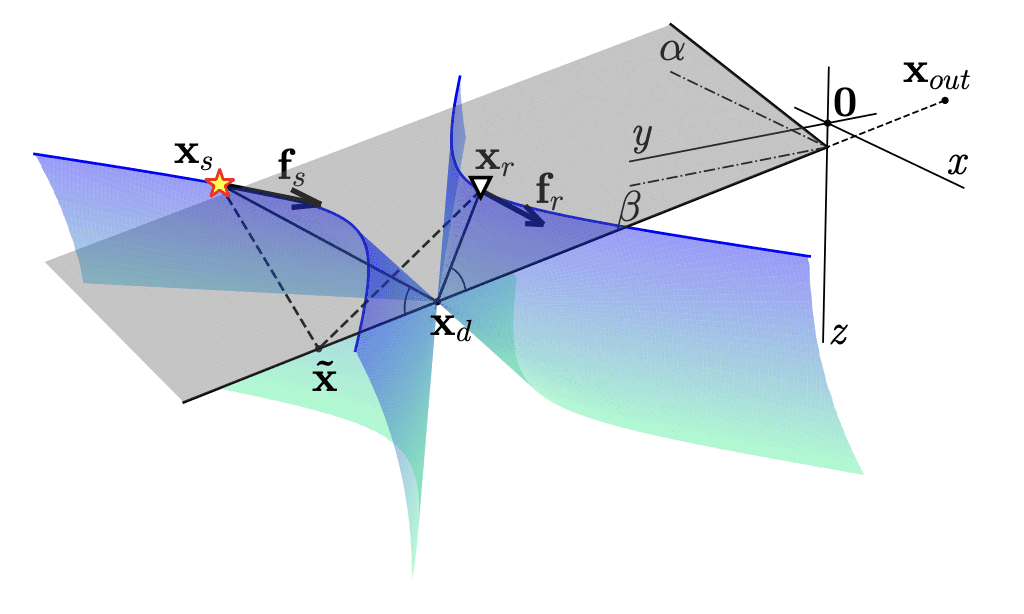
Underground structures, both natural and human-made, frequently scatter seismic waves, creating signals that reveal hidden details beneath the surface. Pavel Znak and Dirk Gajewski, from the Institute of Geophysics at the University of Hamburg, investigate how to better interpret these scattered signals, specifically those generated by the edges of underground objects. Their research demonstrates that analysing how traveltime changes with distance allows researchers to identify edge diffractions, which are distinct from simpler point-source diffractions, and accurately pinpoint the location of these edges. This improved ability to characterise edge diffractions promises to enhance the resolution of seismic imaging, leading to more detailed and accurate subsurface maps for applications ranging from geological exploration to archaeological surveys and engineering site investigations.
Diffraction is commonly categorised as either point or edge diffraction. Despite the prevalence of linear structures in geological formations and among buried anthropogenic objects, diffraction processing frequently relies on the concept of point diffraction. However, three-dimensional edge diffractions possess unique properties that require further investigation.
Diffraction Imaging for Complex Subsurface Structures
This body of research focuses on improving seismic imaging, particularly by harnessing and separating diffracted waves. Conventional seismic imaging often struggles with complex underground structures, such as faults and fractures, because the waves become scattered and distorted. Diffraction imaging specifically aims to image these discontinuities by analyzing waves that bend around them. The studies explore techniques for isolating diffracted waves from more dominant reflected and refracted waves, a challenging task due to differences in their arrival times and amplitudes. Researchers investigate wavefield subtraction, removing reflected and refracted components to reveal diffracted waves.
They also employ dip-angle gathers, analyzing data based on wave arrival angles, and wavefront attributes, using properties like curvature to identify and focus diffractions. Adaptive filters and shaping regularization further refine the clarity of diffraction images, ultimately creating clearer pictures of subsurface discontinuities. The research also delves into advanced wave propagation theory, moving beyond basic ray tracing to more sophisticated modeling of wave behavior, including diffraction from sharp edges and corners. Studies explore wave propagation in complex media where wave velocity varies, and techniques for imaging in situations with small differences between layers.
Mathematical and computational methods, such as Kirchhoff migration, common reflection surface stacking, and least-squares migration, are refined to better handle diffractions. Regularization techniques stabilize the imaging process and prevent artifacts. These advancements have applications in subsurface characterization, reservoir imaging, near-surface geophysics, and the detection of linear geological features. The field is moving towards integrating multiple techniques and prioritizing data quality to unlock a more detailed understanding of the Earth’s subsurface.
Edge Diffraction Reveals Underground Structure Details
Researchers have developed a new method for characterizing underground structures, both natural and artificial, using seismic and electromagnetic waves. The team discovered that analyzing how these waves diffract, or bend, around objects reveals crucial information about their size, shape, and orientation. Traditionally, diffraction processing treats underground anomalies as simple points, but this work demonstrates that considering structures as edges significantly improves accuracy and provides a more complete picture. The breakthrough lies in recognizing that three-dimensional edges produce unique diffraction patterns, distinct from those of point sources.
Scientists established that analyzing the rate of change of wave travel time, specifically mixed source-receiver traveltime derivatives, allows for the precise identification of these edge diffractions, regardless of their distance from sensors. This analysis reveals focusing curves on the earth’s surface, enabling data to be sorted and linked to specific points along the diffracting edge. Researchers derived a precise mathematical formula describing wave travel time from an edge in a simple geological setting, termed the “triple-square-root moveout” due to its mathematical complexity. Comparisons with standard moveout equations and wave modeling demonstrate the accuracy and potential of this new formula.
The triple-square-root moveout requires four parameters, wave velocity, edge dip angle, edge orientation, and the direction to the edge’s outcrop, but these can be determined by analyzing wave patterns at a single location. The research reveals that the shape of the wavefield above a buried edge is more complex than previously understood, exhibiting features like elliptic cones and hyperbolic sheets. Wave modeling confirms the accuracy of the triple-square-root moveout, demonstrating its potential for improved subsurface imaging and characterization in geological exploration, archaeological surveys, and engineering site investigations.
Edge Diffraction Analysis via Traveltime Derivatives
This research details how to better identify and interpret edge diffractions, a type of scattered wave generated by underground structures. The study demonstrates that analyzing specific properties of seismic and electromagnetic waves, specifically mixed source-receiver traveltime derivatives, allows for unambiguous identification of edge diffractions, distinguishing them from point diffractions and reflections. Importantly, the team showed that these edge diffractions can be broken down into smaller, independent sections, each focusing on a different point along the diffracting edge. Researchers derived a precise mathematical formula, termed the triple-square-root moveout, describing wave travel time from an edge in a simple geological setting.
This formula aligns with numerical simulations and confirms the unique characteristics of edge diffractions, potentially offering a more accurate approximation than existing methods in areas with gradual changes in wave velocity. The authors acknowledge that the derived solution applies specifically to a homogeneous medium and that further work is needed to explore its applicability in more complex, realistic geological scenarios. As technology for extracting wavefront attributes advances, these findings promise to improve wave processing techniques used in seismic surveys and ground-penetrating radar applications. This research provides a foundation for more accurate subsurface imaging and characterization, with potential benefits for a range of disciplines including geology, archaeology, and engineering.
👉 More information
🗞 Traveltime signature of 3-D edge diffractions exemplified by triple-square-root moveout
🧠 ArXiv: https://arxiv.org/abs/2508.19187


