

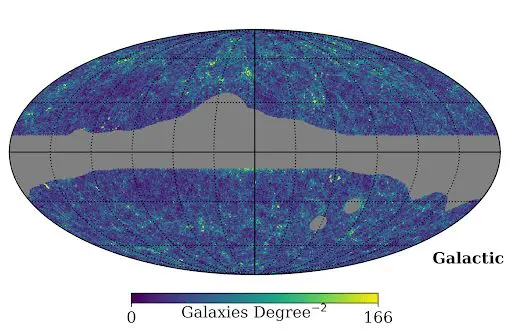
The IceCube Collaboration, comprised of international researchers, has presented findings from a ten-year analysis revealing no statistically significant clustering between high-energy neutrinos detected by the IceCube Neutrino Observatory and the distribution of galaxies. Utilizing the two-point angular cross-correlation function, the study analyzed data from the 1-cubic-kilometer Antarctic detector alongside a galaxy catalog tracing large-scale structure up to 3600 light-years, compiled from Wide-Field Infrared Survey Explorer and Two Micron All-Sky Survey observations. As detailed in a paper submitted to The Astrophysical Journal, these results—led by David Guevel (formerly University of Wisconsin–Madison, now Michigan Technological University)—suggest that observed neutrinos originate from sources beyond the surveyed volume or are not correlated with large-scale matter distribution.
IceCube’s Search for Neutrino-Galaxy Correlations
IceCube, a cubic-kilometer neutrino observatory buried in Antarctic ice, recently investigated potential correlations between high-energy neutrinos and the distribution of galaxies. Utilizing 10 years of data, researchers employed a “two-point angular cross-correlation” – a technique borrowed from cosmology – to search for clustering. The study cataloged galaxies up to 3600 light-years distant, leveraging infrared surveys like WISE and 2MASS to map large-scale matter distribution. This method aims to pinpoint if neutrinos originate from regions with a higher density of galaxies, hinting at shared source origins.
Despite rigorous analysis, the IceCube collaboration found no significant clustering between detected neutrinos and the galaxy catalog. This result is crucial because it challenges the hypothesis that numerous, faint neutrino sources follow the same large-scale distribution as galaxies. Researchers suggest neutrinos likely stem from more distant sources beyond the scope of the current infrared galaxy map—or potentially aren’t strongly correlated with large-scale matter at all.
The findings don’t negate the search for neutrino sources, but refine it. The IceCube-Gen2 upgrade, planned to expand detection volume, will be essential for identifying these elusive, distant origins. Understanding neutrino sources is vital; these particles offer a unique window into the most energetic phenomena in the universe—and potentially unveil details about dark matter and cosmic ray origins currently hidden from traditional telescopes.
Study Results and Future Implications
Recent analysis of a decade of data from the IceCube Neutrino Observatory reveals no statistically significant clustering between high-energy neutrinos and the distribution of galaxies up to 3600 light-years away. Employing the two-point angular cross-correlation function – a standard cosmological tool – researchers compared IceCube neutrino detections with a galaxy catalog compiled from infrared surveys (WISE & 2MASS). This null result challenges the hypothesis that neutrinos originate from the same large-scale structures as galaxies, suggesting alternative origins.
The findings don’t invalidate the search, but reshape the understanding of astrophysical neutrino sources. Currently, IceCube detects only a small percentage of expected neutrinos, and a correlation with galaxy distribution was one potential explanation. This study implies either the sources are beyond the 3600 light-year range probed by the galaxy catalog, or that neutrinos aren’t strongly tied to large-scale matter distributions—perhaps originating from more diffuse or exotic phenomena.
Future prospects are bright with the planned IceCube-Gen2 expansion. This upgrade will dramatically increase the detector’s volume, boosting sensitivity and enabling the identification of fainter, more distant neutrino sources. With enhanced capabilities, researchers hope to resolve the origin of these elusive particles and potentially map the cosmos using neutrinos, offering a complementary view to traditional electromagnetic observations.
The two-point angular cross-correlation function fundamentally measures the angular variance between two sets of points on the sky—in this case, the sky positions of detected neutrinos and cataloged galaxies. Mathematically, it probes the clustering signal, $\omega(\theta)$, which quantifies the likelihood that two objects, separated by an angle $\theta$, are co-located more frequently than expected purely by chance or isotropic background distribution. A positive, statistically significant value for this function would provide compelling evidence for a shared parent population or common astrophysical process generating both the neutrinos and the structured matter in the galaxy catalog.
From a technical standpoint, the detection of these high-energy neutrinos relies on observing the faint Cherenkov light generated when an incoming particle interacts with the Antarctic ice sheet. These interactions typically involve the conversion of the neutrino into a charged lepton (like a muon) or via neutral current interactions leading to cascades of secondary particles. The precise characterization of this faint light cone allows researchers to reconstruct the incoming neutrino’s energy spectrum and directional trajectory, providing directional information that is critical for source localization and distinguishing astrophysical signals from atmospheric backgrounds.
The primary challenge remaining in this field is source identification due to the vast and heterogeneous nature of cosmic particle acceleration mechanisms. Current modeling suggests that only extreme astrophysical environments—such as core-collapse supernovae, active galactic nuclei jets, or tidal disruption events—possess the requisite magnetic fields and energy gradients to accelerate charged particles up to ultra-high energies. The non-correlation observed compels theorists to explore exotic scenarios, including possible decay signatures from relic particle populations, or sources too diffuse or distant to be captured by the existing infrared galaxy map.


