At the inaugural IBM Quantum Developer Conference, IBM celebrated a milestone in quantum computing performance by delivering on a two-year-old challenge: achieving accurate computations on circuits with 100 qubits and gate depths of 100 and 5,000 two-qubit gate operations in under a day’s runtime.
This goal, known as the “100×100 challenge,” pushed quantum computing beyond classical simulation capabilities, opening doors for algorithm discovery and scientific research.
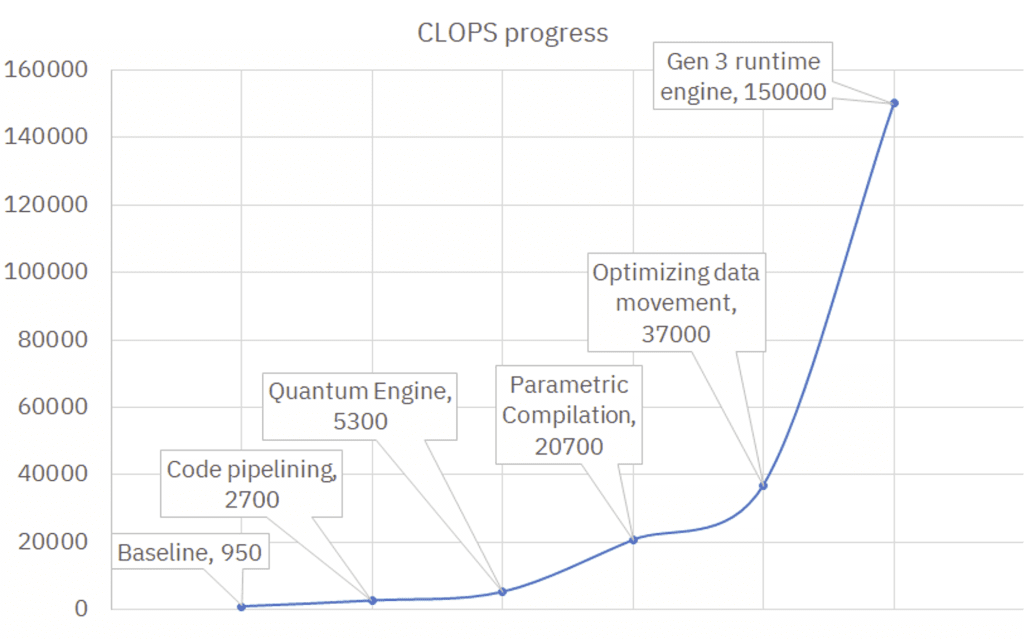
IBM’s breakthrough was powered by the second version of the IBM Quantum Heron chip, now featuring 156 qubits arranged in a heavy-hex layout. The updated chip integrates tunable couplers to suppress crosstalk and mitigate two-level system noise, enhancing performance stability. Alongside these hardware advancements, IBM has optimized its software stack, introduced parametric compiling for iterative circuits, and achieved speeds exceeding 150,000 circuit layer operations per second (CLOPS), significantly reducing runtime.
IBM’s advancements have made complex quantum experiments more accessible through Qiskit software tools, allowing users to replicate utility-level experiments 50 times faster than earlier tests. Additionally, Qiskit Functions provided by IBM’s startup partners extend capabilities further, supporting the development of algorithms designed to fully leverage this hardware’s power. This achievement represents a substantial leap forward in IBM’s hardware, middleware, and quantum algorithm research roadmap.
The company’s innovation roadmap includes developing new couplers to run gates across multiple quantum chips, with recent breakthroughs including the IBM Quantum Flamingo and IBM Quantum Crossbill systems. These advancements bring us closer to realizing error-corrected quantum computing at scale. Key players involved in this work include IBM, RIKEN, the Cleveland Clinic Foundation, Lockheed Martin, and Rensselaer Polytechnic Institute.
IBM Quantum Surpasses 5,000-Gate Challenge with Advanced Hardware and Software
IBM Quantum has achieved a significant milestone with successfully demonstrating circuits capable of running over 5,000 two-qubit gate operations, fulfilling its “100×100” challenge set in 2022. This challenge aimed to develop hardware and quantum algorithms well beyond the scope of classical simulation, pushing the boundaries of quantum advantage.
IBM’s updated Heron R2 chip is key to this accomplishment, which incorporates 156 qubits in a heavy-hex layout. This modular design, advanced noise-mitigation techniques, and tunable couplers enable greater operational stability and accuracy. To complement these hardware improvements, IBM enhanced its quantum software stack, optimizing data flow and introducing parametric compiling, which has accelerated execution speeds to over 150,000 circuit layer operations per second (CLOPS).
These advances now allow IBM Quantum users to replicate complex experiments rapidly and with greater reliability. Through Qiskit tools and the contributions of IBM’s startup partners, users can explore algorithms at the 5,000-gate level, fostering new possibilities in quantum research and algorithm discovery.
IBM Quantum’s New Tools Enhance Quantum Software and Accelerate Scientific Discovery
IBM Quantum has launched several advancements that make quantum computing more accessible, performant, and suitable for accelerating scientific research. As quantum devices reach computational capabilities beyond classical methods, IBM has focused on tools that enable researchers to develop algorithms that leverage quantum computing for computational advantage, particularly in tasks reliant on complex linear algebra.
Central to these developments is the Qiskit software stack, which has become more efficient with the release of Qiskit SDK v1.0 and new tools like the Qiskit Transpiler Service. This cloud-based service, enhanced with AI-driven optimizations, enables circuits to run with 30% greater depth efficiency, optimizing the execution of complex quantum routines.
The Qiskit Functions Catalog and Code Assistant, available to Premium Plan users, further simplify quantum software development. Modular Qiskit add-ons, such as the SQD addon developed from IBM and RIKEN’s work on quantum-centric supercomputing for chemistry, accelerate research outcomes. Institutions like the Cleveland Clinic Foundation have used these tools to conduct and publish advanced chemistry simulations in significantly reduced timelines.
These improvements underscore IBM Quantum’s commitment to equipping researchers with the tools needed to explore domain-specific applications and advance scientific discovery with quantum computing.
IBM Quantum Road Map
IBM Quantum’s latest roadmap updates showcase technological strides aimed at achieving error-corrected quantum computing at scale. A primary focus has been on multi-chip coupling innovations, with two new types: “l-couplers” for linking distant chips via cables, and “m-couplers” for tightly connecting adjacent chips. This year, IBM demonstrated l-couplers with the IBM Quantum Flamingo, which successfully connects two Heron R2 chips and performs CNOT gates across them. The anticipated production-ready Flamingo system is expected in 2025.
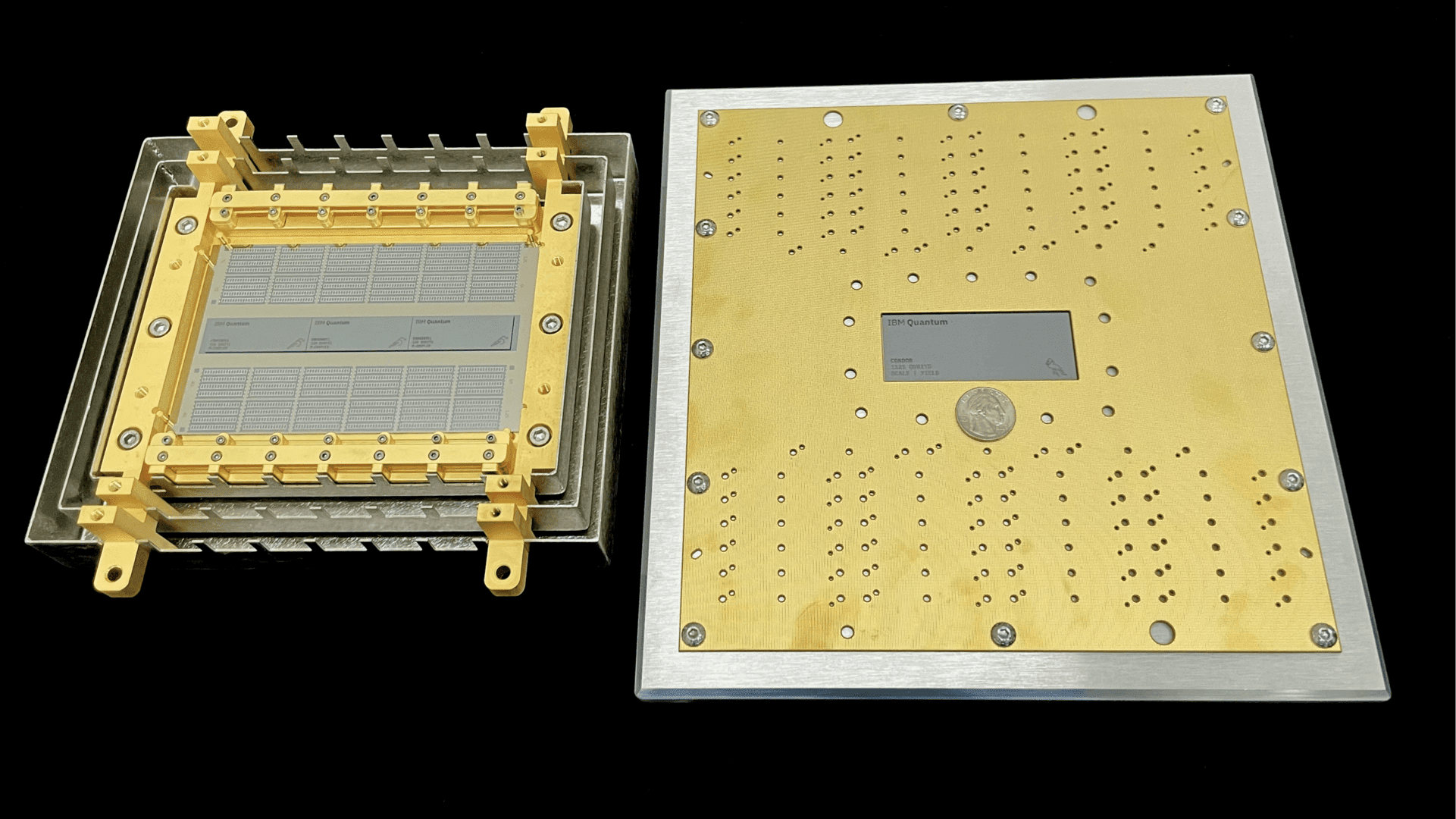
The m-couplers, featured in IBM Quantum Crossbill, allow seamless connections among three Heron chips, enabling high-quality two-qubit gates across a compact, silicon-packaged setup. With these m-couplers, Crossbill contains over 1,000 quantum elements, achieving a high qubit density in a reduced physical area compared to IBM Quantum Condor, IBM’s 1,121-qubit single-chip design.
IBM also announced work on “c-couplers,” connectors that link distant qubits within the same chip, necessary for the high connectivity required by a new error-correcting code. The first demonstration of c-couplers is planned with IBM Quantum Kookaburra in 2026.
Lastly, IBM’s quantum-centric supercomputing vision took a step forward with the first heterogenous workflow in a quantum environment. Partnering with Rensselaer Polytechnic Institute (RPI), IBM integrated its quantum and classical resources into a unified system managed by Slurm, an achievement marking a pivotal advance in workload management for quantum-enabled supercomputing.
External Link: Click Here For More