The seemingly impossible is inching closer to reality, as IBM announced significant leaps forward in the development of practical quantum computers today. Building on years of research, the company revealed new processors, software capabilities, and algorithmic breakthroughs designed to overcome the limitations of today’s machines, and ultimately achieve “quantum advantage”—the point where quantum computers outperform even the most powerful classical computers. These advancements, including the unveiling of the Nighthawk processor and progress toward fault-tolerant computing, aren’t just technical feats; they signal a potential revolution across fields like medicine, materials science, and artificial intelligence, promising solutions to problems previously considered unsolvable.
IBM Advances Towards Quantum Advantage
IBM is aggressively pushing towards “quantum advantage” – the point where quantum computers demonstrably outperform classical systems – targeting 2026. Their new IBM Quantum Nighthawk processor boasts 120 qubits and significantly increased connectivity with 218 couplers. This architecture allows for circuits with 30% more complexity than previous generations, capable of handling up to 5,000 two-qubit gates. IBM is collaborating with partners, contributing to an open quantum advantage tracker to rigorously validate these performance gains against classical methods.
Alongside the pursuit of advantage, IBM is laying the groundwork for fault-tolerant quantum computing, aiming for a functional system by 2029. The IBM Quantum Loon processor demonstrates all the necessary hardware components for error correction, including advanced routing layers connecting distant qubits. Crucially, IBM achieved a 10x speedup in error decoding – a year ahead of schedule – utilizing classical computing to correct errors in under 480 nanoseconds.
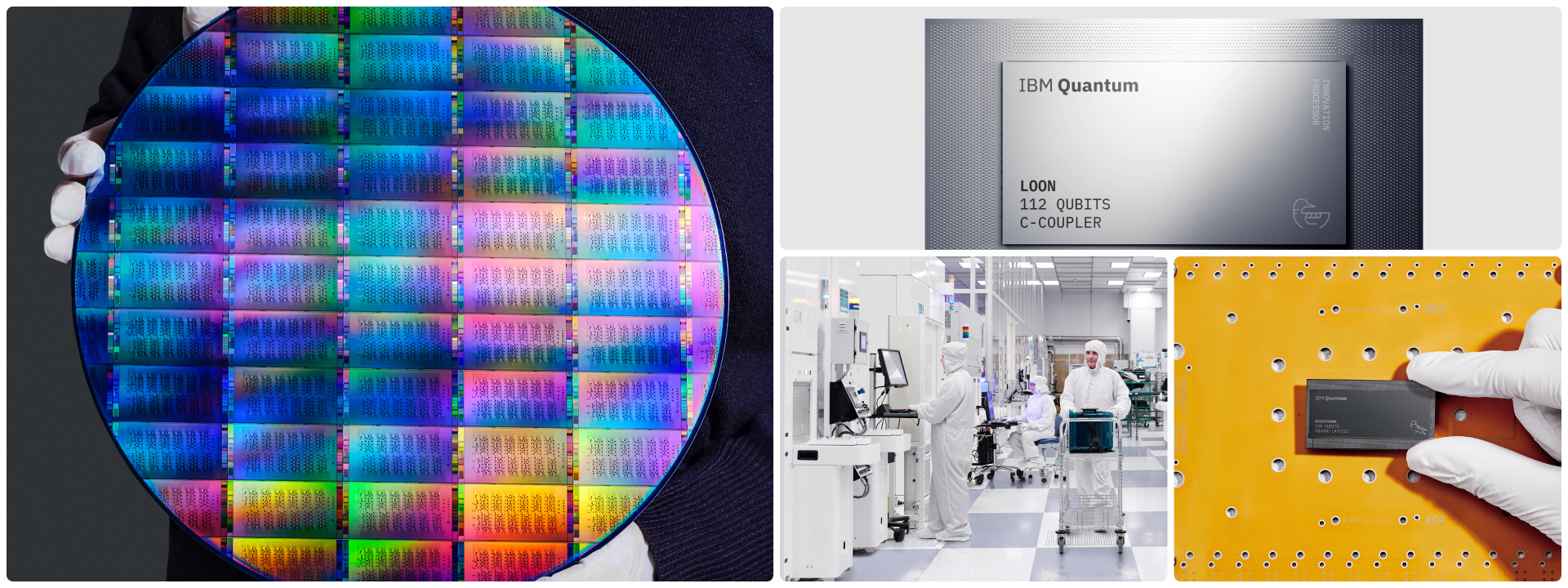
To accelerate development, IBM is transitioning quantum processor fabrication to a 300mm wafer facility. This shift, combined with architectural improvements, is expected to boost physical chip complexity by 10x – essential for scaling error correction. Software advancements are also key; Qiskit now offers 24% improved accuracy with dynamic circuits and over 100x cost reduction in extracting accurate results through HPC-powered error mitigation, bridging the gap between quantum hardware and practical applications.
New Qiskit Capabilities Enhance Quantum Control
IBM is significantly boosting quantum control through advancements in both hardware and software. The new IBM Quantum Nighthawk processor, slated for release in 2025, boasts increased qubit connectivity – 218 couplers, a 20% jump – enabling circuits with 30% more complexity while maintaining low error rates. This allows for tackling more computationally demanding problems, supporting up to 5,000 two-qubit gates, a critical metric for quantum computation, with future iterations aiming for 10,000+ gates by 2027.
Qiskit, IBM’s quantum software stack, is receiving key updates to enhance control and accuracy. Recent improvements deliver a 24% increase in accuracy for dynamic circuits at the 100+ qubit scale. Furthermore, a new HPC-powered error mitigation model, enabled by a C-API, reduces the computational cost of obtaining accurate results by over 100x. This blending of quantum and classical computing is vital for maximizing performance and scalability.
Alongside these improvements, IBM’s Quantum Loon processor demonstrates all necessary components for fault-tolerant quantum computing. Crucially, IBM achieved real-time error decoding (under 480 nanoseconds) using qLDPC codes – a year ahead of schedule. Combined with the shift to 300mm wafer fabrication, these milestones position IBM to deliver a large-scale, fault-tolerant quantum computer by 2029, accelerating progress beyond current capabilities.
Loon Processor Demonstrates Fault Tolerance Building Blocks
IBM has demonstrated key building blocks for fault-tolerant quantum computing with its “Loon” processor. This experimental chip showcases all necessary hardware components, including advanced routing layers enabling connections beyond nearest-neighbor qubits—a crucial step for scalable error correction. Importantly, IBM achieved real-time error decoding (under 480 nanoseconds) using qLDPC codes, a year ahead of schedule. This validates the potential to scale error correction on their superconducting qubit platform, paving the way for more reliable quantum computations.
The Loon processor’s architecture focuses on high-efficiency quantum error correction, a critical hurdle in quantum computing. By physically linking distant qubits on a single chip, and demonstrating rapid error decoding, IBM is tackling the challenge of maintaining quantum information integrity. This isn’t just about building more qubits; it’s about building qubits that can reliably perform calculations despite environmental noise and imperfections, bringing practical quantum computing closer to reality.
Beyond the processor itself, IBM is scaling its fabrication process to 300mm wafers—a move that will dramatically increase production capacity and complexity. This shift allows for a tenfold increase in the physical complexity of quantum chips needed for fault-tolerant error correction. Coupled with advancements in Qiskit software—including a 24% accuracy boost with dynamic circuits and over 100x faster error mitigation using HPC—IBM is addressing both hardware and software challenges simultaneously.
IBM Validates Quantum Error Correction Decoding
IBM recently announced a significant leap forward in quantum error correction decoding, achieving a 10x speedup over current leading approaches – a year ahead of schedule. This breakthrough, coupled with the new IBM Quantum Loon processor demonstrating all necessary hardware components for fault tolerance, positions the company strongly towards its 2029 goal of building a large-scale, fault-tolerant quantum computer. The rapid decoding is crucial for real-time error mitigation, a necessity for complex quantum computations.
The company’s new IBM Quantum Nighthawk processor is designed to deliver quantum advantage by the end of 2026. Nighthawk boasts 120 qubits with increased connectivity—over 20% more couplers than previous designs—allowing for circuits with 30% more complexity. This increased capability, potentially supporting up to 15,000 two-qubit gates by 2028, is being validated through collaboration with partners contributing to an open quantum advantage tracker.
IBM is also accelerating its fabrication process, transitioning primary wafer production to a 300mm facility. This shift will boost physical chip complexity by a factor of ten, crucial for scaling the quantum error correction needed for fault tolerance. Coupled with software improvements—Qiskit now offers a 24% accuracy increase with dynamic circuits and over 100x cost reduction in extracting accurate results—IBM is pushing boundaries on both hardware and software fronts.
Scaling Fabrication with 300mm Wafer Technology
IBM is dramatically scaling its quantum computing fabrication by transitioning to 300mm wafer production. This move represents a significant leap from smaller wafer sizes, enabling a projected 10x increase in physical chip complexity crucial for realizing fault-tolerant quantum error correction. The larger wafer size allows for more qubits and intricate connections per chip, accelerating development timelines and bringing IBM closer to its 2029 goal of a large-scale, fault-tolerant quantum computer. This fabrication shift is fundamental to building systems capable of handling the demands of complex quantum algorithms.
The new IBM Quantum Loon processor showcases all essential hardware components needed for fault-tolerant quantum computing. Key advancements include multi-layered, low-loss routing for extended qubit connections beyond nearest-neighbor coupling. Coupled with a breakthrough in error decoding – achieving real-time processing (under 480 nanoseconds) using qLDPC codes a year ahead of schedule – Loon validates a new architecture for scalable quantum error correction. This represents significant progress towards building practical, high-efficiency systems.
Alongside hardware advancements, IBM is boosting software capabilities with Qiskit. New dynamic circuit capabilities deliver a 24% accuracy increase at 100+ qubits, while HPC-powered error mitigation reduces result extraction costs by over 100x. A C++ interface powered by a C-API allows seamless integration into existing HPC environments. These software improvements, combined with 300mm wafer fabrication, position IBM to deliver both quantum advantage by 2026 and fault-tolerant computing by 2029.