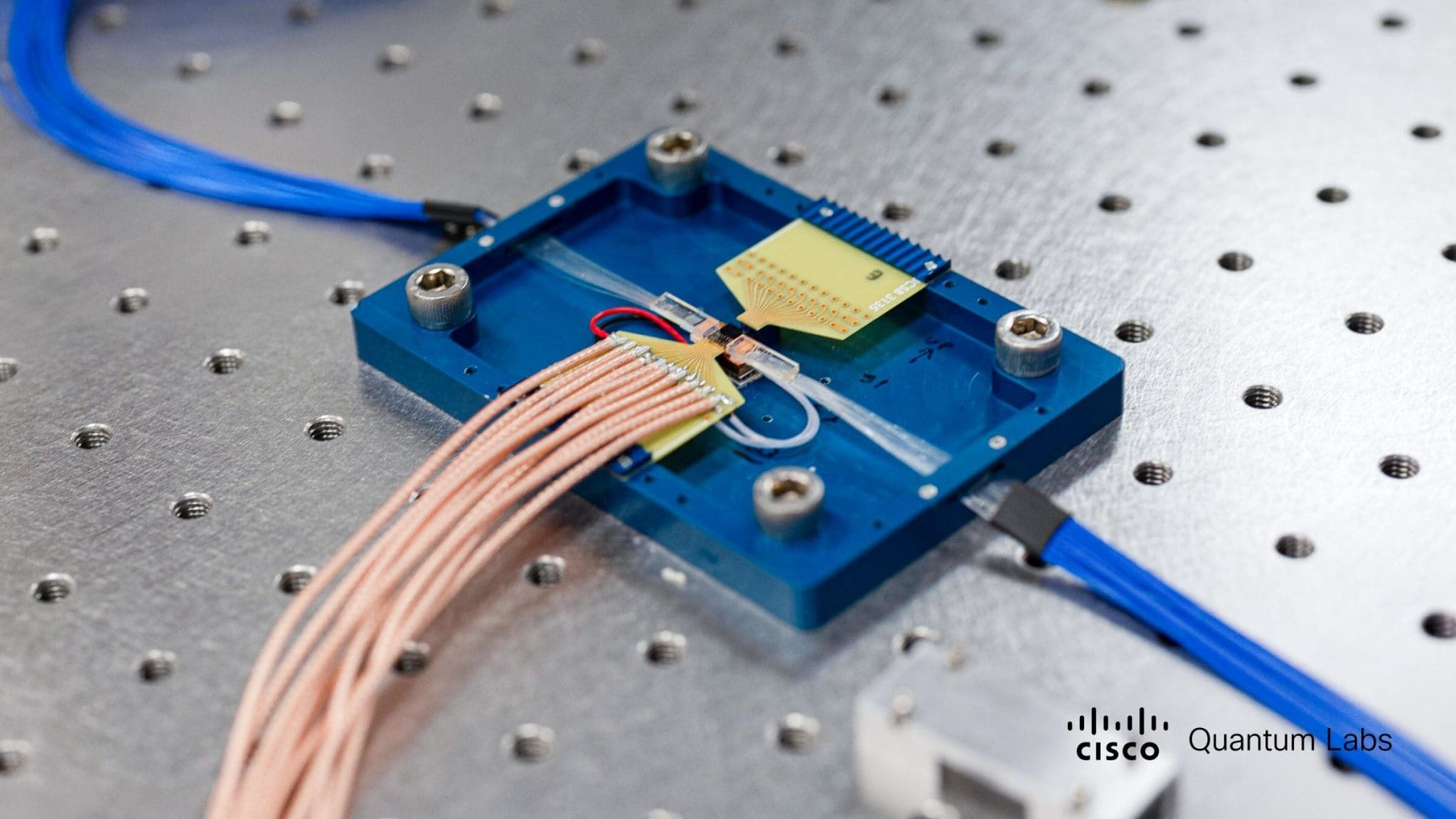
IBM and Cisco announced a collaborative intention to establish a network of large-scale, fault-tolerant quantum computers, targeted for realization in the early 2030s. The companies plan to combine IBM’s quantum computing leadership with Cisco’s quantum networking innovations to scale beyond IBM’s existing roadmap, exploring how to physically link multiple quantum processing units (QPUs). This distributed quantum network aims to demonstrate a proof-of-concept within five years, combining individual quantum computers capable of running computations over tens to hundreds of thousands of qubits and potentially trillions of quantum gates. This collaboration seeks to address fundamental challenges toward a future quantum computing internet.
Scaling a Distributed Quantum Computing Network
IBM and Cisco are collaborating to build a network of large-scale, fault-tolerant quantum computers, targeting an initial demonstration by the early 2030s. This network aims to link multiple quantum processing units (QPUs) – IBM’s quantum computers – enabling computations with potentially trillions of quantum gates. The companies plan to explore hardware and software solutions to physically connect these computers, ultimately scaling quantum computing beyond current capabilities and paving the way for more powerful applications like complex optimization and materials design.
The collaboration will focus on creating an interface, dubbed a quantum networking unit (QNU), to convert stationary quantum information within QPUs into “flying” quantum information for transmission across the network. Cisco aims to distribute entanglement resources on demand between these QNUs using a high-speed software protocol, dynamically reconfiguring network paths. An initial demonstration of multiple connected QPUs is planned within the next three years, with investigations into how many QNUs could be used within quantum data centers.
Looking further ahead, IBM and Cisco envision this network as a foundation for a quantum computing internet by the late 2030s. This future internet would connect quantum computers, sensors, and communication systems over vast distances – potentially planetary scale – enabling technologies like ultra-secure communications and precise environmental monitoring. Both companies plan to co-fund academic research to advance the broader quantum ecosystem and accelerate progress towards this ambitious goal.
The Foundation of a Quantum Computing Internet
IBM and Cisco are collaborating to build a networked distributed quantum computing system, with a target for an initial demonstration by the end of 2030. This effort aims to link large-scale, fault-tolerant quantum computers located in distinct cryogenic environments, requiring new connections like microwave-optical transducers and supporting software. The goal is to scale quantum computational power beyond individual machines and explore how to connect them for increasingly complex computations involving potentially trillions of quantum gates.
The companies envision this networked system as a foundation for a future quantum computing internet, potentially emerging by the late 2030s. This internet would connect distributed quantum technologies – computers, sensors, and communications – across distances, starting locally and potentially expanding to a planetary scale. Such a network could enable advancements like ultra-secure communications and precise monitoring of environmental factors, such as climate and seismic activity.
To facilitate this connection, IBM plans to develop a quantum networking unit (QNU) to interface with quantum processing units (QPUs), converting stationary quantum information into “flying” quantum information. Cisco is developing a quantum network to distribute entanglement resources on demand between these QNUs. They intend to use high-speed software to dynamically reconfigure network paths, enabling efficient quantum information transfer and bridging multiple QPUs within and between data centers.
At IBM, our roadmap includes plans to deliver large-scale, fault-tolerant quantum computers before the end of the decade.
Jay Gambetta, Director of IBM Research and IBM Fellow
IBM and Cisco Collaboration Goals
IBM and Cisco are collaborating to build a network of large-scale, fault-tolerant quantum computers, targeting realization by the early 2030s. This initiative combines IBM’s expertise in building quantum computers with Cisco’s innovations in quantum networking. The companies aim to demonstrate a proof-of-concept network within five years, initially linking individual quantum computers capable of running computations with potentially trillions of quantum gates – enabling complex problem-solving in areas like optimization and materials science.
The collaboration focuses on physically linking multiple large-scale quantum computers through novel hardware and software. Cisco envisions a quantum network infrastructure with a complete software stack designed to preserve quantum states and distribute entanglement with sub-nanosecond precision. IBM plans to develop a quantum networking unit (QNU) to interface with its quantum processing units (QPUs), converting stationary quantum information into “flying” quantum information for network transmission.
Ultimately, IBM and Cisco envision this work laying the groundwork for a quantum computing internet by the late 2030s. This future network would connect quantum computers, sensors, and communication systems, enabling technologies like ultra-secure communications and precise environmental monitoring. The companies also plan to co-fund academic research to further advance the broader quantum ecosystem and accelerate innovation in this field.
Quantum Hardware and Software Development
IBM and Cisco are collaborating to build a network of large-scale, fault-tolerant quantum computers, targeting an initial demonstration by the early 2030s. This involves linking individual quantum computers to enable computations with potentially trillions of quantum gates. The companies aim to demonstrate a proof-of-concept network within five years, utilizing IBM’s quantum processing units (QPUs) and Cisco’s quantum networking innovations to scale computational power beyond current limitations.
A key component of this development is the creation of a quantum networking unit (QNU) by IBM, designed to interface with QPUs. The QNU will convert stationary quantum information into “flying” quantum information, facilitating connections across multiple quantum computers. Cisco’s quantum network will distribute entanglement to these QNUs on-demand, supported by a high-speed software protocol for dynamic network reconfiguration, enabling efficient quantum information transfer.
Ultimately, this collaboration envisions a future quantum computing internet, potentially realized by the late 2030s. This network would connect quantum computers, sensors, and communications systems, enabling technologies like ultra-secure communications and precise environmental monitoring. IBM and Cisco also plan to co-fund academic research to advance the broader quantum ecosystem and accelerate development in this field.