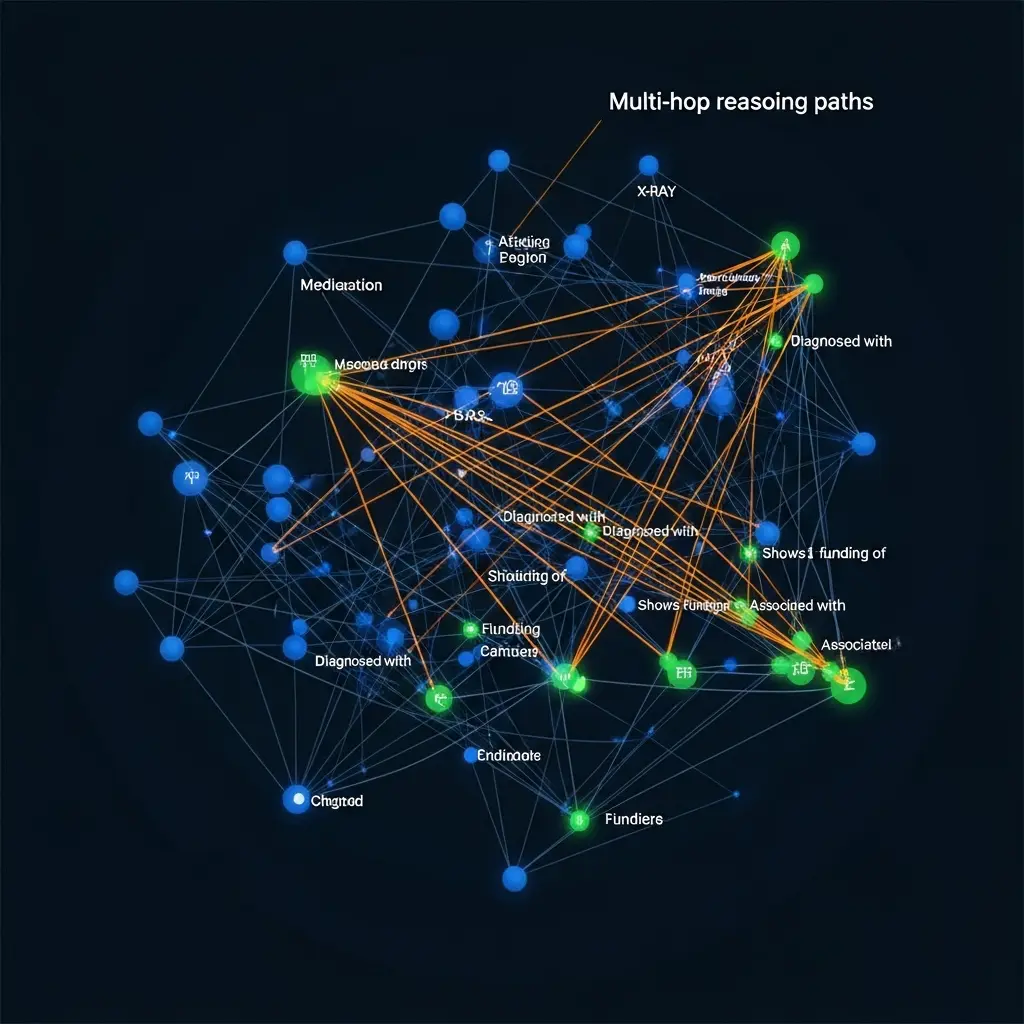
Automated clinical diagnosis presents a significant hurdle in modern medicine, demanding models capable of integrating diverse data and complex patient histories. Yuezhe Yang, Hao Wang, and Yige Peng, from the Institute of Translational Medicine at Shanghai Jiao Tong University, alongside Jinman Kim from the University of Sydney and Lei Bi, address this challenge with their novel HyperWalker framework. Their research tackles the limitations of current medical vision-language models (VLMs) which typically analyse cases in isolation, failing to leverage the wealth of information contained within longitudinal electronic health records (EHRs) and related patient data. By reformulating clinical reasoning through dynamic hypergraphs and a reinforcement learning agent , termed ‘Walker’ , HyperWalker dynamically constructs a network, ‘iBrochure’, to model complex relationships and identify optimal diagnostic pathways, achieving state-of-the-art performance on both medical report generation and visual question answering tasks.
This breakthrough reformulates clinical reasoning through dynamic hypergraphs and test-time training, enabling more accurate and contextually aware diagnoses. The team achieved this by constructing a dynamic hypergraph, termed iBrochure, to model the intricate relationships within EHR data and the implicit connections between various clinical factors.
Within this iBrochure hypergraph, a reinforcement learning agent, named Walker, intelligently navigates to pinpoint optimal diagnostic pathways. Walker learns to identify the most relevant evidence by balancing clinical relevance, consistency, and diversity, effectively mimicking how a physician synthesises information from multiple sources. To ensure comprehensive consideration of diverse clinical characteristics, the researchers incorporated a ‘linger mechanism’, a sophisticated multi-hop orthogonal retrieval strategy that iteratively selects clinically complementary cases reflecting distinct attributes. This innovative approach moves beyond simple similarity searches, allowing the model to consider a broader range of potential diagnoses and refine its reasoning process.
Experiments conducted on medical report generation (MRG) using the MIMIC dataset and medical visual question answering (VQA) on EHRXQA demonstrate that HyperWalker achieves state-of-the-art performance. The study unveils a significant advancement over existing methods, which typically operate under a sample-isolated inference paradigm, limiting their ability to leverage the wealth of information contained within EHRs. By integrating longitudinal data and employing a dynamic hypergraph structure, HyperWalker establishes a more robust and accurate diagnostic process, mirroring the holistic approach of human clinicians. The research establishes a new paradigm for medical VLMs, moving beyond simple alignment of visual and textual representations towards genuine diagnostic reasoning and effective knowledge utilisation. Furthermore, the incorporation of a test-time training mechanism allows HyperWalker to adapt to individual case nuances, bridging the gap between general medical knowledge and specific patient evidence. This work opens exciting possibilities for real-world clinical applications, promising to enhance diagnostic accuracy, reduce medical errors, and ultimately improve patient outcomes, code is freely available at https://github. com/Bean-Young/HyperWalker.
IBrochure Hypergraph Construction and Walker Navigation are key
Scientists developed HyperWalker, a Deep Diagnosis framework designed to overcome limitations in current medical vision-language models (VLMs) that typically operate under a sample-isolated inference paradigm. The research team addressed the need for integrating longitudinal electronic health records (EHRs) and structurally related patient examples into the diagnostic process, moving beyond reliance on image-derived information alone. Initially, they constructed a dynamic hypergraph, termed iBrochure, to model the structural heterogeneity of EHR data and capture implicit high-order associations among multimodal clinical information, effectively creating a comprehensive knowledge base. Within iBrochure, a reinforcement learning agent, Walker, was implemented to navigate the hypergraph and identify optimal diagnostic paths, mimicking the clinical reasoning process.
To ensure comprehensive coverage of diverse clinical characteristics, the study pioneered a ‘linger mechanism’, a multi-hop orthogonal retrieval strategy. This innovative technique iteratively selects clinically complementary neighborhood cases, reflecting distinct clinical attributes and enriching the diagnostic context. Experiments employed the MIMIC dataset for medical report generation (MRG) and the EHRXQA dataset for medical visual question answering (VQA), rigorously testing HyperWalker’s performance. The team trained Walker using a reinforcement learning approach, rewarding the agent for selecting paths leading to accurate diagnoses and penalising those that did not, refining its navigational abilities over time.
This method achieves state-of-the-art performance on both MRG and medical VQA tasks, demonstrating a significant advancement over existing approaches. The system delivers improved diagnostic accuracy by leveraging the interconnectedness of patient data within the iBrochure hypergraph. Furthermore, the researchers harnessed test-time training, enabling the model to adapt and refine its reasoning capabilities based on the specific characteristics of each new case encountered. The innovative combination of dynamic hypergraphs, reinforcement learning, and a multi-hop retrieval strategy enables HyperWalker to perform structured, multi-hop diagnostic reasoning, effectively bridging the gap between visual perception and evidence-based clinical decision-making. Code for the research is publicly available, facilitating further investigation and development in the field.
HyperWalker improves medical report generation significantly
Scientists achieved a breakthrough in automated clinical diagnosis with the development of HyperWalker, a Deep Diagnosis framework that reformulates clinical reasoning via dynamic hypergraphs and test-time training. Experiments revealed that HyperWalker constructs a dynamic hypergraph, termed iBrochure, to model the structural heterogeneity of electronic health record (EHR) data and implicit high-order associations among clinical information. Within this hypergraph, a reinforcement learning agent, Walker, navigates to identify optimal diagnostic paths, demonstrating a novel approach to clinical reasoning. Results demonstrate that on medical report generation (MRG) using the MIMIC dataset, HyperWalker achieves a BLEU-4 score of 4.98 and an F1-score of 29.69, representing a substantial improvement over MedGemma’s F1-score of 19.69.
The team measured that HyperWalker effectively leverages the Walker agent to distill relevant multimodal evidence, even when augmented with longitudinal EHR data, confirming the necessity of active graph-based filtering. Data shows the model’s resilience to data heterogeneity, as most baselines exhibited performance degradation when naively augmented with longitudinal EHR data. Tests prove that despite its relatively compact parameter size of approximately 4 billion parameters, HyperWalker surpasses much larger thinking models in generation quality. Specifically, while models like Qwen3-VL-Thinking require 86.56 seconds for inference, HyperWalker completes the diagnostic trajectory in only 4.66 seconds.
Measurements confirm this efficiency-accuracy trade-off, proving that recursive hypergraph navigation effectively replaces the need for massive chain-of-thought token generation. The breakthrough delivers a system that “walks” to the answer rather than “hallucinating” a reasoning path, avoiding computational overhead. Furthermore, the VQA results on EHRXQA show that HyperWalker reaches an accuracy of 70.43%, outstripping the next best medical model, Lingshu, by nearly 10%. The high METEOR score of 6.86 in open-ended VQA highlights the model’s ability to synthesize complex clinical evidence into precise natural language answers. Ablation studies revealed that removing X-ray inputs caused the most severe drop in performance, indicating that visual evidence is indispensable for accurate report generation. Removing knowledge nodes also led to noticeable declines in both BLEU-4 and F1, highlighting their role in maintaining clinical consistency.
Hypergraphs and Reinforcement Learning for Diagnosis
Scientists have developed HyperWalker, a new deep diagnosis framework addressing limitations in current medical vision-language models (VLMs). These models typically perform sample-isolated inference, meaning they analyse each case independently without utilising longitudinal electronic health records (EHRs) or related patient data. HyperWalker overcomes this by reformulating clinical reasoning through dynamic hypergraphs and test-time training, enabling a more holistic approach to diagnosis. Researchers constructed a dynamic hypergraph, termed iBrochure, to model the complex structure of EHR data and the relationships between clinical information.
Within this hypergraph, a reinforcement learning agent, Walker, navigates to identify optimal diagnostic paths, aided by a ‘linger mechanism’ which retrieves clinically complementary cases to reflect diverse attributes. Experiments on medical report generation (MIMIC) and medical visual question answering (EHRXQA) demonstrate that HyperWalker achieves state-of-the-art performance, surpassing existing models in both accuracy and efficiency. The findings establish that integrating EHR data and comparative evidence significantly improves diagnostic reasoning. Ablation studies confirm the importance of each component, with diversity-related rewards enhancing factual accuracy and depth/hop-related rewards improving exploration efficiency. However, the authors acknowledge a limitation in the model’s reliance on the quality and completeness of EHR data, as gaps or inaccuracies could impact performance. Future research could explore methods to mitigate these data-related challenges and extend the framework to encompass a wider range of medical specialties and data modalities, potentially leading to more robust and generalisable diagnostic tools.
🗞 HyperWalker: Dynamic Hypergraph-Based Deep Diagnosis for Multi-Hop Clinical Modeling across EHR and X-Ray in Medical VLMs
🧠 ArXiv: https://arxiv.org/abs/2601.13919