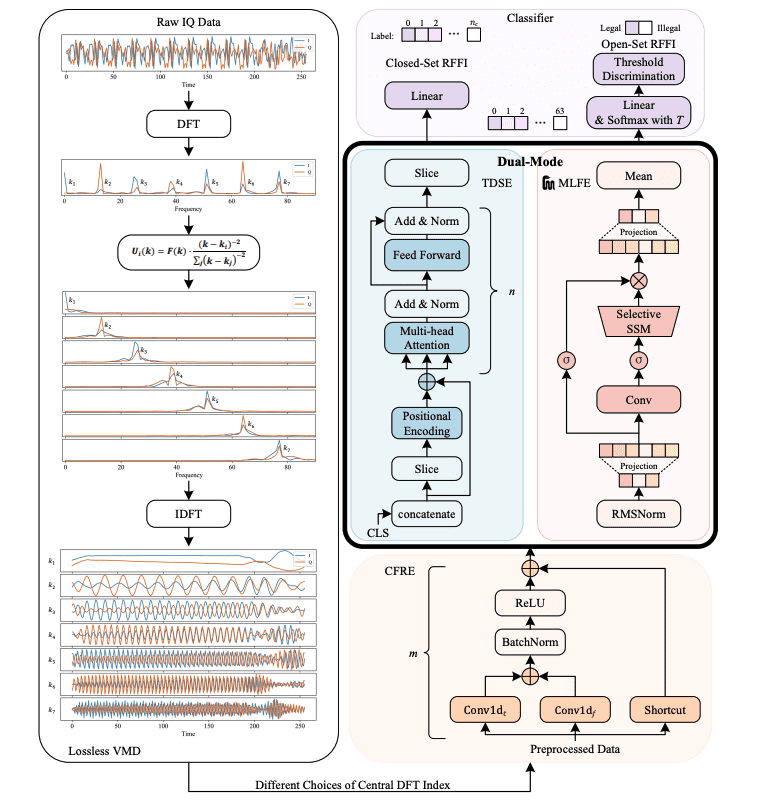
Securing wireless communication relies increasingly on identifying individual devices, and researchers are now exploring methods beyond traditional cryptography. Hanwen Liu, Yuhe Huang, and Yifeng Gong, along with their colleagues, present a new approach to Radio Frequency Fingerprint Identification (RFFI) called HyDRA, a Hybrid Dual-mode RF Architecture. This innovative system leverages the unique ‘fingerprints’ present in radio signals, caused by subtle hardware imperfections, to distinguish between authorized and unauthorized devices. By combining advanced signal processing with a novel neural network architecture, integrating Convolutional Neural Networks, Transformers, and Mamba components, HyDRA achieves both highly accurate identification in controlled environments and robust performance when encountering previously unseen devices. The team demonstrates that HyDRA not only surpasses existing methods in accuracy but also operates with sufficient speed and efficiency for real-time wireless authentication, offering a practical solution for enhancing security in a connected world.
Radio Fingerprints Secure Wireless Device Identification
The increasing prevalence of wireless communication networks presents significant security challenges, particularly in authenticating devices and preventing unauthorized access. Radio Frequency Fingerprint Identification (RFFI) offers a promising alternative by uniquely identifying devices based on subtle, hardware-induced distortions in their radio signals, essentially creating a ‘fingerprint’ for each device. These distortions, stemming from manufacturing variations, provide a means of authentication independent of passwords or encryption. Current RFFI methods often struggle with noisy signals, adapting to complex wireless environments, and recognizing new, unauthorized devices.
Existing methods also frequently focus on ‘closed-set’ testing, leaving them vulnerable in real-world scenarios. To address these limitations, researchers have been exploring more sophisticated signal processing techniques and network architectures. Recent advancements include utilizing Variational Mode Decomposition (VMD) to refine signal analysis and improve accuracy, but conventional VMD can introduce errors and become computationally expensive with large datasets. Recognizing these challenges, a new framework called HyDRA has been developed to enhance both the efficiency and security of RFFI. HyDRA integrates an optimized VMD technique to minimize signal distortion and computational cost, alongside a novel network architecture that combines the strengths of convolutional networks, transformers, and a new type of processing unit called Mamba. This dual-mode design allows the system to dynamically adapt to varying conditions, prioritizing either high precision or high efficiency as needed, and enabling robust open-set classification for improved security in dynamic wireless environments.
Deep Learning for Robust Wireless Device Identification
Researchers developed HyDRA, a novel system for identifying wireless devices by analyzing unique distortions in their radio signals. Recognizing the limitations of traditional methods, the team adopted a deep learning approach to automatically extract identifying characteristics from the wireless transmissions, allowing for robust identification even in complex and congested wireless environments. The methodology begins with signal processing using Variational Mode Decomposition (VMD), an adaptive technique that breaks down complex signals into simpler components, enhancing clarity and reducing noise. This optimized VMD fixes center frequencies and employs closed-form solutions, improving both efficiency and accuracy in preparing the radio signals.
HyDRA then employs a sophisticated neural network architecture combining Convolutional Neural Networks (CNNs), Transformers, and Mamba components. CNNs excel at identifying local patterns within the signal, while Transformers capture long-range dependencies. The innovative addition of Mamba, a recently developed linear flow encoder, further enhances efficiency by processing data with linear complexity, allowing the system to adapt to varying signal conditions and maintain speed. To improve performance on real-world datasets, the team developed the Transformer Dynamic Sequence Encoder (TDSE) and the Mamba Linear Flow Encoder (MLFE). These components work in tandem to model global dependencies and process data efficiently, enabling the system to accurately identify devices even in large-scale deployments. Furthermore, HyDRA is designed to perform both closed-set identification and open-set identification, providing a more comprehensive security solution.
Hybrid Deep Learning Identifies Wireless Devices
HyDRA represents a significant advance in radio frequency fingerprint identification (RFFI), offering a non-cryptographic method for access control and device authentication. The research team developed a hybrid architecture that combines optimized signal processing with advanced deep learning techniques to achieve state-of-the-art performance in both identifying known devices and detecting unauthorized ones. A key innovation lies in the optimized Variational Mode Decomposition (VMD) process, which efficiently breaks down complex radio signals into simpler components. Previous methods for signal decomposition often struggled with adaptability and accuracy, particularly in dynamic environments.
HyDRA’s approach fixes the center frequencies during decomposition, using a closed-form solution that avoids information loss and ensures robust performance even with varying signal conditions. The core of HyDRA’s intelligence lies in a dual-mode neural network, leveraging the strengths of both Transformer and Mamba encoding techniques. Transformers excel at modeling long-range dependencies within the signal, while Mamba offers efficient processing of sequential data. By integrating these architectures, HyDRA can accurately capture both transient characteristics and steady-state features, providing a comprehensive fingerprint for each device.
In testing, HyDRA achieved significantly improved accuracy compared to existing methods. Notably, HyDRA demonstrates robust performance in open-set classification, meaning it can reliably identify not only devices it has been trained on, but also detect previously unseen, potentially malicious devices. Furthermore, the system is designed for efficient deployment on embedded devices like the Jetson Xavier NX, achieving millisecond-level inference speed with low power consumption, making it suitable for real-time wireless authentication in a variety of settings.
HyDRA Achieves Robust RF Fingerprint Identification
This research introduces HyDRA, a novel hybrid dual-mode RF architecture designed to improve Radio Frequency Fingerprint Identification (RFFI). HyDRA addresses challenges in dynamic and open-set environments by combining an optimized Variational Mode Decomposition (VMD) technique with a system leveraging both Transformer-based and Mamba-based encoding, while the adaptable architecture allows robust performance across varying conditions. Testing on publicly available datasets demonstrates HyDRA’s high accuracy in identifying known devices and its ability to reliably classify unauthorized devices in open-set scenarios. Importantly, the system achieves millisecond-level inference speeds and low power consumption when deployed on an NVIDIA Jetson Xavier NX, indicating its practicality for real-time wireless authentication in real-world applications. Future work will focus on integrating HyDRA with antenna systems to enable real-time signal processing and classification, moving beyond reliance on preprocessed datasets.
👉 More information
🗞 HyDRA: A Hybrid Dual-Mode Network for Closed- and Open-Set RFFI with Optimized VMD
🧠 DOI: https://doi.org/10.48550/arXiv.2507.12133