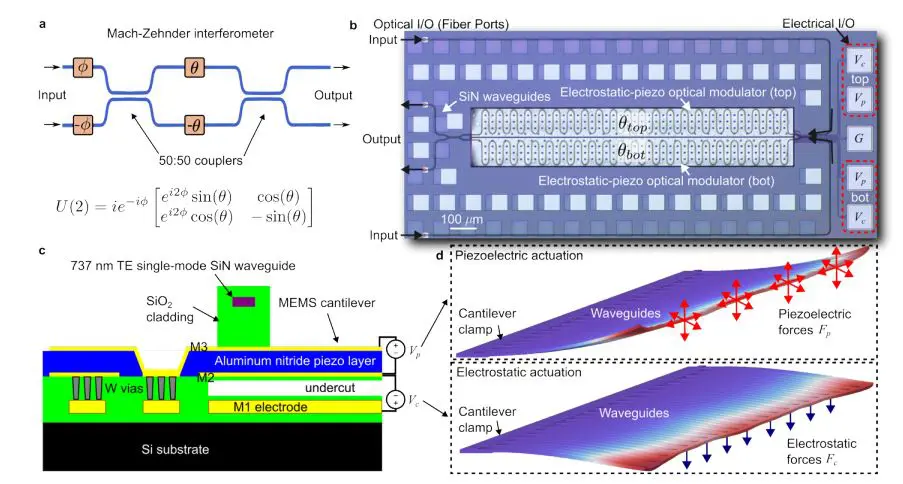
Programmable photonic integrated circuits represent a rapidly developing technology with significant implications for information science and artificial intelligence, and researchers are increasingly focused on creating efficient and versatile modulators for these circuits. Thuy-Linh Le, Hardit Singh, and Julia M. Boyle, alongside colleagues at The MITRE Corporation and Sandia National Laboratories, demonstrate a novel modulator design that combines piezoelectric and electrostatic forces to achieve precise control of light on a silicon nitride chip. This hybrid approach enables both slow, fine-tuned adjustments and rapid, high-speed modulation exceeding 20MHz, with dynamically adjustable mechanical resonances between 25 and 40MHz. The team’s work reveals how carefully engineered geometric nonlinearities allow the device to operate in different modes, offering a pathway towards scalable, energy-efficient programmable photonic circuits for applications like high-speed optical switching and optomechanical systems.
Hybrid Modulator Experimental Details and Setup
Scientists developed a hybrid electrostatic-piezoelectric modulator, a component for integrated photonic circuits, and meticulously documented the experimental setup and characterization process. The research focused on three cantilever designs, differing in width and overhang length, which influenced their mechanical properties. Detailed measurements of capacitance and frequency response revealed that the cantilever with the shortest overhang and widest width consistently outperformed the others, achieving stronger actuation with lower required voltages, likely due to a more consistent fabrication process and favorable mechanical response. The study highlights the importance of precise fabrication control and cantilever geometry in maximizing modulator efficiency.
Photonic Modulator Control Using Hybrid Actuation
Researchers engineered a programmable photonic integrated circuit incorporating a cantilever optical modulator, achieving precise control of light through a combination of piezoelectric and electrostatic forces. Fabricated on a silicon nitride platform, the device demonstrates both quasi-static modulation up to 10kHz at a low voltage and high-speed AC modulation exceeding 20MHz. Experiments characterized the individual responses of piezoelectric and electrostatic control, revealing that piezoelectric actuation switches much faster. By combining these forces, the team observed a primary resonance around 23MHz, crucial for achieving optical phase shifts, which finite-element simulations confirmed aligned with the device’s physical structure.
Fast Optical Modulation via Integrated Cantilever Device
Scientists achieved a breakthrough in programmable photonic integrated circuits by developing a cantilever optical modulator that combines piezoelectric and electrostatic tuning forces on a silicon nitride platform. This innovative device demonstrates quasi-static tuning of visible-wavelength light up to 10kHz at a low energy cost, alongside high-speed AC modulation exceeding 20MHz. Detailed characterization revealed that piezoelectric actuation provides fast, linear modulation, while electrostatic actuation offers efficient switching through different mechanical regimes. Measurements showed dynamically adjustable mechanical resonances ranging from 25 to 40MHz, opening new possibilities for high-speed optical switching and optomechanical systems, and finite-element simulations validated the understanding of the underlying mechanisms.
Tunable Modulation via Integrated Silicon Nitride Photonics
This research demonstrates a new integrated optical modulator based on a silicon nitride platform, combining piezoelectric and electrostatic forces to control light. The device achieves both static modulation at 10kHz with low energy consumption and high-speed modulation exceeding 20MHz, offering flexibility for various applications. Importantly, the team identified how geometric factors influence the device’s mechanical resonances, allowing for tunable performance characteristics and optimized switching speeds. The successful fabrication of this modulator represents an advance in foundry-processed microelectromechanical systems photonics, particularly for visible wavelengths and cryogenic environments, and future work will focus on improving fabrication processes and tailoring cantilever geometry to enhance device efficiency and reduce operating voltages.
🗞 Hybrid electrostatic-piezo MEMS photonic integrated modulators
🧠 ArXiv: https://arxiv.org/abs/2512.12383