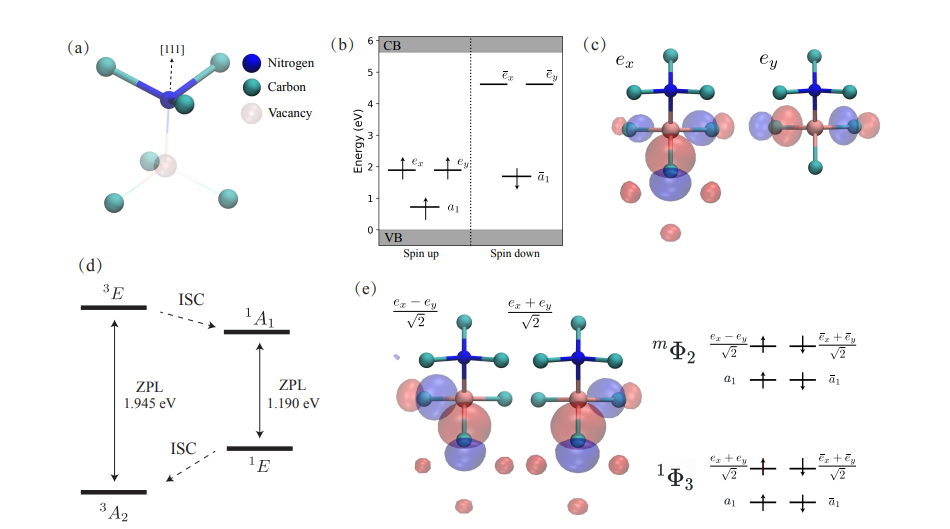
The pursuit of stable quantum states within diamond, a material increasingly vital for emerging technologies, drives ongoing research into defects within its structure. Lei Sun from Peking University, alongside Elvar Örn Jónsson and Hannes Jónsson from the University of Iceland, and their colleagues, now present calculations that significantly improve our understanding of the excited states of the negatively charged nitrogen-vacancy (NV) centre. Their work employs a sophisticated computational approach to determine the energies of these excited states, incorporating the effects of atomic relaxation, and achieves remarkable agreement with experimental measurements, differing by less than 0. 1 electron volts. This advancement, building on previous calculations, demonstrates the power of accurate computational modelling to predict and refine the properties of quantum defects, paving the way for the identification of new materials suitable for quantum technologies.
NV Center Excited States via Optimized DFT
This research details a computational study of the nitrogen-vacancy (NV) center in diamond, focusing on accurately calculating its electronic structure and excited states. The authors present a novel methodology combining advanced density functional theory (DFT) calculations with a direct optimization approach for excited states, addressing a critical need for precise modeling of this promising qubit candidate for quantum technologies. Traditional computational methods often struggle with the complex electronic structure of this defect. The team employed DFT calculations using various exchange-correlation functionals, including SCAN and hybrid functionals, to model the NV center’s electronic structure.
They then utilized a direct energy minimization approach to directly converge on the excited state wavefunctions, overcoming the limitations of conventional methods. This calculation relies on the variational principle, ensuring energetically stable solutions. The results demonstrate that this methodology accurately reproduces experimentally measured excited state energies of the NV center. The choice of exchange-correlation functional significantly impacts the accuracy of the calculations, with SCAN and hybrid functionals generally performing better than traditional functionals. The study confirms the multiconfigurational nature of the NV center’s electronic structure, highlighting the importance of considering electron correlation effects.
Calculations also provide insights into the Jahn-Teller effect, which influences its geometry and electronic properties. This research provides a more accurate and detailed understanding of the NV center’s electronic structure and excited states, contributing to the development of more efficient and reliable quantum devices. The presented methodology offers a valuable tool for studying other complex defects and materials, paving the way for a deeper understanding of its properties and its potential applications in quantum technologies.
Excited State Energies of NV− Defects in Diamond
Scientists developed a novel computational approach to accurately model the excited electronic states of the negatively charged nitrogen-vacancy (NV−) defect in diamond, a system crucial for emerging quantum technologies. The study pioneers the use of time-independent variational calculations combined with the HSE06 hybrid density functional, delivering significantly improved accuracy compared to previously used local and semi-local functionals. This technique directly optimizes orbitals to determine excited state energies, providing a robust pathway to calculate energies beyond the ground state. To achieve precise results, researchers employed the direct orbital optimization combined with the maximum overlap method (DO-MOM), a strategy designed to reduce computational cost and accelerate convergence.
The DO-MOM method guides calculations towards specific excited states or utilizes gradient projections to converge on saddle points, proving particularly effective for systems with challenging electronic structures. The variational nature of the solution ensures compliance with the Hellmann-Feynman theorem, enabling the calculation of nuclear forces for excited-state geometry optimizations and dynamics. The team meticulously calculated both vertical and adiabatic excitations of the NV− center, also assessing structural relaxation in the excited states. They performed structural relaxations at the same theoretical level as the excitation energy calculations, utilizing spin-purified atomic forces to optimize the structure of the 1E singlet state.
The resulting zero-phonon line (ZPL) energies and relaxation energies in the 3E triplet state demonstrate excellent agreement with available experimental estimates, falling within 0. 1 eV of experimental values. Analysis of atomic displacements in both the 1E and 3E states, compared with known Jahn-Teller distortions, further validates the predicted structural relaxations and confirms the accuracy of the computational approach. This work establishes a powerful screening tool for identifying other defect systems suitable for quantum technologies.
NV Center Excited State Energies Accurately Modeled
Scientists achieved a significant breakthrough in modeling the electronic structure of the nitrogen-vacancy (NV−) center in diamond, a promising system for quantum technologies. The team performed time-independent variational calculations of excited electronic states using a hybrid density functional, specifically HSE06, and a direct orbital optimization method, accurately determining the energies of the triplet excited state and the two lowest singlet states relative to the ground triplet state. Results demonstrate that structural relaxation lowers the energy of the triplet excited state by an amount within 0. 1 eV of experimental estimates, yielding a zero-phonon line triplet excitation energy consistent with observation.
The study also modeled structural relaxation in the lower energy singlet state, utilizing spin-purified atomic forces, and estimated a lowering of energy by 0. 06 eV. These calculations represent an improvement over previous work employing local and semi-local functionals, which are known to underestimate the band gap of diamond. The team’s approach successfully calculates the energies of excited states while simultaneously optimizing the atomic structure, addressing a key challenge in accurately modeling defects. Measurements confirm that the calculated energy levels align with experimental data, validating the accuracy of the method. This work demonstrates the power of time-independent variational calculations using density functionals as a tool for identifying other defect systems suitable for quantum technologies. The method’s ability to accurately model both electronic structure and atomic relaxation provides a pathway for more precise theoretical predictions and validation against experimental results, advancing the development of diamond-based quantum devices.
NV− Defect Excited State Energies Calculated Accurately
The team accurately calculates the excited electronic states of the negatively charged nitrogen-vacancy (NV−) defect in diamond using a sophisticated computational approach. Employing a hybrid density functional method combined with variational optimization, researchers determined the energies of excited triplet and singlet states relative to the ground state. Importantly, the calculations account for structural relaxation, estimating how the atomic arrangement changes upon excitation, and achieve results that closely match experimental measurements, with deviations of less than 0. 1 electron volts.
This work demonstrates a significant improvement over previous calculations that used simpler computational methods, which tended to underestimate the energy gap. The accurate prediction of excitation energies, alongside the correct capture of expected structural distortions, validates the approach as a powerful tool for screening other defect systems for potential applications in quantum technologies. By accurately modelling the excited states, the team provides valuable input for further theoretical analyses of complex effects such as Jahn-Teller distortions and non-adiabatic processes. Future research will likely focus on incorporating more advanced computational techniques to further refine the calculations and explore the dynamic behaviour of these excited states. This work highlights the potential of time-independent variational methods for advancing the study of excited states in solid-state quantum systems and paves the way for the design of improved quantum devices.
🗞 Variational Calculations of the Excited States of the Charged NV-center in Diamond Using a Hybrid Functional
🧠 ArXiv: https://arxiv.org/abs/2510.24144