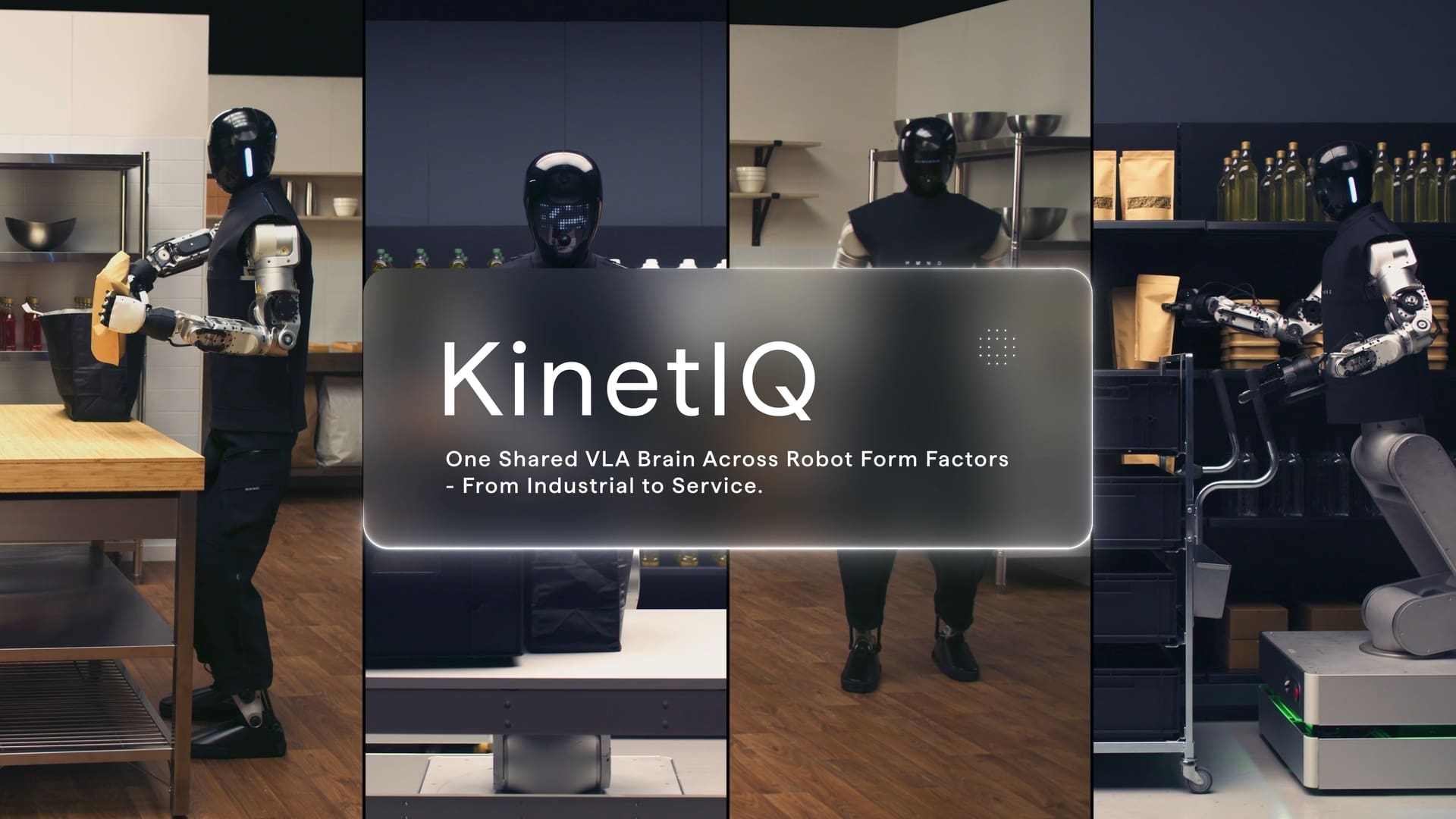
Humanoid.ai today launched KinetIQ, a novel artificial intelligence framework designed to orchestrate fleets of humanoid robots for applications ranging from industrial logistics to in-home assistance. This single AI system uniquely controls robots with diverse physical forms – both wheeled and bipedal – and coordinates their interactions, promising to streamline operations across retail, manufacturing, and beyond. KinetIQ’s architecture operates across multiple timescales, from millisecond-level joint control to fleet-level goal assignment, allowing for independent component improvement and scalable complexity. According to Humanoid.ai, the system utilizes an “agentic pattern” seen in frontier AI, where each layer treats those below as “tools” to achieve objectives. This advancement signals a significant step towards truly versatile and adaptable robotic systems capable of handling a wide array of real-world tasks.
KinetIQ’s Cross-Timescale, Four-Layer Architecture
The system’s core strength lies in its unique, cross-timescale architecture—four distinct layers operating concurrently, spanning from fleet-level task assignment down to millisecond-level joint control. This layered approach isn’t hierarchical in the traditional sense; each layer “treats the layer below as a set of tools, orchestrating them via prompting and tool use to achieve goals set from above.” This allows for independent component improvement while facilitating scalability for increasingly complex operations. The uppermost layer, System 3—the “Humanoid AI Fleet Agent”—functions as an agentic AI, reacting within seconds to optimize fleet operations and integrate with existing facility management systems.
It ingests task requests, SOPs, and real-time updates to allocate tasks across both wheeled and bipedal robots, even coordinating workstation swaps to “maximize throughput and uptime.” Below this sits System 2, responsible for robot-level reasoning on a second-to-subminute timescale. Utilizing an omni-modal language model, it interprets high-level instructions and decomposes goals into actionable sub-tasks, dynamically adjusting plans based on visual context—a process akin to “how agentic systems select and sequence tools.” Should a robot encounter difficulty, System 2 can request human support at either the fleet or low-level execution layers.
The subsequent layers focus on execution: System 1, a Vision-Language-Action (VLA) network, commands body parts at a subsecond timescale—typically 5-10Hz—while System 0, employing reinforcement learning, manages whole-body control at 50Hz. Notably, training System 0 requires approximately “15k hours of experience to produce a capable model.” This multi-layered design, with its emphasis on agentic behavior, is described by Humanoid.ai as a key factor in their progress “towards solving Physical AI.”
Agentic Fleet Orchestration & Task Allocation
Humanoid.ai is pioneering a new approach to robotics with KinetIQ, an AI framework designed for the comprehensive orchestration of robot fleets across diverse settings—from industrial warehouses to domestic homes. This system moves beyond simple pre-programming, employing a four-layered architecture that operates “simultaneously, from fleet-level goal assignment to millisecond-level joint control.” Crucially, each layer leverages the one below as a toolkit, achieving objectives through prompting and tool use, a methodology inspired by “agentic patterns” observed in advanced AI systems. This allows for independent component improvement and scalable fleet management.
KinetIQ’s capabilities extend to both wheeled and bipedal robots, demonstrated through applications like grocery picking and container handling in industrial environments, as well as intelligent assistance within the home—including voice interaction and online ordering. The system’s core, “System 3—Humanoid AI Fleet Agent,” functions as an agentic layer, intelligently allocating tasks and coordinating robot movements to “maximize throughput and uptime.” It integrates directly with existing facility management systems, receiving task requests, tracking performance, and handling exceptions, with the ability to coordinate with both traditional and agentic systems.
System 2, the robot-level reasoning layer, operates on a second-to-subminute timescale, utilizing an “omni-modal language model” to interpret instructions and dynamically plan actions. Unlike rigid, pre-programmed sequences, this layer reasons about the best approach, even saving successful workflows as shareable SOPs across the fleet. At the lowest level, System 1, a Vision-Language-Action (VLA) neural network, executes commands at a rate of 5-10Hz, while System 0, the RL-based whole-body control, runs at 50Hz, ensuring dynamic stability. “Working in unison across multiple embodiments and timescales,” these layers unlock complex task completion.
VLA-Based Low-Level Control & RL Training
Humanoid.ai is pioneering a novel approach to robotic control, leveraging a Vision-Language-Action (VLA) neural network as the foundation for low-level task execution, designated System 1. This system doesn’t rely on pre-programmed sequences; instead, it commands target poses for specific robot body parts – hands, torso, or pelvis – to drive progress towards immediate objectives dictated by higher-level reasoning. System 1 exposes “multiple low-level capabilities to System 2 that can be invoked via different prompts,” including tasks like object manipulation, container handling, and locomotion. Crucially, each capability reports its status—success, failure, or in-progress—back to the reasoning layer for continuous progress tracking.
The VLA operates at a rapid pace, issuing new predictions at a frequency of 5-10Hz, translating to higher-frequency actions executed at 30 to 50Hz depending on the task. To account for the asynchronous nature of action planning and execution, KinetIQ employs “the prefix conditioning technique,” ensuring each action chunk aligns with the current reality. Complementing this is System 0, a reinforcement learning (RL)-trained whole-body control system running at 50 Hz, responsible for achieving the pose targets set by System 1 while maintaining dynamic stability.
Humanoid.ai reports that training this whole-body control system requires “roughly 15k hours of experience” solely in simulation, showcasing the power of RL in developing capable locomotion controllers for both wheeled and bipedal robots. This synergy between platforms is a core tenet of the KinetIQ framework.
The fully-agentic design of KinetIQ that embraces recent breakthroughs in the field of AI is one of the key factors behind Humanoid’s rapid progress towards solving Physical AI.
Humanoid’s team