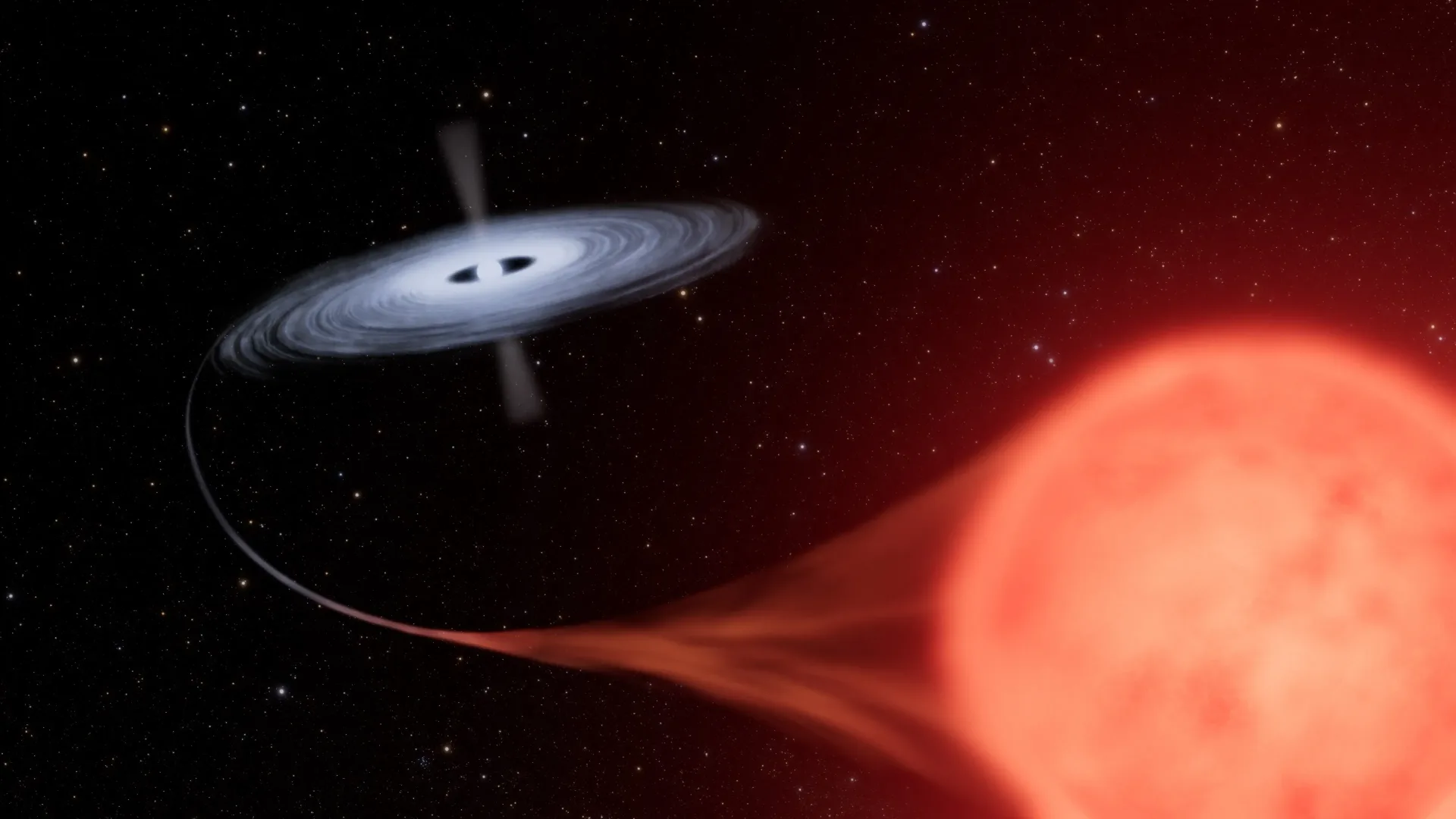
NASA’s Hubble Space Telescope and the retired SOFIA (Stratospheric Observatory for Infrared Astronomy) have provided new data on the binary star system HM Sagittae (HM Sge), which became 250 times brighter in 1975 and has maintained its luminosity for decades. The system consists of a white dwarf star and a red giant companion, with the dwarf pulling material from the giant, leading to potential thermonuclear explosions. Recent observations show the system has become hotter but slightly dimmer. Astronomers Ravi Sankrit and Steven Goldman of the Space Telescope Science Institute have used this data to study changes in the system over the past 30 years.
The Peculiar Binary Star System: HM Sagittae
In the vast expanse of our galaxy, the binary star system HM Sagittae (HM Sge) stands out as one of the most intriguing celestial bodies. This system, composed of a white dwarf and a red giant, first caught the attention of astronomers in 1975 when it suddenly became 250 times brighter. Unlike typical novae, which fade away after a few months or years, HM Sge has maintained its luminosity for decades. Recent observations, however, have shown that while the system has become hotter, it has paradoxically faded slightly.
HM Sge is a unique type of symbiotic star system. The white dwarf and its red giant companion, which produces a significant amount of dust, orbit each other in an eccentric pattern. The white dwarf absorbs gas from the giant star, forming a blazing hot disk around itself. This disk can unpredictably undergo a spontaneous thermonuclear explosion when the infall of hydrogen from the giant becomes denser and reaches a critical point. These explosive interactions between the companion stars provide astronomers with valuable insights into the physics and dynamics of stellar evolution in binary systems.
Hubble and SOFIA: Unveiling the Mysteries of HM Sge
NASA’s Hubble Space Telescope and the retired Stratospheric Observatory for Infrared Astronomy (SOFIA), along with archival data from other missions, have been instrumental in studying HM Sge. In 2021, a team of astronomers used these instruments to investigate the changes in HM Sge over the last 30 years. The ultraviolet data from Hubble revealed a strong emission line of highly ionized magnesium that was not present in the spectra from 1990. This indicates that the estimated temperature of the white dwarf and its accretion disk has increased from less than 400,000 degrees Fahrenheit in 1989 to over 450,000 degrees Fahrenheit now.
The Role of SOFIA and Amateur Astronomers
Data from SOFIA, which retired in 2022, allowed the team to detect the water, gas, and dust flowing in and around the system. Infrared spectral data showed that the giant star returned to its normal behavior within a few years of the explosion, but it has dimmed in recent years, presenting another puzzle for astronomers to solve. The team also collaborated with the American Association of Variable Star Observers (AAVSO) and amateur astronomers worldwide to monitor HM Sge, revealing changes that haven’t been observed since its outburst 40 years ago.
The Significance of HM Sge in Astrophysics
“Symbiotic stars like HM Sge are rare in our galaxy, and witnessing a nova-like explosion is even rarer. This unique event is a treasure for astrophysicists spanning decades,” said Steven Goldman of the Space Telescope Science Institute (STScI). The initial results from the team’s research were published in the Astrophysical Journal, and Ravi Sankrit of STScI presented research focused on the UV spectroscopy at the 244th meeting of the American Astronomical Society.
The Hubble Space Telescope: A Pillar of Astronomical Research
The Hubble Space Telescope, a project of international cooperation between NASA and the European Space Agency (ESA), has been operating for over three decades. It continues to make groundbreaking discoveries that shape our fundamental understanding of the universe. NASA’s Goddard Space Flight Center in Greenbelt, Maryland, manages the telescope and mission operations, with support from Lockheed Martin Space, based in Denver, Colorado. The Space Telescope Science Institute in Baltimore, Maryland, which is operated by the Association of Universities for Research in Astronomy, conducts Hubble science operations for NASA.
External Link: Click Here For More