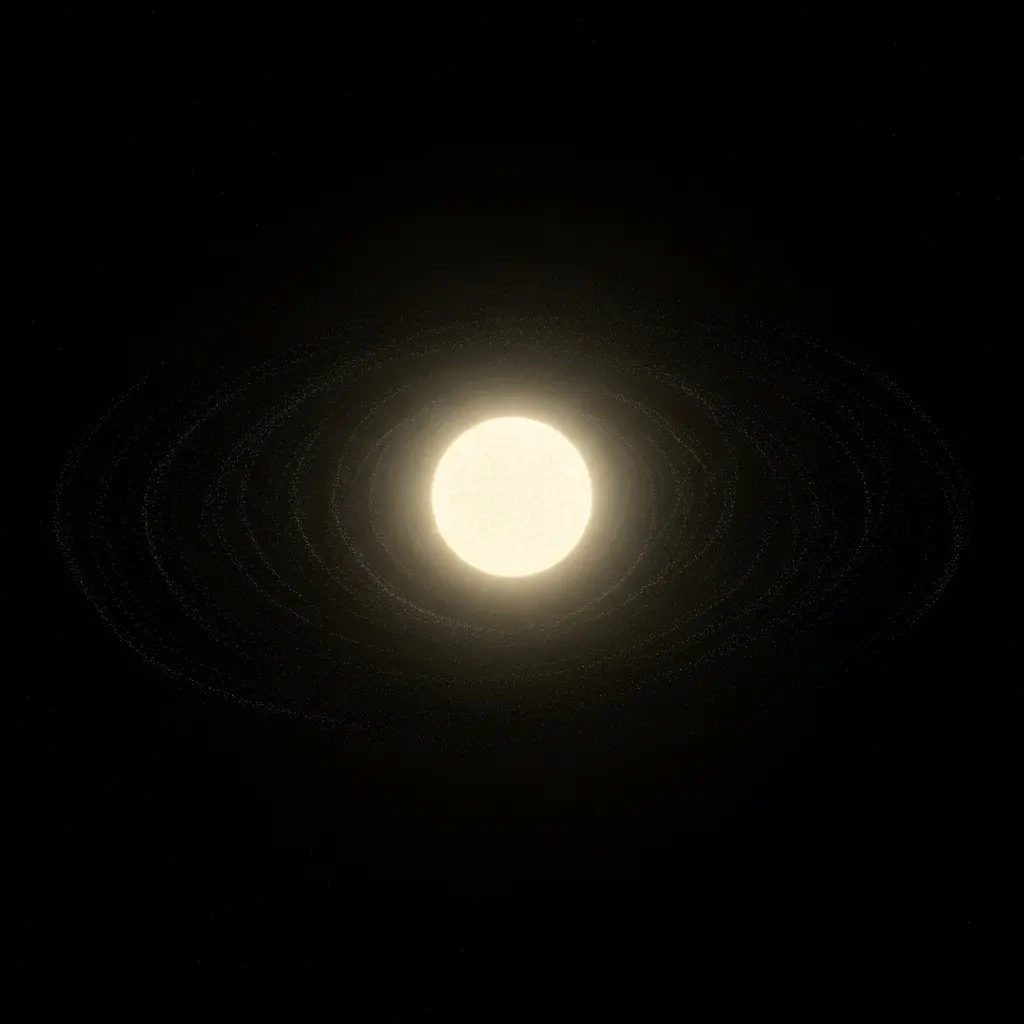
Understanding stellar magnetic activity and its impact on surrounding space environments is crucial for modelling stellar evolution and planetary habitability. Brian E. Wood of the Naval Research Laboratory, alongside Hans-Reinhard Mueller from Dartmouth College and Dean Hartshorn, Seth Redfield, and Travis S. Metcalfe et al. from Wesleyan University and the Center for Solar-Stellar Connections, have used the Hubble Space Telescope to observe HD 166620, a star undergoing a rare “magnetic grand minimum” similar to a period of reduced solar activity. These new ultraviolet spectra represent the first such observations of a star in this state, revealing exceptionally low hydrogen emission and providing insights into the extent of its surrounding astrosphere. The research also includes a detailed analysis of Tau Ceti, confirming a weak stellar wind and a compact astrosphere, suggesting the star’s disk may be vulnerable to interstellar material. This work significantly advances knowledge of how magnetic inactivity affects a star’s interaction with its environment and offers valuable comparisons to our own Sun.
HD 166620 Ultraviolet Spectra Reveal Magnetic Minimum
Studying Stars in Magnetic Grand Minimums
Scientists have, for the first time, obtained ultraviolet spectra of HD 166620, a star definitively identified as being in a “magnetic grand minimum”, a state analogous to the Sun’s Maunder Minimum experienced in the late 1600s. The study focuses on the hydrogen Lyman-alpha line and magnesium II emissions, key indicators of chromospheric activity, to characterise the star’s atmospheric properties and wind output. These spectra were then compared with existing and newly acquired data for Tau Ceti (G8V) and HD 191408 (K2.5V), two stars with similar spectral types and ages of approximately 10 billion years. By comparing these stars, scientists aimed to establish a baseline for understanding the unique characteristics of HD 166620’s diminished activity. The Lyman-alpha data were instrumental in confirming a lack of astrospheric Lyman-alpha absorption, indicating a remarkably weak stellar wind with a mass loss rate of less than 0.1 solar masses per year.
Experiments reveal that HD 166620 exhibits exceptionally low Lyman-alpha surface fluxes, approximately half of those observed during periods of solar minimum, and significantly lower than those of both Tau Ceti and HD 191408. This finding strongly supports the classification of HD 166620 as a star in a magnetic grand minimum, providing a unique opportunity to study a stellar analogue of the Sun’s Maunder Minimum. The compact astrosphere inferred for Tau Ceti suggests that its debris disk is partially exposed to the interstellar medium, raising questions about potential interactions and atmospheric erosion. This research establishes a crucial link between stellar magnetic activity, wind strength, and the surrounding interstellar environment.
The study unveils that the very weak stellar wind emanating from HD 166620, coupled with its diminished chromospheric activity, suggests a significantly reduced magnetic field strength. This finding is consistent with theoretical models predicting that magnetic grand minima are associated with weakened magnetic braking, potentially leading to a complete cessation of the star’s activity cycle. The work opens new avenues for investigating the long-term evolution of stellar dynamos and the factors governing the duration and intensity of activity cycles. Observations, conducted under program GO-17793.2, employed the E230H and E140M gratings, capturing wavelengths ranging from 1150 to 2851 Angstroms. To contextualize these findings, the study also incorporated archival and new HST/STIS data for Tau Ceti (G8V) and HD 191408 (K2.5V), stars similar in spectral type and age, approximately 10 Gyr, to HD 166620.
Data Acquisition and Target Observations
Tau Ceti observations included data from 2000-08-01 and 2022-08-19 using the E140M and E230H gratings respectively, with exposure times of 13450 and 300 seconds. A new observation of Tau Ceti was also acquired on 2025-06-15 using the E140M grating for 2093 seconds. HD 191408 was observed on 2018-09-04 with the E230H and E140M gratings, with exposure times of 306 and 4064 seconds. The study focused on the H I Lyman-alpha line at 1215.7 Angstroms and the Mg II h & k lines at 2803.5 and 2796.3 Angstroms, key indicators of chromospheric activity. By comparing the Lyman-alpha surface fluxes of these stars, scientists aimed to quantify the extremely low emission levels of HD 166620, approximately half those observed during solar minimum.
This precise spectral analysis enabled the team to confirm the absence of astrospheric Lyman-alpha absorption for HD 166620, suggesting a weak stellar wind with a mass loss rate of less than 0.1 solar masses per year. This methodological approach, combining high-resolution UV spectroscopy with comparative stellar analysis, pioneered a new means of characterizing magnetic grand minima and provided crucial insights into the potential future behavior of the Sun’s activity cycle. These fluxes are also significantly reduced when compared to those of Tau Ceti (G8V) and HD 191408 (K2.5V), two stars of comparable spectral type and age, estimated at around 10 Gyr0.1 Mdot_sun. Detailed analysis of the Lyman-alpha data, alongside Mg II and Fe II lines, allowed scientists to infer the properties of the interstellar medium (ISM) surrounding the star. The compact astrosphere surrounding Tau Ceti suggests that the star’s circumstellar disk is at least partially exposed to the ISM, prompting further investigation into the potential consequences of this exposure. Measurements of ISM absorption lines, Mg II at 2796.3543 and 2803.5315 Angstroms, and Fe II at 2586.6500 and 2600.1729 Angstroms, were performed using a χ2 minimization technique with Monte Carlo uncertainty estimation.
Analyzing Spectral Lines and ISM Components
Results demonstrate that for HD 166620, the best fit to the data requires two ISM components with velocities of -20.44 ±0.70km/s and -14.19 ±0.46km/s, and log N (A) values of 12.98 ±0.13 and 13.92 ±0.28 respectively. For Tau Ceti, the measured H I Lyman-alpha line parameters are 12.34 ±0.06km/s velocity and 18.006 ±0.002 log(cm−2) column density, derived from analysis of both older and new HST spectra. The study’s analysis of the H I and D I lines, constrained by Fe II measurements, provides three free parameters for the Lyα fit, even in the two-component HD 166620 model. Specifically, the team measured a Doppler parameter of 13.03 ±1.42km/s for HD 166620’s primary ISM component, and 13.03 ±1.42km/s for its secondary component. These findings establish HD 166620 as the first star definitively identified in such a state, offering a unique opportunity to study the characteristics of diminished stellar magnetic activity. Comparative analysis with stars like Tau Ceti further supports the conclusion that HD 166620 possesses a significantly weaker stellar wind than comparable stars. Detailed examination of Tau Ceti’s astrosphere suggests a compact structure, with upper limits placed on stellar mass loss at less than 0.1 solar masses per year.
Implications for Debris Disks and Stellar Systems
This compactness implies that the star’s debris disk may be partially exposed to the interstellar medium, a condition not typically observed in systems with robust astrospheres. The authors acknowledge some subjectivity in determining mass loss limits, but maintain a consistent upper bound established in prior research. Future work could focus on refining models of astrospheric interaction with the interstellar medium and exploring the implications for debris disk evolution around stars with weak stellar winds.
🗞 HST Observations of HD 166620 and Tau Ceti: First UV Spectra of a Magnetic Grand Minimum Star and the Extent of Tau Ceti’s Astrosphere
🧠 ArXiv: https://arxiv.org/abs/2601.10579