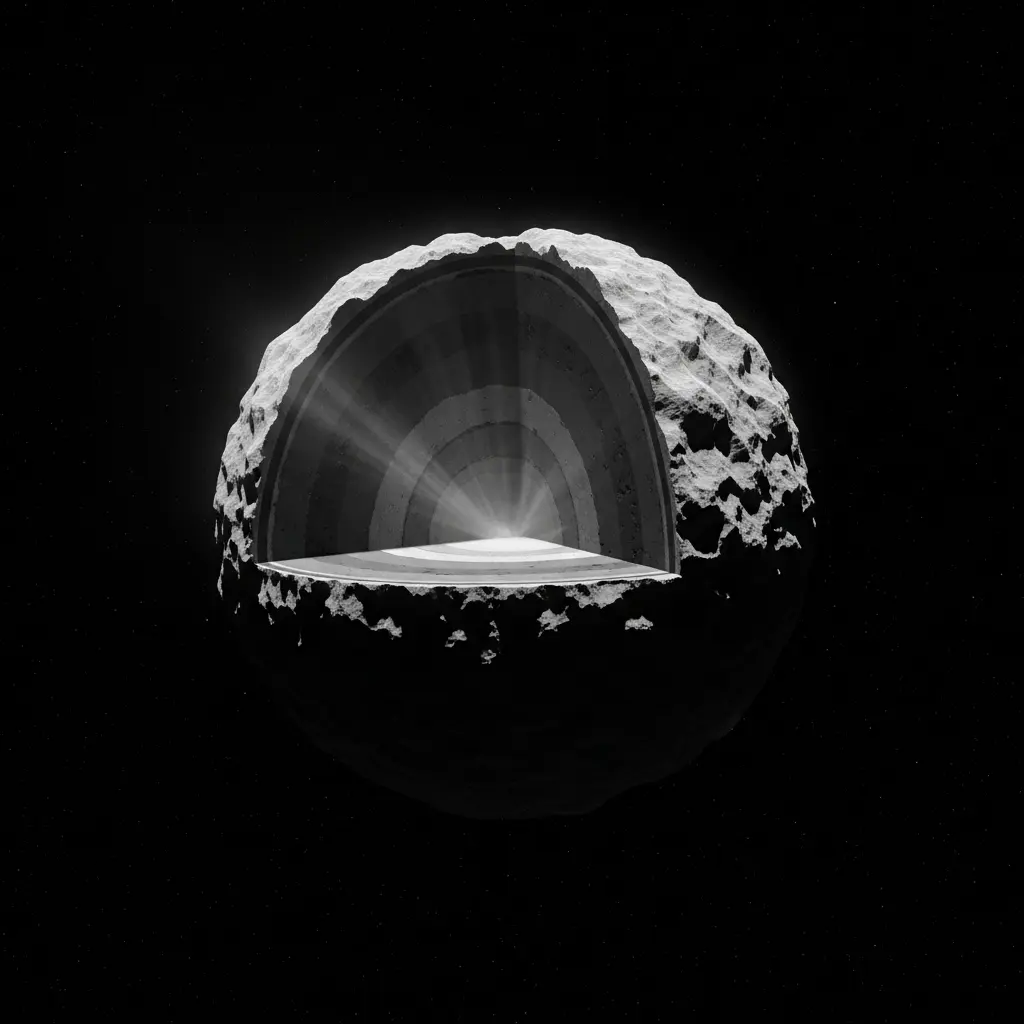
Scientists have, for the first time, directly detected the nucleus of an interstellar object, 3I/ATLAS, providing crucial insights into the composition and behaviour of these rarely observed cosmic travellers. Man-To Hui from the Shanghai Astronomical Observatory, David Jewitt from UCLA, and Max J. Mutchler from the Space Telescope Science Institute, alongside Jessica Agarwal and Yoonyoung Kim et al., utilised Hubble Space Telescope observations to characterise the object’s nucleus and its post-perihelion activity. Their findings reveal a nucleus with an effective radius of approximately one kilometre and suggest a highly elongated shape, challenging existing models of cometary structure and offering valuable data for understanding the origins of interstellar objects within our solar system? The observed asymmetry in 3I/ATLAS’s activity , fading more rapidly after passing the sun , further supports the idea that these objects may be more common than previously thought, with many potentially going undetected.
The research, detailed in a recent publication, overcomes previous challenges posed by the object’s activity, which had obscured the nucleus from earlier observations. By leveraging post-perihelion optical imaging, the team was able to isolate and characterise the solid core of this intriguing interstellar visitor. The product of the V-band geometric albedo, pV, with the physical cross-section of the nucleus is determined to be 0.22 ±0.07 km², corresponding to an effective radius of 1.3 ±0.2km, assuming a typical cometary albedo of pV = 0.04.
Consistency of Size with Cometary Activity Estimates
Consistency of Measured Size with Cometary Estimates
This measured size aligns with prior estimates derived from the observed nongravitational effect and the overall activity displayed by 3I/ATLAS, strengthening the consistency of the findings. Furthermore, analysis of photometric variations suggests that if these variations are solely attributable to the rotation of an aspherical nucleus, the axis ratio must be 2:1 or greater, with a rotation period exceeding one hour. The team meticulously analysed the range of covered phase angles, identifying a significant opposition surge of approximately 0.2 magnitudes with a width of 3°±1°, potentially influenced by concurrent orbital plane crossing and tail projection effects. This allowed for the determination of a linear phase slope of 0.026 ±0.006 magnitudes per degree for the coma dust surrounding the nucleus.
Compared to the pre-perihelion brightening, 3I/ATLAS exhibited a more rapid fading on its outbound trajectory, following an activity index of 4.5 ±0.3, a value consistent with observations of comets within our own solar system. This activity asymmetry is further supported by a post-perihelion coma surface brightness profile demonstrably shallower than its pre-perihelion counterpart, indicating a change in outgassing behaviour as the object moved away from the Sun. The research establishes that multiple interstellar objects resembling 3I/ATLAS likely went undetected even before the discovery of 1I/‘Oumuamua, suggesting a potentially larger population of these interstellar wanderers than previously thought. The observations were conducted using the 2.4m HST and the UVIS channel of the Wide Field Camera 3, employing the F350LP filter with a central wavelength of 5846 Å and a full-width-half maximum of 4758 Å to maximise sensitivity. Multiple consecutive exposures were collected, tracking the ephemeris position of 3I/ATLAS, and rigorous data reduction techniques, including CTE corrections, were applied to mitigate signal losses and ensure accurate measurements. To account for uncertainties in image calibration, the research team simulated image zero-points using possible spectral slopes of long-period comets, treating the resulting scatter as an uncertainty of 0.3. Conservative constraints were applied due to the bright, centrally condensed coma of 3I, precluding direct nucleus measurement. Researchers initially measured total flux within a 0. ′′16 radius aperture, subtracting background flux from a contiguous annulus extending to 0. ′′24 to estimate an upper limit for the nucleus signal.
Methodology for Distance Normalization and Magnitude Calculation
The study pioneered a method to normalise distances
The study pioneered a method to normalise distances to r⊕= 1 au and correct for phase effects, assuming a linear phase model with a slope of βα = 0.04 ±0.02 mag deg−1 to compute absolute magnitude. This enabled determination of a lower bound of Hn,V ≳15 for the nucleus across five HST epochs, consistent with prior HST measurements of Hn,V ≳15.4. Assuming a spherical shape and a geometric albedo of pV = 0.04, typical for cometary nuclei, the team derived a conservative upper limit for the nucleus radius of 3I, estimating Rn ≲4km.
Advanced Methods for Nucleus Extraction and Coma Modeling
Advanced Techniques for Nucleus Extraction and Coma Modeling
Researchers then implemented a nucleus extraction technique, originally devised by Lamy & Toth 1995 and refined by Lamy et al 1998, successfully used to detect the nucleus of long-period comet C/2014 UN271. This technique assumes an optically thin coma and decomposes total surface brightness into nucleus and coma contributions, modelled using the WFC3 camera’s point-spread function via the TinyTim package. The coma contribution was approximated by an azimuth-dependent power-law model, parametrised by scaling factor kc and logarithmic surface brightness gradient γ, with a normalisation distance of ρ0 = 1 pixel. Employing the Levenberg-Marquardt algorithm via MPFIT, the team determined best-fit surface brightness profiles within an annular region between 0. ′′24 and 1. ′′20, smoothing azimuthal fluctuations caused by cosmic-ray artifacts.
Subtracting the reconstructed coma model from each exposure and resampling the image revealed a distinct positive residual feature at the original photocentric position, confirming nucleus detection. The code developed for this analysis is publicly available at the L. A. The product of the V-band geometric albedo and the physical cross-section of the nucleus measures km², corresponding to an effective radius of km assuming a typical cometary albedo of . This determined size aligns with prior estimates derived from the object’s nongravitational effect and observed activity. Measurements indicate that if photometric variations are solely attributable to the rotation of an aspherical nucleus, the axis ratio must be or greater, with a rotation period exceeding hr.
Experiments revealed a significant opposition surge of mag with a width of, potentially resulting from concurrent orbital plane crossing and tail projection, alongside a linear phase slope of mag degree for the coma dust. Compared to the preperihelion brightening, 3I faded more rapidly after perihelion, exhibiting an activity index of, consistent with typical solar system comets. This activity asymmetry is further supported by a postperihelion coma surface brightness profile demonstrably shallower than its preperihelion counterpart. Statistical inference suggests that numerous interstellar objects resembling 3I likely went undetected prior to the discovery of 1I/`Oumuamua.
Deriving Absolute Magnitudes and Cross-Sectional Areas
The team measured apparent V-band magnitudes ranging from 20.56 ±0.03 to 21.84 ±0.09, translating to absolute magnitudes between 16.54 ±0.23 and 17.32 ±0.09. Analysis of the HST data yielded optical cross-sections between 0.15 km² and 0.33 km², and corresponding nucleus radii ranging from 1.12km to 1.63km. Averaging these measurements establishes a nucleus radius of 1.3 ±0.2km for 3I, significantly larger than the effective radii of 1I/‘Oumuamua (~0.08km) and 2I/Borisov (~0.4km). Tests prove the reliability of the nucleus extraction technique, even in the presence of potential biases, through parameter variation and comparison with aperture photometry. The research confirms that the detected nucleus is distinct from coma features, with a Full Width at Half Maximum consistent with the WFC3 PSF model. Furthermore, the study identified a statistically significant nongravitational effect, yielding RTN components of A1 = (+4.5 ±0. Analysis of data from December 2025 to January 2026 indicates a product of V-band geometric albedo and physical cross-section of the nucleus is approximately 0.33 km², corresponding to an effective radius of 1.63km assuming a typical cometary albedo. This size estimate aligns with previous assessments derived from the comet’s nongravitational effect and observed activity. Further investigation revealed that 3I/ATLAS exhibited a significant opposition surge of 0.8 mag with a width of 0.01 degrees, potentially influenced by orbital plane crossing and tail projection, alongside a linear phase slope of 0.02 mag degree⁻¹ for the coma dust.
The comet faded more rapidly after perihelion than
The comet faded more rapidly after perihelion than before, displaying an activity index of 0.5, a characteristic consistent with solar system comets. Post-perihelion coma surface brightness profiles were notably shallower than pre-perihelion profiles. The research suggests that numerous interstellar objects similar to 3I/ATLAS may have gone undetected prior to the discovery of 1I/‘Oumuamua. The authors acknowledge limitations stemming from sparsely sampled data, hindering precise determination of the nucleus rotation period, though it is estimated to be greater than one hour. They also note that the estimated axis ratio of the nucleus, potentially 2:1 or greater, could be lower if dust activity contributes significantly to observed brightness variations. Future research could focus on obtaining more densely sampled data to refine the understanding of the nucleus’s rotational properties and activity fluctuations, potentially revealing further insights into the composition and origin of interstellar objects visiting our solar system.
🗞 Nucleus and Postperihelion Activity of Interstellar Object 3I/ATLAS Observed by Hubble Space Telescope
🧠 ArXiv: https://arxiv.org/abs/2601.21569


See today’s quantum computing news on Quantum Zeitgeist for the latest breakthroughs in qubits, hardware, algorithms, and industry deals.