

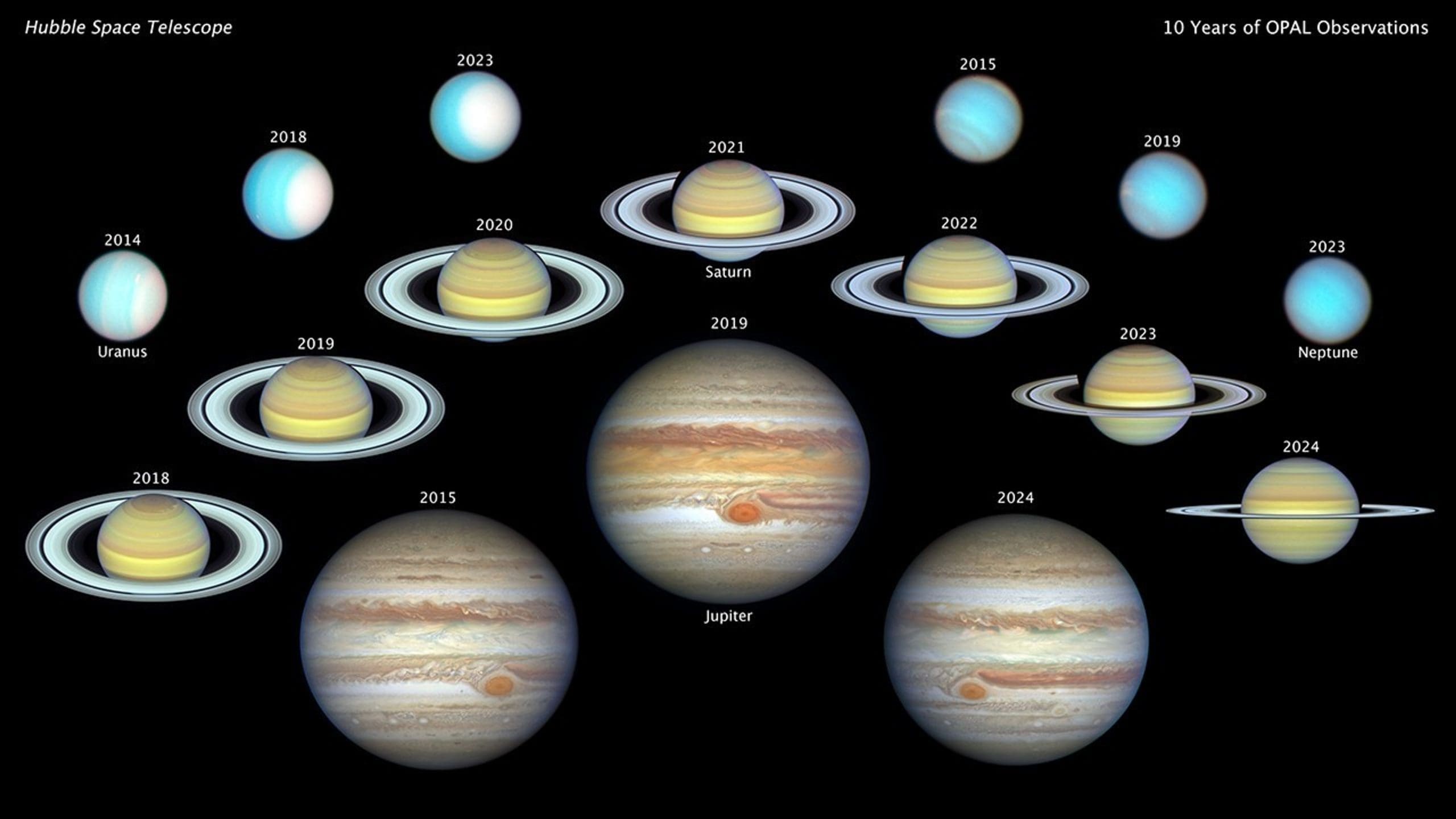
The Hubble Space Telescope has completed its annual grand tour of the outer solar system returning crisp images of Jupiter Saturn Uranus and Neptune. The Outer Planet Atmospheres Legacy project or OPAL has been monitoring changes in the atmospheres of these planets. NASA’s Goddard Space Flight Center manages the telescope and mission operations with support from Lockheed Martin Space and the Space Telescope Science Institute.
The Hubble Space Telescope is a project of international cooperation between NASA and the European Space Agency. Scientists have used Hubble to study the seasonal changes on these planets, including the appearance of dark spots on Neptune and the changing colors of Saturn’s atmosphere. The OPAL project has also revealed a link between Neptune’s cloudy weather and the 11-year solar cycle. Paul Morris is the lead producer of the video showcasing the OPAL project’s findings.
The Hubble Space Telescope has provided remarkable insights into the outer planets of our solar system through long-term observations. Saturn’s ring system, observed from 2018 to 2024, shows dynamic changes in tilt and color as it orbits the Sun, with the rings appearing edge-on every 15 years. Hubble has also captured transient “ring spokes,” whose appearance and intensity vary with Saturn’s seasons. Uranus, with its unique axial tilt, undergoes dramatic seasonal shifts. Since its spring equinox, Hubble has detected methane ice-crystal storms and a brightening photochemical haze over its north pole, revealing significant atmospheric activity. On Neptune, Hubble has documented short-lived dark spots in its atmosphere and linked cloud patterns to the Sun’s 11-year solar cycle, an unexpected connection given the planet’s vast distance from the Sun.
These observations are part of Hubble’s ongoing Outer Planet Atmospheres Legacy (OPAL) program, allowing astronomers to monitor outer planetary systems’ evolution. Over its three-decade mission, Hubble has continually advanced our understanding of planetary atmospheres, seasonal changes, and atmospheric dynamics. This data deepens our knowledge of these distant worlds and informs the planning of future missions, such as NASA’s proposed Uranus Orbiter and Probe.
External Link: Click Here For More


