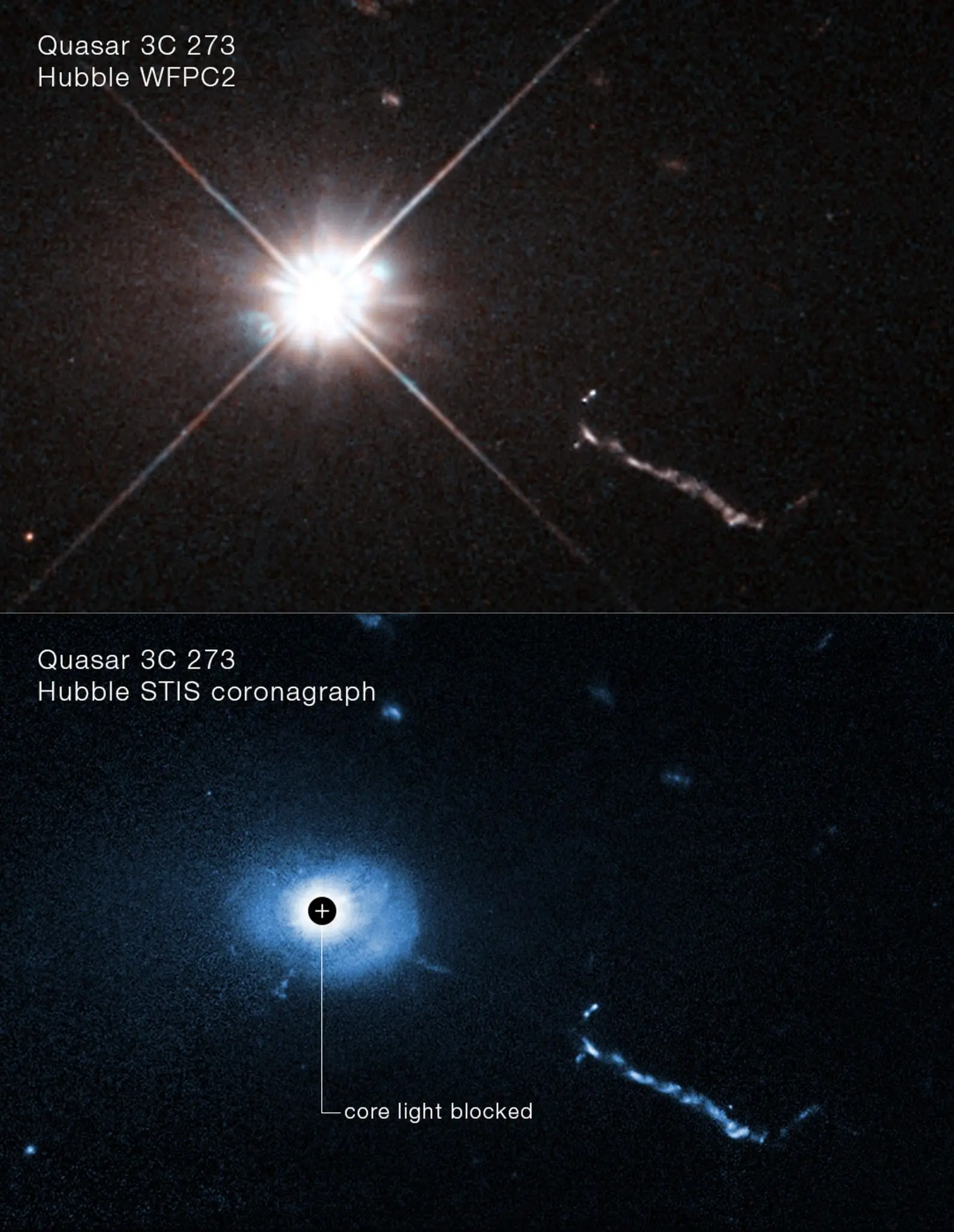
NASA’s Hubble Space Telescope has captured the closest-ever look at a quasar, a galactic center that glows brightly as a black hole consumes material in its surroundings. The new views of the environment around quasar 3C 273 show unusual features, including blobs and an L-shaped filamentary structure within 16,000 light-years of the black hole.
According to Bin Ren of the Côte d’Azur Observatory and Université Côte d’Azur in Nice, France, these objects could be small satellite galaxies falling into the black hole, providing material that will accrete onto the central supermassive black hole, powering the bright quasar. The Hubble Space Telescope’s Imaging Spectrograph coronagraph allowed astronomers to block out the glare from the quasar and see unprecedented details near the black hole. This achievement opens a new gateway into understanding quasars, said Ren.
Maarten Schmidt first identified 3C 273 as a quasar in 1963, and it is one of the closest quasars to Earth, located 2.5 billion light-years away. The James Webb Space Telescope may provide further clues about this quasar in the future.
Unveiling the Secrets of Quasars: A Closer Look with Hubble
Quasars, incredibly luminous objects thought to be powered by supermassive black holes at the centers of galaxies, have long fascinated astronomers. With the Hubble Space Telescope’s unparalleled resolution and sensitivity, scientists have studied these enigmatic objects in unprecedented detail. In this article, we’ll delve into the latest discoveries made possible by Hubble’s observations of quasar 3C 273, one of the closest and most well-studied quasars to Earth.
In the 1990s, Hubble’s sharp vision revealed that the environment surrounding quasars is far more complex than initially suspected. The images suggested galactic collisions and mergers between quasars and companion galaxies, where debris cascades down onto supermassive black holes. This reignites the giant black holes that drive quasars. The latest observations of 3C 273 have further illuminated this intricate dance.
Hubble’s Space Telescope Imaging Spectrograph (STIS) can serve as a coronagraph, blocking light from central sources and allowing astronomers to peer deeper into the quasar’s heart. By using STIS in this mode, scientists have been able to observe dusty disks around stars and understand planetary system formation. Now, they can apply this technique to better comprehend quasars’ host galaxies. The Hubble coronagraph has enabled astronomers to look eight times closer to the black hole than ever before.
Scientists have gained rare insight into the quasar’s 300,000-light-year-long extragalactic jet of material blazing across space at nearly the speed of light. By comparing STIS coronagraphic data with archival STIS images taken 22 years apart, the team led by Bin Ren concluded that the jet is moving faster when it is farther away from the monster black hole.
With the fine spatial structures and jet motion revealed by Hubble, scientists have bridged a gap between small-scale radio interferometry and large-scale optical imaging observations. This has enabled them to take an observational step towards a more complete understanding of quasar host morphology. The future holds promise, as observing 3C 273 in infrared light with the James Webb Space Telescope may provide further clues.
At least 1 million quasars are scattered across the sky, serving as useful background “spotlights” for a variety of astronomical observations. Quasars were most abundant about 3 billion years after the big bang, when galaxy collisions were more common.
The Hubble Space Telescope has been operating for over three decades and continues to make ground-breaking discoveries that shape our fundamental understanding of the universe. As a project of international cooperation between NASA and ESA (European Space Agency), Hubble is managed by NASA’s Goddard Space Flight Center in Greenbelt, Maryland, with mission operations supported by Lockheed Martin Space and the Space Telescope Science Institute (STScI) in Baltimore.
In conclusion, Hubble’s observations of quasar 3C 273 have significantly advanced our understanding of these enigmatic objects. As we continue to explore the universe with next-generation telescopes like the James Webb Space Telescope, we may uncover even more secrets hidden within the hearts of quasars.
External Link: Click Here For More