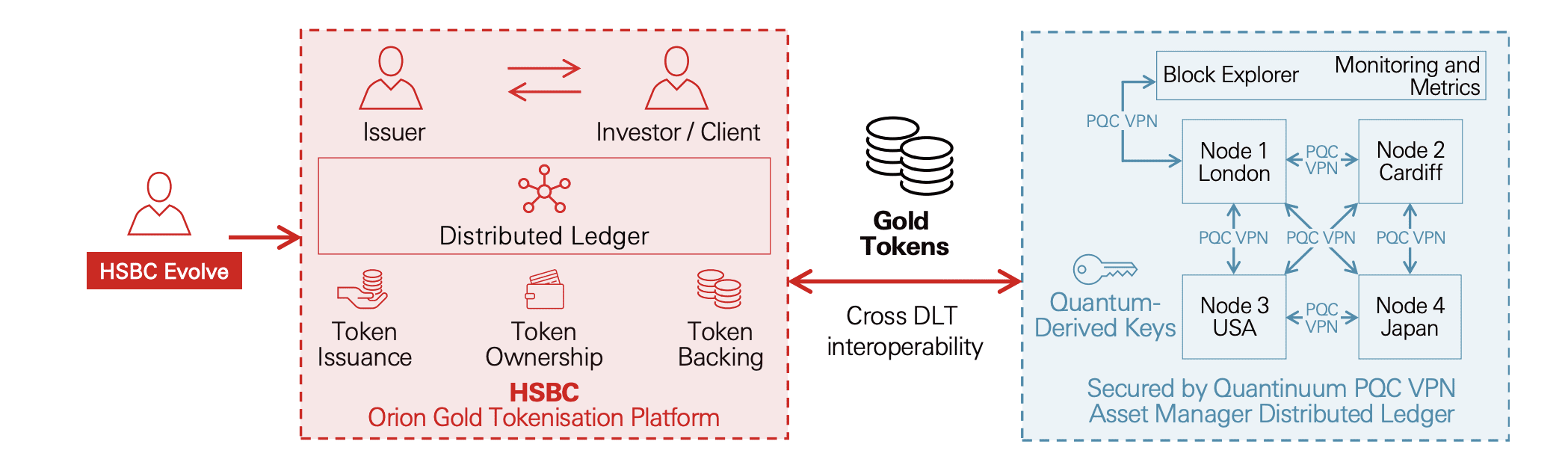
HSBC has successfully trialed the first application of quantum-secure technology for distributing tokenized physical gold, marking a significant step in protecting critical applications from potential future quantum computing attacks. In collaboration with Quantinuum, HSBC’s achievement presents a cost-effective approach to securing existing production Distributed Ledger Technology (DLT) without needing to rearchitect it.
This breakthrough is crucial as the world prepares for the Quantum Age, where traditional encryption methods may be vulnerable to quantum computing attacks. The work demonstrates thought leadership in future-proofing asset tokenization and highlights HSBC’s commitment to innovation and security.
The white paper outlines some of the benefits:
- Cost-effectiveness: PQC VPNs offer a cost-effective solution for securing digital communications, particularly when directly implementing PQC algorithms in core DLT systems. Implementing PQC algorithms directly often requires substantial investment in new hardware and software and significant testing and validation resources. Conversely, a PQC VPN can leverage existing network infrastructure, requiring minimal adjustments. This means organisations can achieve quantum-resistant security, without the need for expensive overhauls of their current systems, making PQC VPNs a more budget-friendly option.
- Seamless integration with existing DLT systems: One of the most significant advantages of PQC VPNs is their ability to integrate seamlessly into existing DLT systems, without necessitating a redesign of the distributed ledger architecture or costly IT hardware upgrades. The PQC VPN operates as an overlay on the existing network, providing quantum-resistant encryption for data in transit without altering the underlying DLT structure. This compatibility ensures that businesses can enhance the security of their blockchain applications, while preserving their current investments in infrastructure and technology.
- Minimal changes required for deployment: PQC VPNs can be deployed on an existing production DLT infrastructure with minimal changes, which is a key factor in their practicality. Unlike more invasive security upgrades that might disrupt operations or require significant downtime, PQC VPNs can be implemented with lower changes, allowing for a smooth transition to a quantum-resistant state. This minimal disruption is particularly beneficial for organisations that rely on continuous operation of their DLT systems and cannot afford extended downtime or significant changes to their operational processes.
- Low latency impact: One of the critical concerns when implementing PQC in DLT systems is the potential for increased latency in transaction processing and block validation. Directly embedding PQC algorithms into the core architecture of DLTs can introduce significant delays due to the computational complexity of these algorithms. In contrast, using a PQC VPN approach mitigates this risk, as the encryption process occurs outside the core DLT system, thereby maintaining the speed and efficiency of transaction processing. This ensures that the DLT’s relative performance remains robust while still benefiting from enhanced security against quantum threats.
- Practical security for the short and medium term.
HSBC, in collaboration with Quantinuum, has successfully trialed the first application of quantum-secure technology for distributing tokenized physical gold. This marks a significant step forward in protecting critical applications from potential future quantum computing attacks.
As we move towards the Quantum Age, there’s a growing concern about the security of existing distributed ledger technologies (DLTs). The threat is real: quantum computers could potentially break certain classical encryption algorithms, compromising the integrity of these systems. HSBC’s approach addresses this issue by providing a cost-effective way to protect existing production DLTs in the short and medium term, without requiring a complete overhaul.
This achievement demonstrates thought leadership in future-proofing asset tokenization for the Quantum Age. By considering both technological and business needs, HSBC has taken a comprehensive approach that sets a new standard for the industry.
In summary, HSBC’s successful trial of quantum-secure technology for distributing tokenized physical gold marks an important milestone in protecting critical applications from future quantum computing attacks. This cost-effective approach sets a new standard for the industry and demonstrates thought leadership in future-proofing asset tokenization for the Quantum Age.
External Link: Click Here For More