

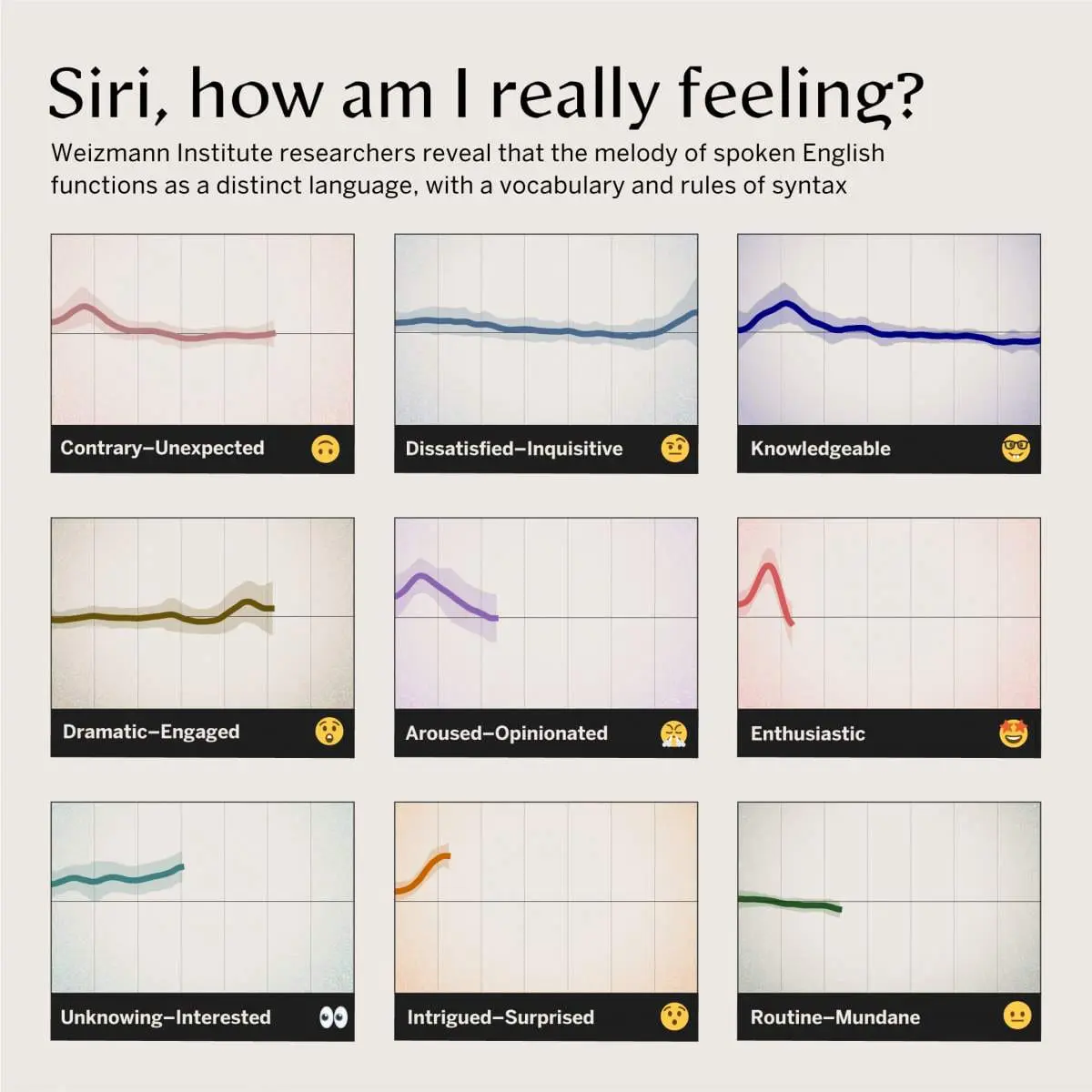
Researchers from Prof. Elisha Mosess lab at the Weizmann Institute of Science have published a groundbreaking study in Proceedings of the National Academy of Sciences (PNAS), revealing that prosody—the melody and rhythm of speech—functions as a distinct language beyond words. Their work demonstrates that prosody possesses its own vocabulary of hundreds of basic melodic patterns and syntactic rules governing their sequence. By analyzing spontaneous English conversations using artificial intelligence, the team identified these patterns, each conveying specific functions or speaker attitudes such as curiosity or surprise.
They discovered that certain prosodic pairs act as simple sentences, expressing single ideas. This research opens avenues for developing AI capable of understanding and conveying emotions through speech melody, with potential applications in enhancing robotic voices and aiding individuals with speech impairments via brain implants.
In recent research, scientists have begun treating prosody—the melody and rhythm of speech—as a distinct language in its own right. This groundbreaking approach reveals that prosody operates through unique patterns and rules, often pairing with spontaneous conversations to form simple syntactic structures aligned with short-term memory constraints. For instance, a sharp rise in pitch followed by a quick drop can signal emotions ranging from enthusiasm to confusion. These findings suggest that prosody functions as an independent layer of communication, existing beyond the semantic content of speech.
The study analyzed audiobooks and discovered that prosodic patterns are significantly longer in scripted speech compared to spontaneous conversations. This indicates that prosody is a dynamic aspect of communication, evolving across different contexts and influenced by factors such as social status, historical events, and the speaker’s age. Interestingly, variations in prosody are evident even in literary works reflecting spontaneous speech, further underscoring its adaptability and significance.
The implications for artificial intelligence are profound. By integrating prosody into AI systems, researchers aim to enhance machines’ ability to interpret nuanced speech and recognize emotional states. This could lead to improved voice assistants capable of understanding human emotions more effectively. Additionally, the development of more expressive robotic voices for assistive technologies holds promise for creating more natural and empathetic interactions between humans and machines.
Beyond its applications in technology, prosody also plays a crucial role in internal speech—the language of thought. By studying how prosody functions internally, researchers hope to gain insights into how humans think and communicate within their own minds. Furthermore, quantifiable changes in prosody during the aging process and childhood language acquisition suggest potential applications in studying cognitive development and communication disorders.
In conclusion, treating prosody as a distinct language offers a new layer of analysis for human communication. By incorporating prosody into AI systems, researchers can create more natural and expressive human-computer interactions, benefiting voice assistants, assistive technologies, and our understanding of internal cognition. This innovative approach not only enhances technological applications but also deepens our appreciation for the complexity and richness of human expression.
More information
External Link: Click Here For More


