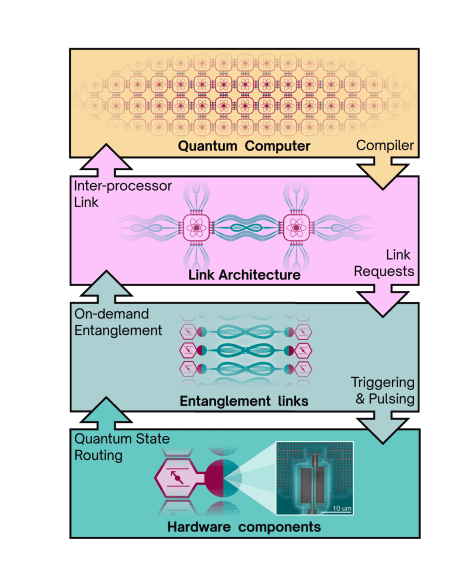
Published on May 1, 2025, Scalable Quantum Computing with Optical Links addresses a critical challenge in quantum computing by proposing optical links as a solution to scale processors. The research highlights the use of microwave-to-optical transducers to enable high-fidelity entanglement between quantum processors and outlines steps for integrating these technologies into fault-tolerant systems, paving the way for utility-scale quantum data centers.
The study addresses challenges in scaling quantum processors by exploring microwave-to-optical transducers for linking cryogenic units. Despite current limitations in transducer determinism, the research demonstrates that these links can surpass individual module performance. Methods are proposed for achieving high-fidelity entanglement between separated processors on demand. Key steps for technology adoption include scaling transducers and integrating with existing hardware. Architectures using such links could enable utility-scale quantum data centers, advancing beyond current physical constraints.
In recent years, optical computing has emerged as a beacon of hope in the quest for practical quantum applications. This innovative field is not only advancing our ability to harness quantum mechanics but also addressing critical challenges such as qubit stability and error correction. By focusing on these areas, researchers are paving the way for scalable and reliable quantum systems that could transform industries from secure communication to drug discovery.
At the heart of optical computing lies the challenge of maintaining qubit coherence. Recent advancements have achieved superconducting cavity qubits with unprecedented stability, boasting coherence times of tens of milliseconds. This enhancement is pivotal as longer coherence periods enable more reliable quantum operations, mitigating the effects of decoherence—a persistent hurdle in quantum state maintenance.
Error correction remains a cornerstone of practical quantum computing. Breakthroughs using Gottesman-Kitaev-Preskill (GKP) codes have demonstrated real-time error detection and correction beyond the break-even point, marking a significant leap towards fault-tolerant systems. These bosonic codes ensure that quantum operations retain accuracy despite environmental noise, a crucial step in achieving reliable large-scale computations.
The scalability of quantum systems hinges on effective qubit interconnection. Recent studies have shown how to connect error-corrected qubits using noisy links effectively, providing methods to maintain reliability across interconnected modules. This advancement is essential for constructing large-scale quantum computers, where maintaining coherence and accuracy across numerous qubits is paramount.
The convergence of improved qubit stability, advanced error correction techniques, and scalable architectures represents a significant milestone in optical computing. While challenges remain, these innovations are bringing us closer to realising the potential of quantum technology. The implications for fields such as cryptography, material science, and drug discovery are profound, offering transformative potential that could redefine our technological landscape.
👉 More information
🗞 Scalable Quantum Computing with Optical Links
🧠 DOI: https://doi.org/10.48550/arXiv.2505.00542