
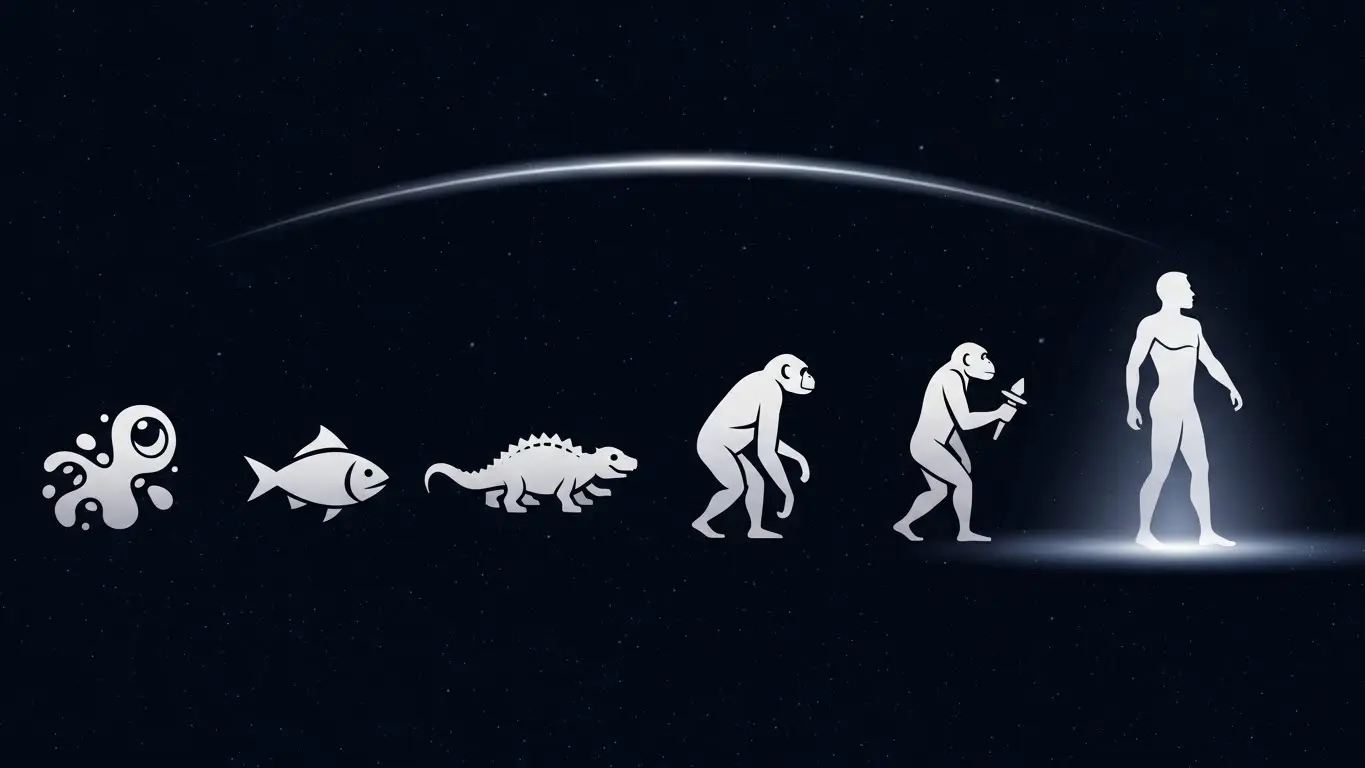
The idea that evolution “discovered” quantum mechanics billions of years before human scientists formalized it may seem paradoxical. Yet, when examined through the lens of biological processes, it becomes clear that nature has been exploiting quantum phenomena for survival, energy transfer, and molecular precision long before humans even conceptualized quantum theory. From the efficiency of photosynthesis to the precision of enzymatic reactions, quantum effects such as coherence, tunneling, and entanglement play critical roles in life’s fundamental mechanisms. These phenomena, once thought to be confined to the subatomic realm, are now understood to operate in complex biological systems, challenging the notion that quantum mechanics is solely a human-constructed framework. This article explores how evolutionary processes have inherently utilized quantum principles to optimize biological functions, and how modern science is now uncovering these mechanisms to inspire breakthroughs in technology, medicine, and our understanding of life itself.
The significance of this topic lies in its interdisciplinary implications. By studying how evolution harnessed quantum mechanics, researchers can develop more efficient solar energy systems, design novel drugs, and even advance quantum computing. Moreover, it raises profound questions about the relationship between quantum physics and biological complexity, suggesting that life may have evolved in ways deeply intertwined with the quantum fabric of reality.
Quantum mechanics is a branch of physics that describes the behavior of matter and energy at the atomic and subatomic levels, where particles exhibit wave-like properties and probabilistic behaviors.
— Britannica Encyclopedia
The Fundamental Principles Behind Evolutionary Quantum Utilization
At the heart of this evolutionary quantum interplay lies the concept of quantum coherence, which allows biological systems to maintain synchronized quantum states over short timescales. This phenomenon is critical in processes like photosynthesis, where energy transfer must occur with near-perfect efficiency to sustain life. Similarly, quantum tunneling enables particles to traverse energy barriers that would otherwise be insurmountable, a principle exploited in enzymatic reactions to accelerate biochemical processes. These quantum effects are not random occurrences but are instead selected for by evolution due to their functional advantages. For instance, the ability of certain proteins to facilitate electron or proton tunneling at room temperature underpins metabolic efficiency, a trait that would have been favored in early life forms. By leveraging these quantum phenomena, biological systems achieve levels of precision and efficiency that classical physics alone cannot explain. Understanding these principles requires a synthesis of quantum physics, biochemistry, and evolutionary biology, highlighting the deep interconnection between the physical laws governing the universe and the mechanisms of life.
Evolution is the process through which heritable traits in populations of organisms change over successive generations, driven by mechanisms such as natural selection and genetic drift.
— Britannica Encyclopedia
How Quantum Coherence Enhances Photosynthetic Efficiency
Photosynthesis is one of the most striking examples of evolution harnessing quantum mechanics. In plants, algae, and some bacteria, light-harvesting complexes capture photons and transfer their energy to reaction centers with near 100% efficiency. Classical models struggle to explain this efficiency, but quantum coherence provides the answer. When a photon is absorbed by a chlorophyll molecule, the energy exists in a superposition of states, allowing it to explore multiple pathways simultaneously. This quantum walk ensures the energy follows the most efficient route to the reaction center, minimizing losses. Studies using ultrafast spectroscopy have confirmed that these coherence effects persist for hundreds of femtoseconds—long enough to influence energy transfer dynamics. This quantum advantage likely evolved because even small improvements in energy capture would have provided significant survival benefits in early ecosystems. The ability to exploit coherence in such a complex, warm, and noisy biological environment challenges the traditional view that quantum effects are fragile and only observable in highly controlled, low-temperature settings.
Enzymatic Reactions and the Role of Quantum Tunneling
Quantum tunneling, the phenomenon where particles pass through energy barriers rather than overcoming them, plays a pivotal role in enzymatic reactions. Enzymes accelerate biochemical processes by lowering activation energy, but in some cases, quantum tunneling further enhances reaction rates. For example, hydrogen tunneling is critical in the function of enzymes like alcohol dehydrogenase and DNA polymerase. In these reactions, protons or electrons tunnel across distances that would be classically impossible, allowing reactions to occur at biologically relevant timescales. This effect is particularly pronounced at physiological temperatures, where classical thermal activation alone would be insufficient. Evolution appears to have optimized enzyme structures to maximize tunneling probabilities, such as positioning amino acid residues to align reaction pathways precisely. By leveraging tunneling, enzymes achieve catalytic efficiencies that are orders of magnitude higher than what classical chemistry predicts. This evolutionary adaptation underscores how life has co-opted quantum mechanics to overcome thermodynamic limitations, enabling the complex biochemistry necessary for survival.
The Role of Quantum Effects in Evolutionary Adaptation
Quantum effects may also play a subtle but significant role in evolutionary adaptation itself. Mutations, the raw material for evolution, are driven by processes such as DNA replication and repair, which can involve quantum tunneling. For instance, proton tunneling during DNA replication can lead to tautomeric shifts in nucleotide bases, potentially causing mutations that drive genetic diversity. While most such mutations are neutral or harmful, a small fraction may confer adaptive advantages, which natural selection then amplifies. Additionally, quantum coherence in cellular signaling pathways could influence gene expression patterns, allowing organisms to respond more dynamically to environmental changes. These quantum-driven mechanisms suggest that evolution is not purely a classical process but is underpinned by quantum-level fluctuations that shape genetic variation. By integrating quantum phenomena into its toolkit, evolution may have discovered pathways to innovation that classical physics alone could not provide, enabling life to thrive in diverse and challenging environments.
Challenges in Studying Biological Quantum Processes
Studying quantum effects in biological systems presents significant technical and conceptual challenges. One major hurdle is the difficulty of isolating quantum phenomena from classical noise in complex, dynamic environments. Unlike controlled laboratory settings, biological systems operate at ambient temperatures, where thermal fluctuations and molecular motion can obscure quantum signatures. Techniques such as ultrafast laser spectroscopy and cryogenic imaging are essential for capturing fleeting quantum coherence, but these methods often require extreme conditions that may not reflect natural biological contexts. Additionally, theoretical models must reconcile quantum mechanics with classical biochemical frameworks, a task complicated by the vast timescales and spatial scales involved. Another challenge is the lack of a unified theoretical framework to describe how quantum effects influence macroscopic biological functions. Researchers must develop interdisciplinary tools that bridge quantum physics, biochemistry, and computational modeling to disentangle these mechanisms. Overcoming these challenges is critical for advancing our understanding of how evolution has harnessed quantum mechanics and for translating these insights into practical applications.
Technological Implications Inspired by Biological Quantum Systems
The study of biological quantum processes has already begun to inspire revolutionary technologies. For example, the efficiency of quantum coherence in photosynthesis is guiding the development of next-generation solar cells, where artificial light-harvesting complexes mimic natural structures to improve energy capture. Similarly, understanding enzymatic tunneling has led to the design of more efficient catalysts for industrial chemical processes, reducing energy consumption and waste. In quantum computing, insights from biological systems are informing the development of error-resistant qubits that operate at higher temperatures, potentially overcoming one of the field’s most significant limitations. These innovations demonstrate that nature’s quantum strategies offer a blueprint for solving complex technological challenges. By reverse-engineering evolutionary solutions, scientists and engineers can create systems that leverage quantum mechanics in ways that are both efficient and scalable. The convergence of biology and quantum physics thus represents a new frontier for innovation, with the potential to transform energy, materials science, and information technology.
Current Research and Discoveries in Evolutionary Quantum Biology (2024)
In 2024, research into evolutionary quantum biology is advancing rapidly, driven by breakthroughs in experimental techniques and computational modeling. Recent studies have confirmed the presence of quantum coherence in avian navigation, where birds use cryptochrome proteins to detect Earth’s magnetic field through radical pair mechanisms. These findings suggest that quantum effects are not limited to plants and enzymes but extend to sensory systems as well. Additionally, cryo-electron microscopy has revealed structural details of proteins involved in quantum tunneling, providing atomic-level insights into how evolution has optimized these processes. Computational models are also shedding light on how quantum fluctuations might influence genetic mutation rates, potentially linking quantum mechanics to evolutionary dynamics. These discoveries underscore the growing recognition of quantum phenomena as integral to life’s fundamental processes. As research continues, the field is likely to uncover even more examples of evolution’s quantum ingenuity, expanding our understanding of how life interacts with the physical world.
Applications in Quantum Computing and Information Processing
The principles evolved by biological systems to harness quantum mechanics are now informing the next generation of quantum computing architectures. For instance, the ability of photosynthetic complexes to maintain coherence in warm, noisy environments has inspired the development of room-temperature qubit designs. Researchers are exploring biomimetic materials that replicate the structure of light-harvesting proteins to create more stable quantum states. Additionally, the study of enzymatic tunneling has led to the design of quantum dots with optimized energy barriers, enhancing their efficiency in quantum information processing. These innovations are critical for overcoming the fragility of quantum states in artificial systems, which typically require extreme cooling and isolation. By emulating evolutionary strategies, scientists aim to build scalable, fault-tolerant quantum computers that operate under more practical conditions. This convergence of biology and quantum engineering highlights the potential for nature-inspired solutions to some of the most pressing challenges in quantum technology.
Future Directions: Bridging Evolutionary Biology and Quantum Physics
The intersection of evolutionary biology and quantum physics is poised to yield transformative discoveries in the coming decades. One promising area is the development of biohybrid quantum systems, where living cells or biomolecules are integrated with quantum devices to create novel functionalities. For example, researchers are investigating how to use DNA as a quantum information processor, leveraging its natural ability to store and transmit genetic data with high fidelity. Another frontier lies in understanding the role of quantum effects in consciousness and neural signaling, a field that could bridge quantum biology with cognitive science. Additionally, advances in quantum simulation will enable scientists to model complex biological systems with unprecedented accuracy, revealing how quantum processes influence everything from protein folding to cellular communication. As these fields converge, the legacy of evolution’s quantum innovations will continue to shape our understanding of life and the universe, opening new avenues for scientific exploration and technological advancement.