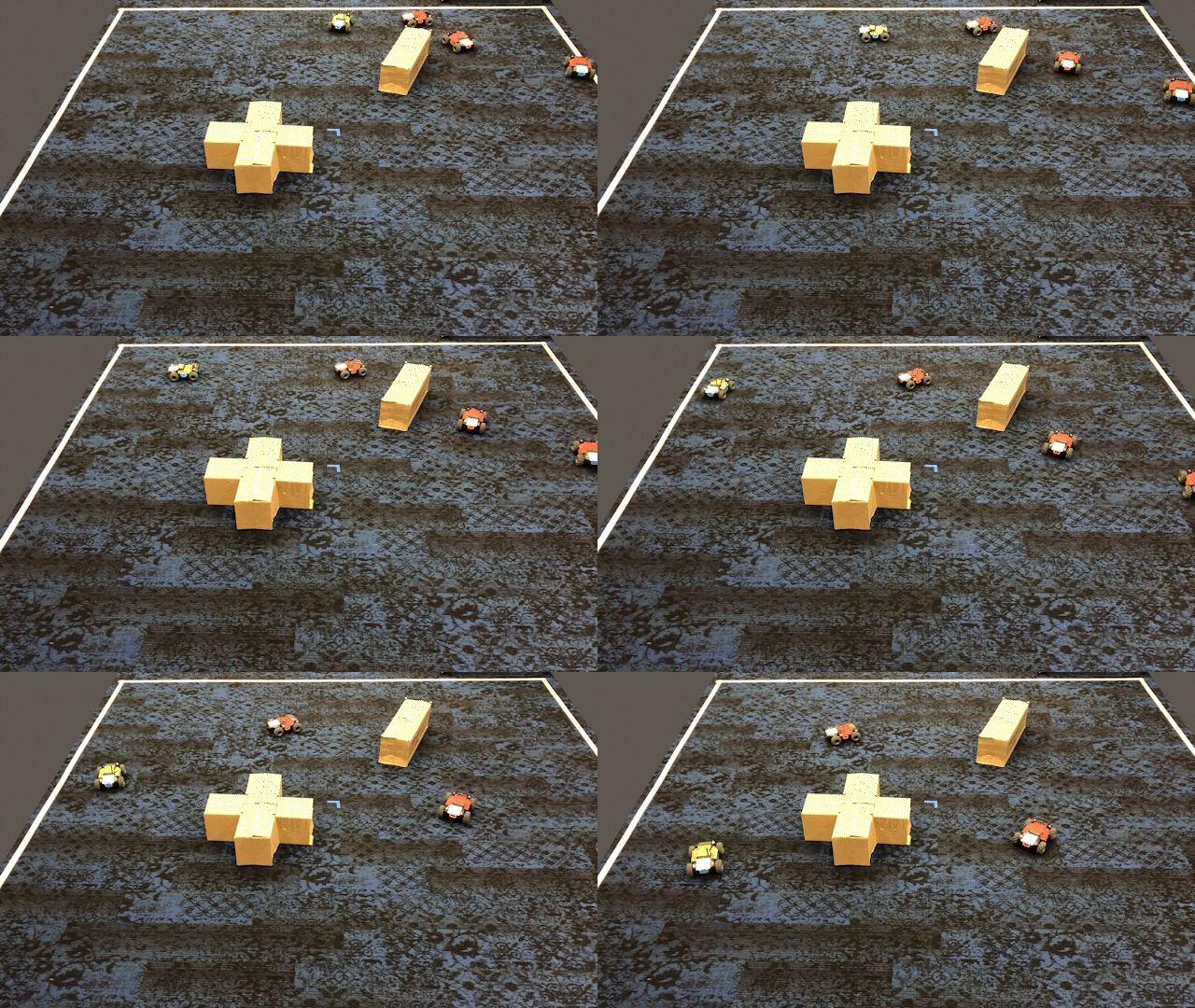
Researchers at Duke University and Columbia University have developed a novel framework called HUMAC that enables robots to collaborate like humans by incorporating Theory of Mind, allowing them to predict teammates’ actions and adapt strategies in real time. Presented at the IEEE International Conference on Robotics and Automation (ICRA 2025) in Atlanta, Georgia, the framework uses simple human coaching to teach groups of robots how to work together efficiently, achieving success rates as high as 84% in simulated scenarios and 80% in physical tests. This approach differs from traditional methods by embedding human insights into robot algorithms, enabling coordinated, collective intelligence for tasks such as disaster response and survival missions where teamwork under constraints is critical.
Theory of mind refers to the ability to attribute mental states—such as beliefs, intentions, desires, and perspectives—to oneself and others. This cognitive capacity is fundamental to human collaboration, enabling individuals to predict and understand each other’s actions and intentions. In humans, theory of mind allows for complex social interactions, cooperation, and the formation of societies based on shared goals and mutual understanding.
In the context of robotics, researchers at Duke University have explored how this concept can be applied to enable more effective human-robot collaboration. Their work focuses on developing frameworks that allow robots to mimic aspects of theory of mind, enabling them to predict and adapt to human behaviors and intentions. This approach is particularly relevant in scenarios where humans and robots need to work together dynamically, such as in search-and-rescue operations or collaborative tasks requiring real-time decision-making.
The Duke researchers have demonstrated the potential of their framework through experiments involving multi-robot systems guided by human operators. By integrating elements of theory of mind into robotic algorithms, they have shown that robots can better anticipate human actions and adapt their behaviors accordingly. This has led to improved coordination and success rates in tasks that previously posed significant challenges for autonomous systems.
The application of theory of mind concepts to robotics represents a significant step toward creating more intuitive and effective human-robot partnerships. By enabling machines to predict and adapt to human intentions, this approach reduces reliance on explicit commands, fostering more natural and effective teamwork. Integrating theory of mind concepts into robotics holds promising implications for future applications in human-AI teaming. By enabling machines to predict and adapt to human intentions, this approach reduces reliance on explicit commands, fostering more natural and effective teamwork. The HUMAC framework represents a step toward creating adaptive human-robot teams, opening new possibilities for applications in fields like search-and-rescue operations.
Looking ahead, the expansion of the HUMAC framework could further enhance human-AI collaboration by incorporating advanced machine learning techniques. This could enable robots to better understand nuanced human behaviours and adapt more effectively to dynamic environments. As research in this area progresses, the potential for creating seamless human-robot partnerships continues to grow, promising transformative impacts across various industries.
More information
External Link: Click Here For More