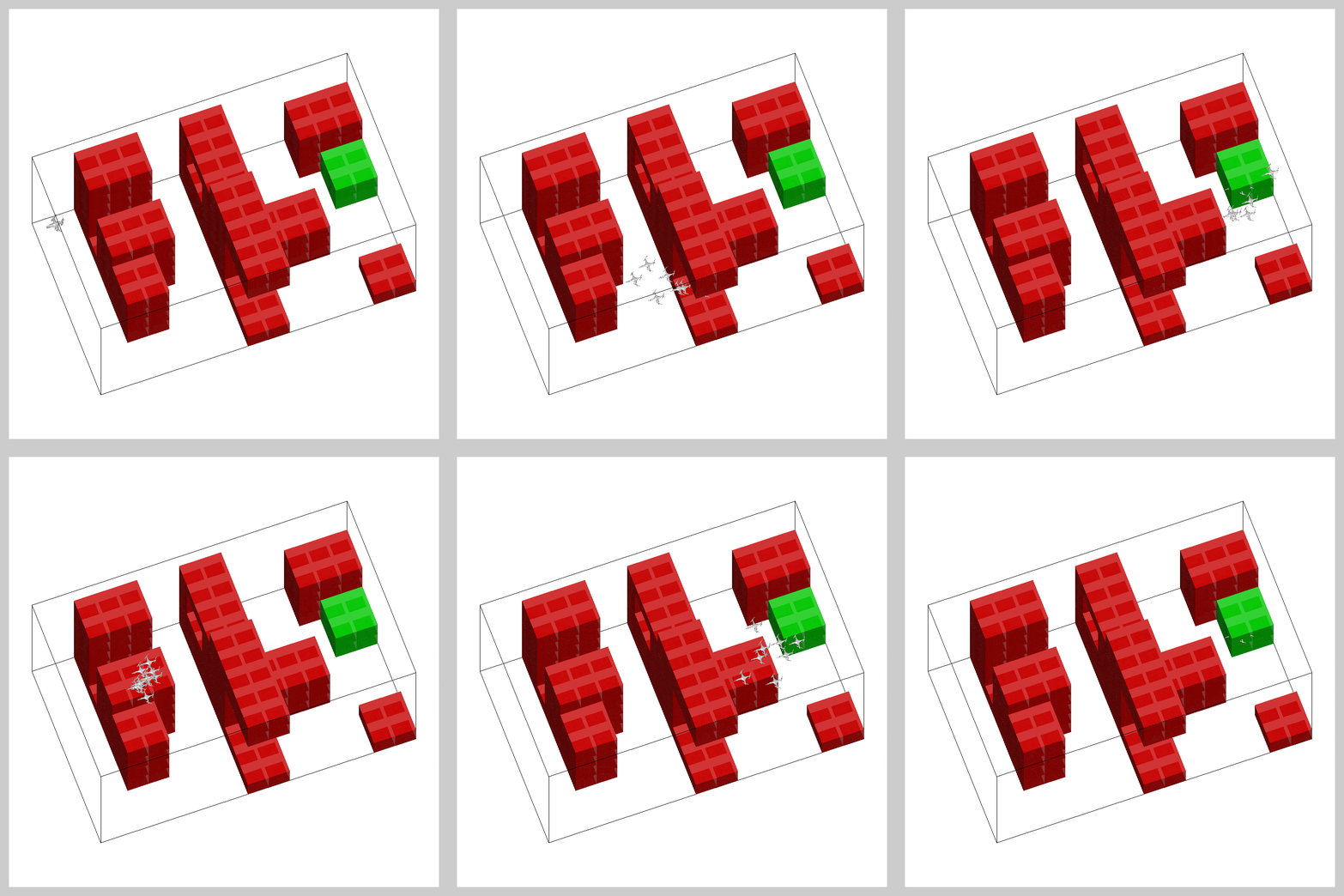
Thom Badings of Radboud University has developed a novel method for AI predictive algorithms that integrates uncertainty into system models using Markov models and probability distributions. This approach enhances safety in applications like drones and self-driving cars by enabling precise predictions without exhaustive simulations, accurately assessing collision risks, and addressing key challenges in AI reliability.
Artificial intelligence (AI) has become integral to modern applications, influencing everything from autonomous vehicles and smart home devices to predictive models for public health crises. These systems rely on complex algorithms designed to make decisions and predictions with varying degrees of accuracy.
Despite their sophistication, AI systems often encounter unpredictability in real-world scenarios. For instance, a self-driving car must navigate unexpected obstacles like pedestrians or road closures, while a drone must adjust to sudden changes in wind speed. These uncertainties pose significant challenges for ensuring the reliability and safety of AI-driven systems.
Thom Badings addressed these challenges by developing a method that explicitly models uncertainty within predictive algorithms. His approach leverages Markov models, which are widely used in control engineering and decision theory. The model can predict outcomes more accurately without exhaustive simulations by incorporating probability distributions over uncertain parameters—such as wind speed or drone weight.
This methodology does not aim to eliminate uncertainty but rather integrates it into the analytical framework. This results in robust predictions that account for real-world unpredictability, significantly improving existing methods that often rely on restrictive assumptions.
However, Badings acknowledges limitations, particularly when dealing with systems characterized by numerous parameters. In such cases, modeling all uncertainties becomes computationally intensive, necessitating practical approximations to achieve meaningful results. This underscores the importance of balancing comprehensive analysis with computational feasibility in AI applications.
Unpredictability in AI systems
AI systems, despite their advanced capabilities, often face unpredictability in real-world applications. For example, self-driving cars must navigate unexpected obstacles such as pedestrians or road closures, while drones need to adapt to sudden changes in wind speed. These uncertainties challenge the reliability and safety of AI-driven systems.
Thom Badings developed a method that explicitly models uncertainty within predictive algorithms using Markov models. By incorporating probability distributions over uncertain parameters—such as wind speed or drone weight—the model can predict outcomes more accurately without exhaustive simulations. This approach integrates uncertainty into the analytical framework, resulting in robust predictions that account for real-world unpredictability.
Badings acknowledges limitations, particularly when dealing with systems characterized by numerous parameters. In such cases, modeling all uncertainties becomes computationally intensive, necessitating practical approximations to achieve meaningful results. This underscores the importance of balancing comprehensive analysis with computational feasibility in AI applications.
Badings’ method for achieving safe solutions
Thom Badings’ methodology focuses on integrating uncertainty into predictive algorithms through Markov models. By embedding probability distributions over variables like wind speed and drone weight, his approach enhances the ability to handle real-world unpredictability without exhaustive scenario simulations. This integration allows AI systems to make more informed decisions under varying conditions, improving both safety and efficiency.
However, challenges remain when dealing with systems characterized by numerous parameters. The computational demands of modeling all uncertainties necessitate practical approximations, highlighting the importance of balancing analytical depth with feasibility in real-world applications. This balance ensures that while the models are sophisticated, they remain implementable within existing technological constraints.
Markov models and uncertainty modelling
Thom Badings’ work leverages Markov models to explicitly model uncertainty within predictive algorithms. The approach enables more accurate predictions without exhaustive simulations by incorporating probability distributions over uncertain parameters—such as wind speed or drone weight. This methodology integrates uncertainty into the analytical framework, resulting in robust predictions that account for real-world unpredictability.
The interdisciplinary nature of Badings’ work is a key strength, combining insights from control engineering, computer science, and AI. This fusion enables a comprehensive approach to problem-solving, where each discipline contributes unique perspectives and tools. For instance, control engineering provides robust frameworks for system stability, while computer science offers efficient algorithms for processing complex data.
In practical terms, this methodology is particularly valuable in applications where precision and adaptability are crucial, such as autonomous vehicles or drone navigation systems. By embracing uncertainty rather than attempting to eliminate it, these systems can make more informed decisions under varying conditions, enhancing both safety and efficiency.
Embracing uncertainty for future innovations
Thom Badings’ work underscores the importance of a holistic approach to AI development, where understanding and integrating uncertainty is as crucial as advancing computational capabilities. This perspective not only improves the reliability of AI systems but also opens avenues for future innovations in handling complex, dynamic environments.
Overall, Badings’ methodology highlights the value of embracing uncertainty rather than attempting to eliminate it. By doing so, AI systems can achieve greater adaptability and resilience in real-world applications, paving the way for safer and more efficient technologies.
More information
External Link: Click Here For More