

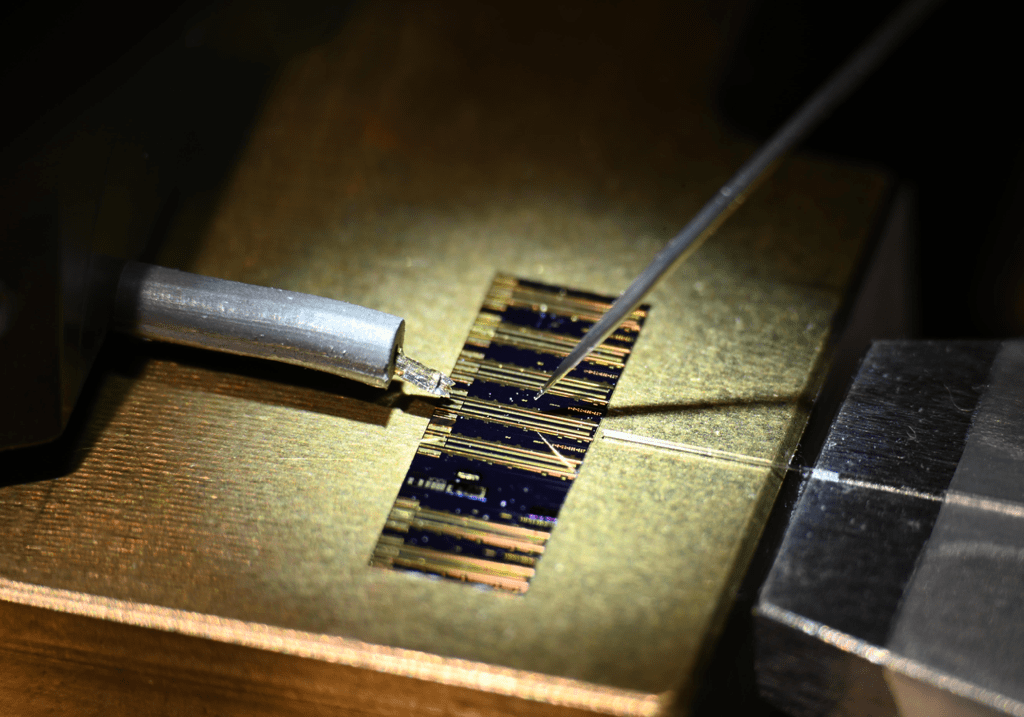
Researchers at the Chinese University of Hong Kong have developed a laser-based artificial neuron. It mimics the functions of a biological nerve cell. This neuron has a processing speed of 10 GBaud. It is a billion times faster than its natural counterpart. Chaoran Huang led the team. They created a chip-based quantum-dot laser graded neuron. This neuron can process vast amounts of data quickly and efficiently.
This technology has the potential to advance artificial intelligence tasks such as pattern recognition and sequence prediction. The laser graded neuron overcomes the speed limitations of current photonic spiking neurons. It is ideal for high-speed reservoir computing. Huang believes integrating this technology into edge computing devices could facilitate faster and smarter AI systems with reduced energy consumption.
Introduction to Laser-Based Artificial Neurons
The development of artificial neurons has been a significant area of research in recent years. These neurons can mimic the functions and dynamics of biological nerve cells. One such innovation is the laser-based artificial neuron. This neuron has shown great promise in advancing artificial intelligence (AI) tasks. These tasks include pattern recognition and sequence prediction. Researchers have successfully developed a chip-based quantum-dot laser graded neuron. It emulates the functions of a biological graded neuron. It achieves a signal processing speed of 10 GBaud. This speed is a billion times faster than its biological counterparts.
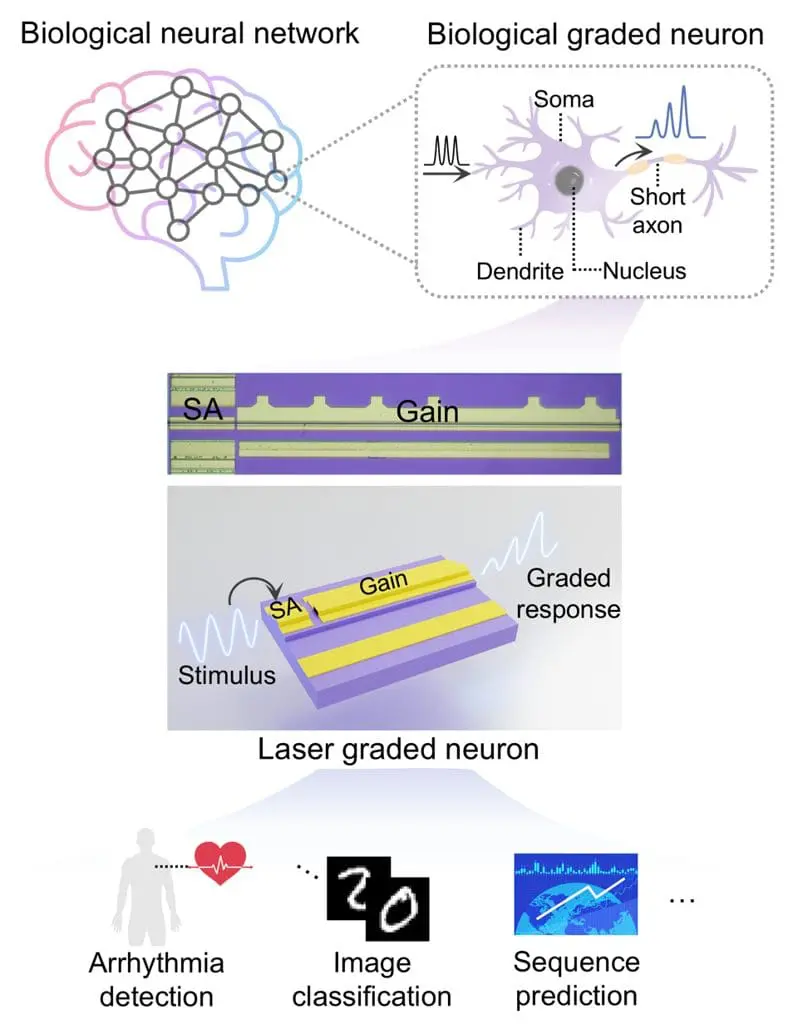
The human body contains various types of nerve cells. This includes graded neurons that encode information through continuous changes in membrane potential. This allows for subtle and precise signal processing, which is essential for many biological functions. In contrast, biological spiking neurons transmit information using all-or-none action potentials, creating a more binary form of communication. The laser graded neuron developed by the researchers overcomes the speed limitations of current photonic versions of spiking neurons. It has the potential for even faster operation.
The research team leader, Chaoran Huang from the Chinese University of Hong Kong, explained that their laser graded neuron leverages its nonlinear dynamics. It also utilizes fast processing similar to a neuron’s. This approach helps build a reservoir computing system. This system demonstrates exceptional performance in AI tasks such as pattern recognition and sequence prediction. The researchers used this speed to process data from 100 million heartbeats or 34. They processed 7 million handwritten digital images in just one second. This showcases the potential of their technology to accelerate AI decision-making in time-critical applications. It does so while maintaining high accuracy.
The integration of this technology into edge computing devices, which process data near its source, could enable faster and smarter AI systems. These systems would better serve real-world applications. They would also operate with reduced energy consumption. The researchers are optimistic about their innovation. They believe it will lead to breakthroughs in fields like artificial intelligence and advanced computing. A single laser graded neuron has powerful memory effects. It also has excellent information processing capabilities. This enables it to behave like a small neural network. It can perform machine learning tasks with high performance without additional complex connections.
Laser Graded Neuron Architecture and Functionality
The laser graded neuron developed by the researchers uses a different approach than photonic spiking neurons. The researchers avoided injecting input pulses into the gain section of the laser. This method causes a delay that limits how fast the neuron can respond. Instead, they injected radio frequency signals into the quantum dot laser’s saturable absorption section. This avoids the delay and allows for faster processing speeds. The researchers also designed high-speed radio frequency pads for the saturable absorption section to produce a faster, simpler, and more energy-efficient system.
The speed limitation of photonic spiking neurons originates because they typically work by injecting input pulses into the laser’s gain section. This causes a delay that limits how fast the neuron can respond. In contrast, the laser graded neuron’s approach allows for much faster processing speeds, making it ideal for high-speed reservoir computing. The researchers’ design also enables the laser graded neuron to behave like a small neural network, allowing it to perform machine learning tasks with high performance without additional complex connections.
The laser graded neuron’s architecture and functionality make it an attractive solution for various AI applications. Its ability to process time-dependent data like speech recognition and weather prediction makes it ideal for supporting high-speed reservoir computing. The researchers’ innovation has the potential to unlock new possibilities in AI research and development, enabling faster and more efficient processing of complex data.
High-Speed Reservoir Computing with Laser Graded Neurons
To further demonstrate the capabilities of their laser graded neuron, the researchers used it to make a reservoir computing system. This computational method uses a particular type of network known as a reservoir. It processes time-dependent data like that used for speech recognition. It also processes time-dependent data used for weather prediction. The neuron-like nonlinear dynamics and fast processing speed of the laser graded neuron make it ideal for supporting high-speed reservoir computing.
In tests, the resulting reservoir computing system exhibited excellent pattern recognition and sequence prediction, particularly long-term prediction, across various AI applications with high processing speed. For example, it processed 100 million heartbeats per second and detected arrhythmic patterns with an average accuracy of 98.4%. The researchers believe that cascading multiple laser graded neurons will further unlock their potential, just as the brain has billions of neurons working together in networks.
The researchers are working to improve the processing speed of their laser-graded neurons. They are also developing a deep reservoir computing architecture that incorporates cascaded laser-graded neurons. This innovation could revolutionize the AI research and development field. It enables faster and more efficient processing of complex data. The use of laser graded neurons in high-speed reservoir computing systems could lead to breakthroughs in various applications. These applications include speech recognition, image classification, and weather prediction.
Potential Applications and Future Developments
The laser graded neuron developed by the researchers has significant potential for various AI applications. Its ability to process time-dependent data like speech recognition and weather prediction makes it ideal for supporting high-speed reservoir computing. The researchers’ innovation could lead to breakthroughs in fields like artificial intelligence and other types of advanced computing.
One potential application of the laser graded neuron is in the field of healthcare. The ability to process large amounts of data quickly and accurately could lead to improved diagnosis and treatment of diseases. For example, the laser graded neuron could be used to analyze electrocardiogram (ECG) signals to detect arrhythmic patterns, allowing for early intervention and treatment.
Another potential application is in the field of image classification. The laser graded neuron’s ability to process large amounts of data quickly and accurately could lead to improved image recognition systems, enabling applications such as self-driving cars and facial recognition software.
The researchers are working to improve the processing speed of their laser-graded neurons. They are also developing a deep reservoir computing architecture that incorporates cascaded laser-graded neurons. This innovation can unlock new possibilities in AI research and development. It enables faster and more efficient processing of complex data. As the field continues to evolve, we can expect to see significant advancements in the development of laser-based artificial neurons and their applications in various fields.
Conclusion
In conclusion, the development of laser-based artificial neurons has been a significant area of research in recent years. The innovation of the laser graded neuron developed by the researchers has shown great promise in advancing AI tasks such as pattern recognition and sequence prediction. Its ability to process time-dependent data like speech recognition and weather prediction makes it ideal for supporting high-speed reservoir computing.
The potential applications of the laser graded neuron are vast, ranging from healthcare to image classification. The researchers’ innovation could lead to breakthroughs in fields like artificial intelligence and other types of advanced computing. As the field continues to evolve, we can expect to see significant advancements in the development of laser-based artificial neurons and their applications in various fields.
The use of laser graded neurons in high-speed reservoir computing systems could revolutionize the field of AI research and development. It enables faster and more efficient processing of complex data. The researchers’ work has paved the way for further innovation and exploration in this area. We can expect to see significant advancements in the coming years.
External Link: Click Here For More


