

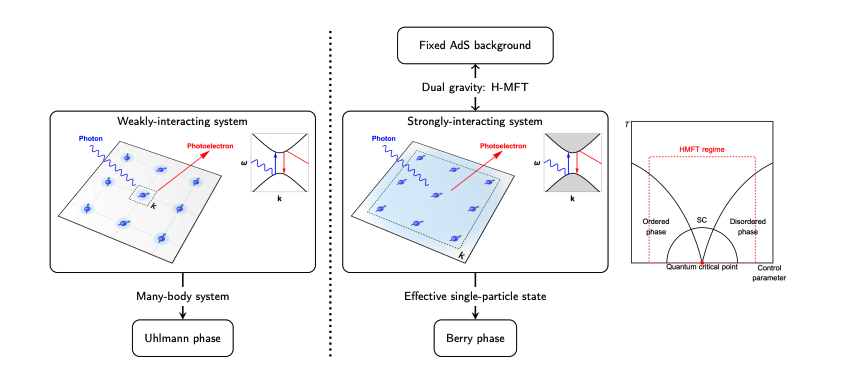
The behaviour of electrons in strongly interacting materials presents a significant challenge to physicists, but new research offers a novel approach to understanding their properties. Moongul Byun, Taewon Yuk, and Young-Kwon Han, all from Hanyang University, alongside Debabrata Ghorai and Sang-Jin Sin, investigate the topological characteristics of these materials using a theoretical framework called holographic mean-field theory. Their work demonstrates how to calculate key topological invariants, which are mathematical quantities that describe the material’s electronic structure, and reveals these invariants remain stable even when the material’s properties change. This stability suggests the holographic approach effectively captures the fundamental topological behaviour of electrons near critical points in strongly correlated materials, offering insights that are difficult to obtain through traditional methods. The research highlights a crucial difference between holographic theories and standard approaches, explaining why topological numbers emerge in the former but not the latter.
The holographic moving-frame transformation (H-MFT) framework provides a means of analysing strongly correlated systems. Analytical expressions for retarded Green’s functions are obtained for all possible fermionic bilinear interactions within the probe limit of Anti-de Sitter space 4 (AdS4), allowing for the construction of topological Hamiltonians. Integrating Berry curvature over the momentum domain for the gapped spectra yields well-defined and quantized Chern numbers, which enable a systematic classification of these invariants across different interaction types. These topological invariants demonstrate robustness under deformation parameters such as interaction strength and temperature, suggesting that H-MFT effectively encodes single-particle-state topology near a quantum critical point in strongly correlated systems.
AdS/CFT Models of Holographic Superconductivity
This research explores the application of the Anti-de Sitter/Conformal Field Theory correspondence (AdS/CFT) to understand holographic superconductivity and topological phases of matter. The AdS/CFT correspondence establishes a duality between gravitational theories and quantum field theories, allowing researchers to study strongly correlated systems by mapping them to a gravitational problem. A central focus is on understanding how superconductivity emerges and how topological properties arise, investigating the role of Berry phases and the Uhlmann phase in characterizing these phases. Researchers employ holographic mean-field theory as a starting point, but also explore methods to move beyond this approximation to capture more realistic physics, with the ultimate goal of connecting these theoretical findings to real-world condensed matter systems like graphene and Kondo lattices.
The research investigates the construction of holographic superconductors and the emergence of Fermi surfaces, describing the behavior of electrons in a material. The team explores charge transport phenomena, including the Nernst effect, and how these properties are affected by strong correlations and topological phases. A significant focus is on understanding Kondo lattices, systems with localized magnetic moments interacting with conduction electrons, and the phenomenon of Kondo condensation. The work also investigates the holographic construction of topological insulators and superconductors, studying the edge and surface states that characterize these phases, and explores the effects of symmetric tensor couplings on the holographic construction of Dirac cones, linear energy dispersions found in graphene-like systems.
The research delves into the Uhlmann phase in the context of open quantum systems, specifically considering Lindblad dynamics, which describes the evolution of quantum systems interacting with an environment. Key techniques employed include analyzing the spectral function, which describes the energy levels of the system, and using Green’s functions to study many-body interactions and correlations. Numerical simulations are used to solve the gravitational equations and extract relevant physical quantities, while analytical approximations are used to gain insights into the system’s behavior and simplify calculations. This research represents a significant contribution to the field of holographic condensed matter physics, demonstrating the power of the AdS/CFT correspondence as a tool for studying strongly correlated systems and topological phases of matter.
Holographic Methods Reveal Quantum Material Topology
Researchers have discovered a novel way to define and quantify topological properties within strongly interacting quantum materials, a longstanding challenge in condensed matter physics. Their work demonstrates that holographic methods, originally developed to understand black holes, can be applied to characterize the topological states of these complex systems, offering insights previously inaccessible through traditional approaches. This breakthrough provides a framework for understanding how electrons behave collectively in materials where interactions are strong, potentially paving the way for the design of new materials with tailored electronic properties. The research team employed holographic mean-field theory to model the behavior of interacting electrons, allowing them to map a complex many-body system onto a simpler gravitational system and calculate key properties like the Green’s function, which describes how electrons propagate through the material.
By analyzing these Green’s functions, the researchers were able to construct a “topological Hamiltonian” and calculate the Chern number, a mathematical quantity that characterizes the topology of the electronic band structure. Importantly, they found that this holographic approach yields well-defined and robust Chern numbers, even in systems where interactions are extremely strong and conventional methods fail. The results reveal that the calculated Chern numbers reflect fundamental properties of the material’s electronic structure, and in some cases, the researchers observed fractional Chern numbers, differing from those typically found in simpler materials. For two-flavor systems, the Chern number can take on integer values, and its value depends on the specific interactions present and the chosen quantization scheme.
The team identified four distinct cases based on how these interactions influence the topology, ranging from single-parameter control to competing gapping orders. A particularly significant finding is the robustness of these topological invariants to changes in temperature, suggesting that these topological states could be observable in real materials under realistic conditions. This contrasts with traditional approaches, which often rely on idealized, zero-temperature scenarios. The research highlights a key distinction between weakly and strongly interacting systems, demonstrating that holographic methods provide a natural framework for defining topology in regimes where conventional approaches break down.
Holographic Theory Defines Robust Topological Numbers
This research investigates topological properties within strongly interacting systems using holographic mean-field theory, a framework connecting quantum systems to classical gravity. The study successfully derives analytical expressions for how fermions behave under various interactions, allowing the construction of topological Hamiltonians that classify these interactions. Importantly, the calculations reveal well-defined and quantized Chern numbers, which are topological invariants robust to changes in interaction strength and temperature, suggesting the method effectively captures single-particle-like topology near critical points in strongly correlated materials. The findings demonstrate that holographic theories can define topological numbers in a way that conventional perturbative field theories cannot.
🗞 Topology in Holographic Mean-Field Theory at Zero and Finite Temperature
🧠 ArXiv: https://arxiv.org/abs/2508.01767


