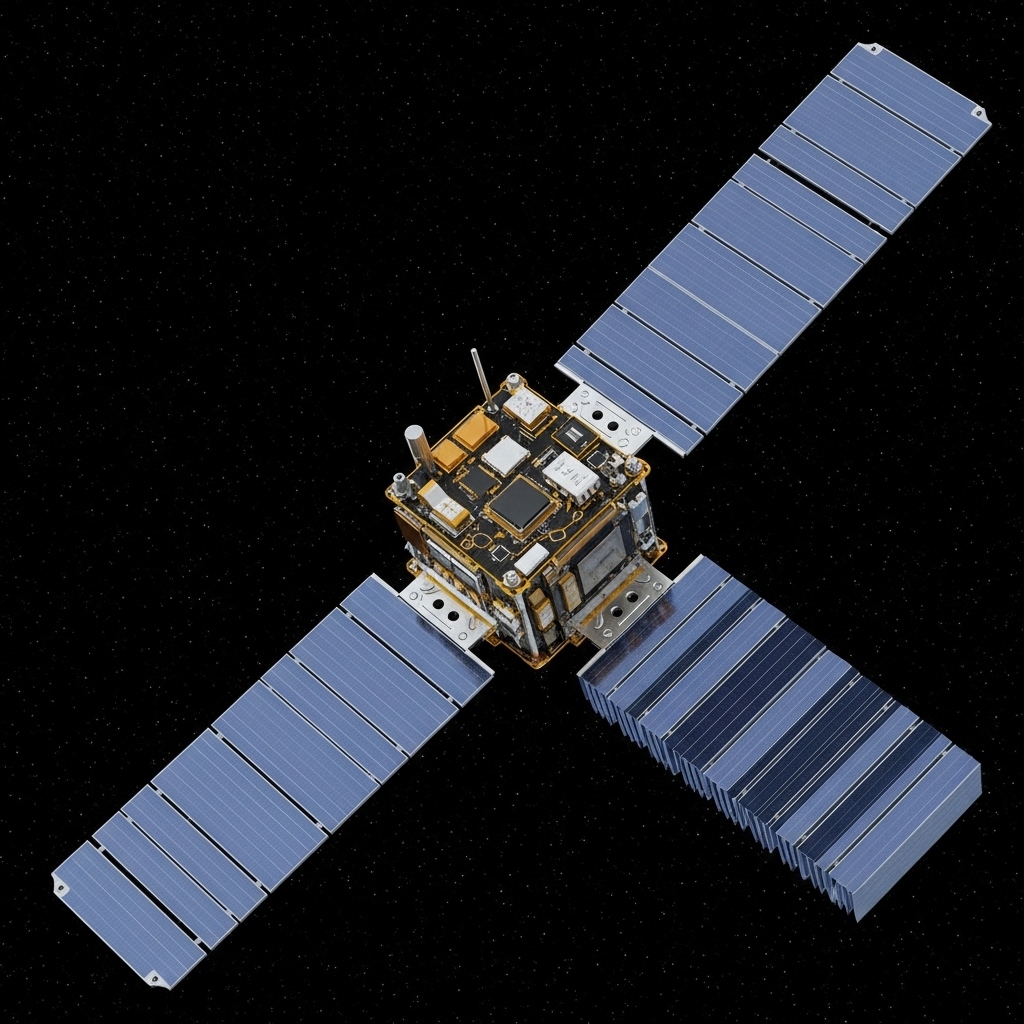
Researchers are increasingly focused on reliable power generation for small satellites, and this paper details a comprehensive system analysis and pre-flight evaluation of deployable solar panels designed for the 3U CubeSat HOKUSHIN-1! Led by Yuji Sakamoto from Green Goals Initiative, Tohoku University, alongside Masaki Aoi and Sho Suzuki from the Division of Mechanical and Aerospace Engineering, Hokkaido University, et al., this study presents crucial structural, thermal, and vibration test results! These findings are particularly significant as deployable solar panels represent a key enabling technology for ambitious future lunar exploration missions requiring substantial power and orbit control capabilities, and HOKUSHIN-1 also showcases a novel compact propulsion system! The CubeSat itself measures approximately 10x10x34cm, weighs 3.99kg, and is scheduled for deployment from the International Space Station into a circular 400km orbit with a 51.6-degree inclination.
Scientists. Appearance of the HOKUSHIN-1 satellite! Table 1 summarizes the specifications of the satellite system! The satellite has approximate dimensions of 10x10x34cm and a launch mass of 3.99kg! Operations will commence from a circular orbit at an altitude of about 400km with an inclination of 51.6 degrees, following0.2W, compared with a maximum power consumption of 16W.
The design requirements for the safety review follow the JAXA handbook (document number JX-ESPC-101132-D)! For structural stiffness and strength, the first natural frequency is required to exceed Hz! Static load analysis assumes a 9 G launch environment and a compressive load of 46.6 N applied at each rail end, with allowable stress limited to less than 30% of the material tensile strength! In this satellite, A6061P-T651 aluminum alloy is selected as the primary structural material, resulting in an allowable stress of 88.5 MPa based on a minimum tensile strength of 295 MPa0.2, the satellite consists of a bus module (MOD2), equivalent to a 2U CubeSat, and a propulsion module (MOD1), equivalent to a 1U CubeSat.
The two modules are connected using four M4 bolts! The outer structure of MOD1 forms a sealed container housing control boards, piping, valves, and propellant! The criteria for classifying this structure as a closed vessel rather than a pressure system are that the internal energy is less than 19,310 J and the differential pressure relative to the external environment is less than 1.5 atm! The propellant pressure is designed to remain below 1.1 atm, even at the maximum temperature of +60°C prior to deployment, and stress analysis confirms that vapor pressure loads remain within allowable limits.
Since structural damage is unacceptable even after deployment, the maximum operational temperature of MOD1 must be maintained below +60°C! Figure 3 illustrates the structural elements of MOD2! With the exception of the +Z face, the first and second natural frequencies were found to be Hz (effective mass = 0.68kg) and Hz (effective mass = 0.14kg), respectively! The maximum static stress was 53.0 MPa under a 9 G load applied along the X-axis! For all axes under a 9 G load condition, the stress levels remained below the allowable stress limit of 88.5 MPa.
After deployment in orbit, insufficient structural stiffness of the deployable panels can lead to increased disturbance during attitude control! Conversely, achievable stiffness is constrained by limitations on dimensions and mass distribution! In this study, the deployable panels were assumed to be fabricated from either FR4 material or aluminum plates! FR4 is a glass-epoxy material commonly used for electronic circuit boards, enabling minimization of physical wiring within the panels! The Young’s modulus of aluminum is 68.9 GPa, whereas that of FR4 (e. g., FR402) is 24.1 GPa.
A lower Young’s modulus results in larger deflections under launch vibration loads, increasing the risk of exceeding the allowable envelope, which extends 6.5mm beyond the CubeSat rail surface planes! As illustrated in Fig0.6, a simplified structural model of the DSAP was defined! Based on mass allocation, 468g was assigned to a single panel assembly (117g per sheet), including solar cells, adhesive layers, wiring, and structural panels! Drawing on results from commercially available products, two spring hinges were installed at both ends of each panel! Considering the thickness of the solar cells and adhesive layers, the panel thickness was set to 1.2mm for both aluminum and FR4 options, in accordance with the 6.5mm envelope constraint outside the CubeSat rails.
A 2mm gap between adjacent panels was introduced to avoid interference between glass-covered solar cells! The simplified hinge model had an inner diameter of 2mm, an outer diameter of 6mm, and a length of 24mm! Due to its small size, the hinge case was machined from aluminum and combined with a stainless-steel hinge pin and a custom torsion spring! For the finite element analysis, a standard mesh size of 10mm was adopted! The boundary conditions were defined by constraining two planar surfaces at the hinge locations on the edge panels! As a result, the natural frequencies for the 1.2mm aluminum panel configuration.
HOKUSHIN-1 CubeSat design for lunar missions utilizes
Experiments revealed the satellite’s expected operational lifespan to be approximately 16 months before atmospheric re-entry, based on the orbital lifetimes of comparable CubeSats. The team measured the power conversion efficiency of the solar cells exceeding 30%, a critical factor for sustained operation in low Earth orbit. After solar array deployment, five parallel strings can be oriented towards the Sun, enabling an expected maximum power generation of 34.2W, significantly exceeding the maximum power consumption of 16W! These measurements confirm the potential for high power generation crucial for long-distance communications and propulsion-based orbit control.
Tests prove the satellite’s structural integrity, with the first natural frequency required to exceed 60Hz to withstand launch conditions. Static load analysis assumed a 9G launch environment and a compressive load of 46.6N applied at each rail end, maintaining allowable stress below 30% of the material tensile strength. Scientists selected A6061P-T651 aluminum alloy as the primary structural material, achieving an allowable stress of 88.5 MPa based on a minimum tensile strength of 295 MPa, as defined by JIS H4000-2017! Researchers recorded the operational temperature range between −15 to +60°C, accounting for launch, ISS residency, and external space conditions.
The onboard sensors provide coarse attitude determination, measuring Sun direction, geomagnetic field vector, and angular velocity, with planned attitude control accuracy of approximately 2, 3 degrees. The design adheres to JAXA safety review requirements outlined in document number JX-ESPC-101132-D.
👉 More information
🗞 System Analysis and Pre-Flight Evaluation of Deployable Solar Panels for 3U CubeSat HOKUSHIN-1
🧠 ArXiv: https://arxiv.org/abs/2601.12851