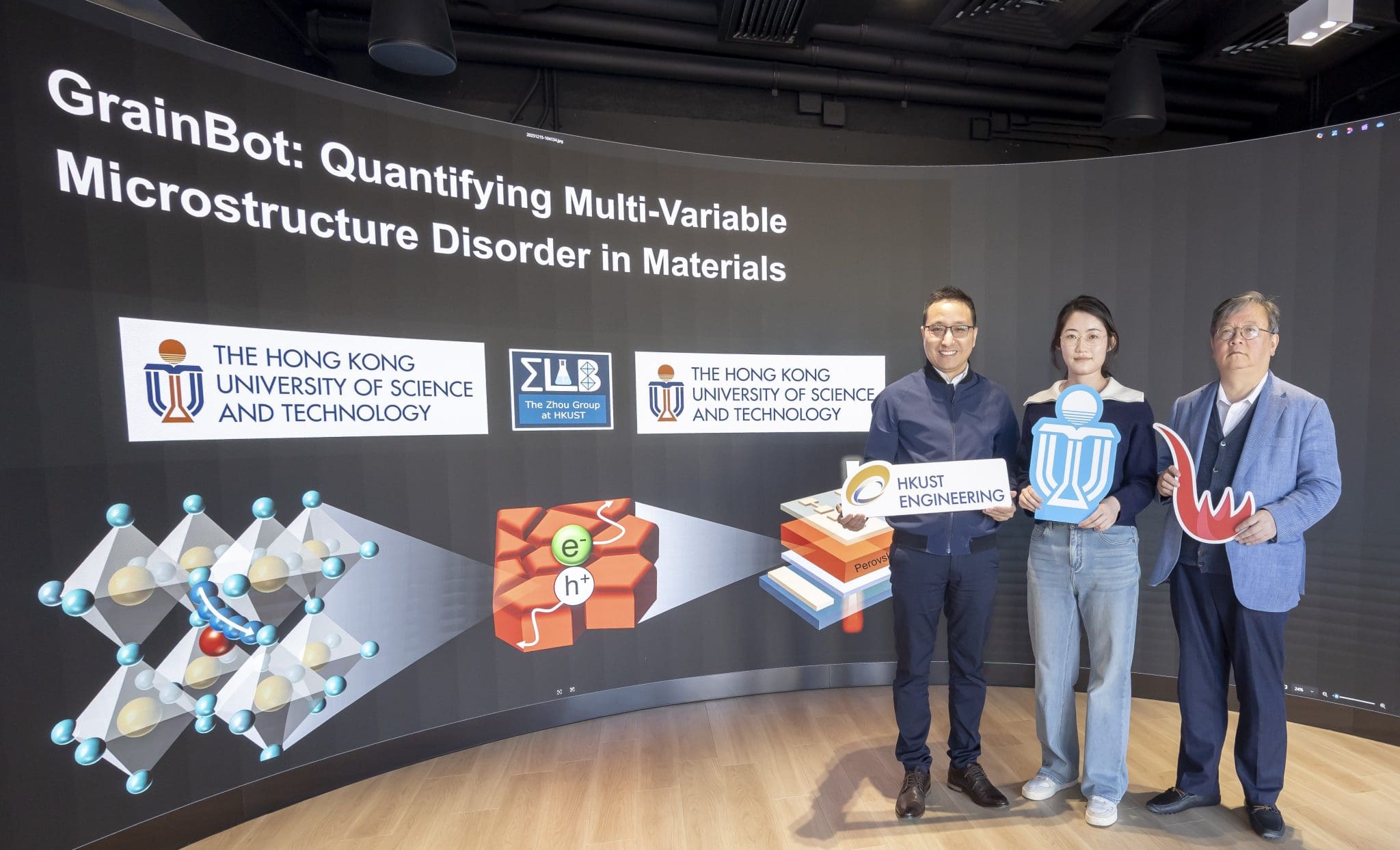
Researchers at The Hong Kong University of Science and Technology (HKUST) have created GrainBot, an AI toolkit designed to automatically extract and quantify microstructural features from microscopy images, addressing a longstanding challenge in materials science and engineering. The new system offers a systematic method for converting complex image information into quantitative data, potentially accelerating the discovery and development of next-generation materials by overcoming limitations in current approaches that often focus on simple feature identification. GrainBot integrates segmentation, feature measurement, and correlation analysis, utilizing a convolutional neural network for precise grain segmentation alongside custom algorithms to measure parameters like grain surface area and groove geometry. “This work highlights the broader relevance for emerging AI-driven scientific infrastructures,” said GUO Yike, Provost and Chair Professor of the Department of Computer Science and Engineering at HKUST, and a co-author of the study, suggesting a future where data-driven materials research becomes more streamlined and insightful.
GrainBot Toolkit Automates Microstructure Quantification from Microscopy Images
The team, led by Prof. ZHOU Yuanyuan, designed GrainBot to provide an integrated solution encompassing segmentation, feature measurement, and correlation analysis, moving beyond approaches limited to identifying simple features or image classification. Validation using metal halide perovskite thin films—critical for high-efficiency solar cells—resulted in a database of thousands of annotated grains, revealing previously difficult-to-quantify relationships between features such as grain size, groove geometry, and surface roughness. Beyond statistical analysis, interpretable machine-learning models were employed to determine how these features influence one another; the team could examine how parameters like grain surface area and grain-boundary groove angle jointly shape surface concavity depth.
According to Prof. GUO Yike, “GrainBot illustrates how AI can transform complex microscopy images into structured, reproducible datasets that can be readily shared, re-analyzed and integrated into larger research platforms.” Prof. Zhou emphasizes the toolkit’s accessibility, stating, “Our goal is to lower the barrier for integrating microscopy characterization into data-driven studies and autonomous laboratory platforms.” The research, published in Matter on February 26, 2026, offers a strategic framework applicable to other polycrystalline thin films and plans to explore correlations between microstructure and device stability.
Convolutional Neural Networks Segment Grains & Measure Surface Geometry
Traditionally, quantifying microstructure has relied on manual analysis of microscopy images, a process that is both time-consuming and prone to inconsistencies, limiting the ability to fully grasp structure-property relationships. GrainBot offers a systematic solution, converting visual data into quantitative descriptors, and enabling the creation of large-scale, standardized databases. The toolkit’s core functionality centers on precise grain segmentation achieved through its convolutional neural network, coupled with algorithms designed to measure specific geometric features such as grain surface area and the geometry of grain boundaries. This allows researchers to move beyond qualitative observations and establish statistically significant correlations between microstructural parameters, as demonstrated through its application to metal halide perovskite thin films—a crucial material for high-efficiency solar cells. Prof. Zhou emphasized the toolkit’s accessibility, stating that their goal is to lower the barrier for integrating microscopy characterization into data-driven studies and autonomous laboratory platforms.
As scientific workflows become more automated and data-intensive, such toolkits will act as key engines in future autonomous laboratories, continuously feeding standardized microstructure metrics into decision-making systems for materials discovery and optimization.
GUO Yike, Provost and Chair Professor of the Department of Computer Science and Engineering and the Department of Electronic and Computer Engineering at HKUST
Perovskite Thin Films Validate Microstructure-Property Relationship Analysis
The team, led by Prof. ZHOU Yuanyuan, Associate Professor of the Department of Chemical and Biological Engineering at HKUST, utilized GrainBot to construct a comprehensive database containing thousands of individual grains, each meticulously annotated with multiple microstructural parameters derived from atomic force microscopy (AFM) images. The validation process revealed general distribution patterns and enabled statistical analysis, uncovering how these parameters interact to influence material properties. Prof. Zhou added that the toolkit aims to support researchers who require consistent, quantitative descriptors of microstructure. This systematic approach to understanding grain morphology, including grain-boundary grooves, concavities, and convex ridges, is particularly vital for enhancing the long-term stability of perovskite solar cells, according to the research published in Matter.
Our goal is to lower the barrier for integrating microscopy characterization into data-driven studies and autonomous laboratory platforms.