

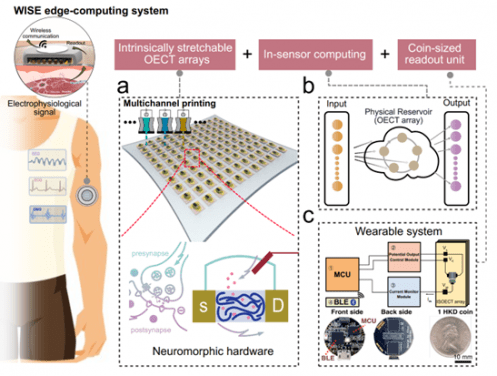
A team of engineers from the University of Hong Kong, led by Professor Shiming Zhang, has developed a wearable AI technology that enables real-time health monitoring. This breakthrough is made possible by the creation of soft microelectronics based on stretchable organic electrochemical transistors (OECTs).
The wearable in-sensor computing platform integrates sensing, computing, and stretchability into one hardware entity, allowing for local data processing and reducing reliance on network connectivity and external devices. This innovation has the potential to revolutionize digital healthcare and AI medicine by enabling faster feedback, increased efficiency, and improved privacy.
The research team has also developed a scalable manufacturing process using multi-channel printing, making it possible to produce these wearable sensors at scale. With this technology, Professor Zhang envisions a future where wearables can seamlessly track human electrophysiological signals in real-time, even during motion, paving the way for new opportunities in healthcare settings.
Wearable AI for Digital Health: A Breakthrough in Soft Microelectronics
The rapid advancement of technology has led to a surge in biomedical engineering research, with wearable biosensors being a fast-rising field. These sensors have the potential to revolutionize digital healthcare and AI medicine by enabling real-time health monitoring, activity tracking, and smart wearable technology. However, current sensors lack computing capabilities, and their mechanical mismatch with soft tissues leads to motion artifacts, restricting their practical applications.
To address these limitations, a research team led by Professor Shiming Zhang of the University of Hong Kong (HKU) has developed a groundbreaking wearable in-sensor computing platform. This platform is built on an emerging microelectronic device, an organic electrochemical transistor (OECT), invented explicitly for bioelectronics applications. The team established a standardized materials and fabrication protocol to endow OECTs with stretchability, enabling the integration of sensing, computing, and stretchability into one hardware entity.
The wearable in-sensor computing platform offers several advantages over traditional sensors. By processing data locally, it reduces power consumption by minimizing data exchange between sensory terminals and computing units. This enables real-time processing, faster feedback, and decreased reliance on network connectivity and external devices, thereby enhancing efficiency, privacy, and responsiveness in various applications.
The Role of Organic Electrochemical Transistors (OECTs) in Wearable Biosensors
Organic electrochemical transistors (OECTs) are an emerging microelectronic device that has been invented explicitly for bioelectronics applications. They play a crucial role in the wearable in-sensor computing platform developed by the HKU research team. OECTs are endowed with stretchability, enabling them to integrate sensing, computing, and stretchability into one hardware entity.
The use of OECTs in wearable biosensors offers several advantages over traditional sensors. Their soft and flexible nature enables them to conform to the human body, reducing motion artifacts and enhancing their practical applications. Additionally, OECTs can operate at low voltages, reducing power consumption and enabling real-time processing and faster feedback.
Scalable Manufacturing of Soft Microelectronics
The HKU research team has also developed an accessible, multi-channel printing platform to ease the fabrication of soft microelectronics at scale. This platform enables the mass production of wearable biosensors with integrated computing capabilities, paving the way for their widespread adoption in various healthcare settings.
The scalable manufacturing of soft microelectronics is critical for the development of wearable AI for digital health. It enables the production of low-cost, high-performance sensors that can be integrated into wearable devices, enhancing their intelligence and reducing power consumption.
Applications of Wearable In-Sensor Computing Platforms
The wearable in-sensor computing platform developed by the HKU research team has far-reaching implications for various healthcare settings. By enabling real-time health monitoring, activity tracking, and smart wearable technology, it can revolutionize digital healthcare and AI medicine.
The platform’s ability to measure human electrophysiological signals in real-time makes it an ideal tool for monitoring chronic diseases, such as diabetes and cardiovascular disease. Additionally, its low power consumption and decreased reliance on network connectivity and external devices make it suitable for use in remote or resource-constrained areas.
In conclusion, the wearable in-sensor computing platform developed by the HKU research team is a groundbreaking achievement that has the potential to revolutionize digital healthcare and AI medicine. Its ability to integrate sensing, computing, and stretchability into one hardware entity makes it an ideal tool for various healthcare settings, enhancing efficiency, privacy, and responsiveness in applications such as health monitoring, activity tracking, and smart wearable technology.
External Link: Click Here For More


