The subtle echoes following the collision of black holes, known as quasinormal modes, offer a unique window into the nature of gravity itself. Juan Pablo Arbelaez from Universidade Federal do ABC, and colleagues, investigate these ringdown signals for black holes that differ from those predicted by Einstein’s theory of General Relativity. The team calculates quasinormal modes for higher-dimensional black holes incorporating corrections that arise from theories dealing with infinite curvature, effectively exploring how modifications to gravity might manifest in gravitational waves. This work advances our understanding of how regularity conditions and potential new gravitational theories could alter the signals detected by gravitational wave observatories, offering a pathway to test the limits of our current understanding of the universe.
Their analysis focuses on how the ringdown phase of gravitational waves from regular black holes deviates from predictions made by General Relativity. Scientists employed the Wentzel, Kramers, Brillouin method to calculate these quasinormal modes and derive compact analytic expressions within the eikonal approximation. These calculations contribute to understanding how quantum-gravity-motivated corrections and regularity conditions can manifest in gravitational-wave signals. Quasinormal modes describe the characteristic oscillations of spacetime geometry in response to perturbations, appearing as damped oscillations with complex frequencies.
Black Hole Ringdown and Gravitational Waves
This research explores the fundamental properties of black holes and their gravitational emissions, particularly focusing on the ringdown phase after a disturbance and how it reveals information about the black hole’s characteristics. The study investigates how modifications to standard gravitational theories, specifically those incorporating higher-curvature terms, affect the frequencies and damping times of these oscillations. By analyzing quasinormal modes, researchers aim to identify potential signatures of exotic black hole solutions, such as those without a central singularity.
Higher-Curvature Effects on Black Hole Quasinormal Modes
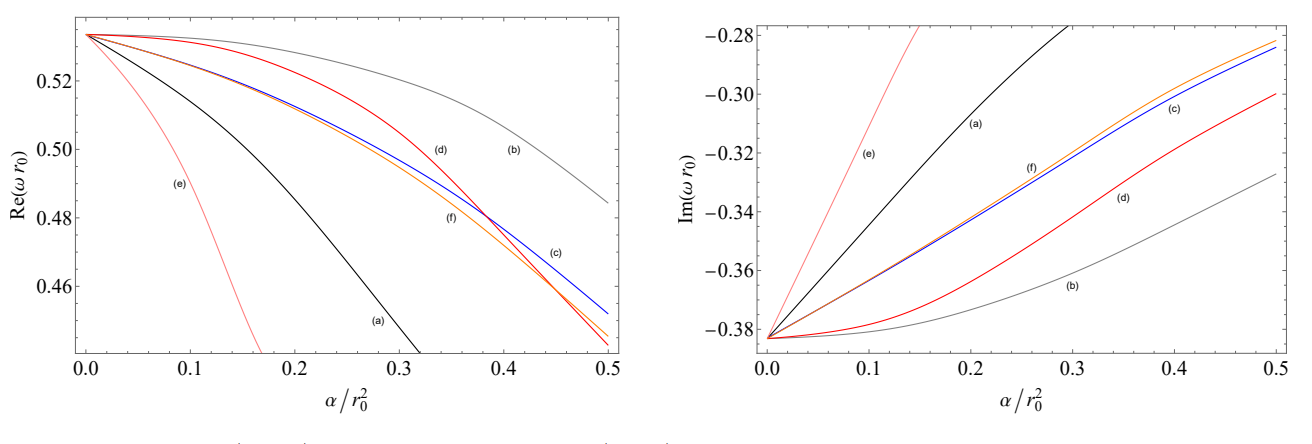
This research presents a detailed investigation into the quasinormal modes of higher-dimensional regular black holes, arising from theories incorporating higher-curvature corrections to general relativity. Scientists calculated these modes using the Wentzel-Kramers-Brillouin method, deriving analytic expressions to understand how deviations from general relativity manifest in gravitational-wave signals. The results demonstrate a universal qualitative modification of the spectrum, with both oscillation frequencies and damping rates decreasing compared to their general relativistic counterparts, a trend consistent across all configurations studied. The magnitude of this effect correlates with the strength of the higher-curvature couplings, suggesting a potential indirect signature of regularity in black hole spacetimes. Importantly, the study confirms the reliability of analytic approximations for calculating quasinormal modes, accurately reproducing asymptotic behavior at higher multipole numbers. While quasinormal modes alone cannot definitively distinguish regular black holes from those with singularities, the consistent reduction in both oscillation frequencies and damping rates offers a promising avenue for identifying regular geometries through gravitational-wave astronomy.
👉 More information
🗞 Quasinormal spectra of higher dimensional regular black holes in theories with infinite curvature corrections
🧠 ArXiv: https://arxiv.org/abs/2509.25141